Covering other artists’ songs is an age-old practice in the musical world. The traditional music canon thrived on the recycling of old hymns, secular tunes, and pre-written song formats. While this practice isn’t quite as common today, most of the popular songs topping the charts in the 1950s, 60s, and 70s were covers of musical theater standards, folk and blues tunes, and even remakes of contemporary hits.
From Led Zeppelin to Tina Turner to the Talking Heads, some of the greatest artists of all time found their most iconic hits in cover songs. We rounded up four 1970s covers that are arguably better than the originals as proof.
Videos by American Songwriter
“Black Betty”
“Black Betty” might be British-American rock band Ram Jam’s most enduring hit, but the song’s roots stretch far further back than the summer of 1977. An undeniable classic rock standard today, “Black Betty” is actually a folk song dating as far back as the 19th century when the Black community used the tune as a work song.
While some historians credit the song to Lead Belly, it’s more likely that the famous blues musician revamped the folk song himself. U.S. musicologists John and Alan Lomax first recorded “Black Betty” in 1933, four decades before Ram Jam released their 1970s cover that would prove to be the most commercially successful song of their entire career.
“When The Levee Breaks”
Before there was ‘Led Zeppelin IV,’ there was Memphis Minnie and Kansas Joe McCoy. Minnie and McCoy wrote and recorded “When the Levee Breaks” in 1929, two years after the Great Mississippi Flood of 1927, which inspired the song’s lyrics. Decades later, Robert Plant suggested the British rock band cover the song for their November 1971 release.
Led Zeppelin incorporated many of the song’s original features, including the lyrics, which Robert Plant credited to Memphis Minnie on their album. The band put their undeniable twist on the track with its modal, droning guitar riffs, ominous reverse echo effects on Plant’s harmonica solo, and, of course, John Bonham’s powerful and distinct drum parts.
“Proud Mary”
Musically speaking, southern California rock band Creedence Clearwater Revival and R&B duo Ike & Tina Turner couldn’t have been more different. However, the two iconic acts found common ground with CCR vocalist and guitarist John Fogerty’s 1969 single “Proud Mary.” CCR’s original version might’ve outperformed the Turners’ on the charts, but the ferocity with which Tina Turner adopted the track as her own is inarguable.
Ike & Tina Turner first released their 1970s cover version in 1971, peaking at No. 4 on the Billboard Hot 100 (two spots below CCR’s version). But with its rousing horns, powerhouse vocals, and tireless choreography, the Turners’ (and later, Tina’s) version of the track remains one of the best covers of all time.
“Take Me To The River”
Like “Proud Mary,” sometimes the qualifications for being one of the best covers is the originality with which you adopted the song as your own. Such is the case for the Talking Heads’ 1978 version of “Take Me to the River,” a song Al Green and Mabon “Teenie” Hodges first wrote in 1974. Although frontman David Byrne was initially hesitant about releasing a cover, co-producer Brian Eno convinced him after demonstrating how the new wave band might put their own spin on the classic track.
Thomas Ryan of American Hit Radio summarized the power of the Talking Heads version in 1996, writing that their cover “broadsided the status quo by combining the best ingredients of conventional pop music and classic soul music, stirring them together, and then presenting the mix in the guise of punk rock.”
Photo by Sebastiao Moreira/EPA-EFE/Shutterstock
More The List
-
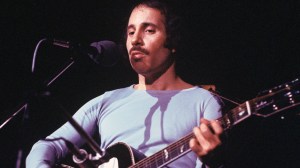
Paul Simon performs on stage in May 1973 in Amsterdam, Netherlands. (Photo by Gijsbert Hanekroot/Redferns) -
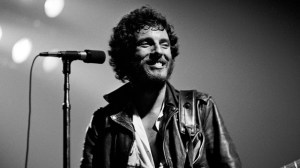
Bruce Springsteen -

Studio portrait of Patti Smith wearing a US air force shirt, Amsterdam, Netherlands, 9th October 1976. (Photo by Gijsbert Hanekroot/Redferns) -
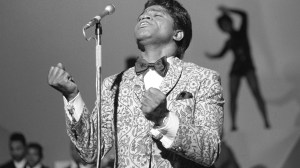
American soul singer James Brown sings on the Ed Sullivan Show, New York, October 30, 1966. (Photo by CBS Photo Archive/Getty Images) -
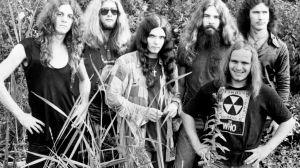
Photo by Michael Ochs Archives/Getty Images -
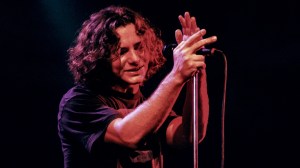
AMSTERDAM, NETHERLANDS – JULY 18: Eddie Vedder of Pearl Jam performs live on stage at Paradiso on July 18, 1993 in Amsterdam, Netherlands. -
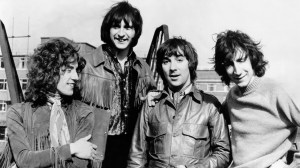
CIRCA 1975: Roger Daltrey, John Entwistle, Keith Moon and Pete Townshend of the rock and roll band "The Who" pose for a portrait in circa 1975. (Photo by Michael Ochs Archives/Getty Images) -
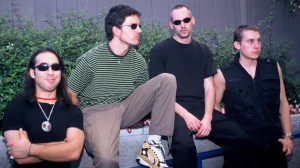
MOUNTAIN VIEW, CA – JUNE 13: Third Eye Blind backstage at Live 105's BFD 1997 at Shoreline Amphitheatre on June 13, 1997 in Mountain View California. (Photo by Tim Mosenfelder/Getty Images)