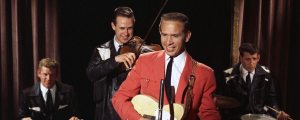
Society held women of the 1950s and 60s, particularly in the more conservative world of country music, to high expectations to be doting, subservient, and modest. Male country music artists helped perpetuate these stereotypes by constantly singing about women breaking their hearts by being untrue and unloving. But starting in the 1950s with artists like Kitty Wells, women began pushing back on this narrative.
Whether talking to their husbands, fellow women, or the general public, these female country songs are full of attitude and just as hilarious and empowering even decades later.
Videos by American Songwriter
“Fist City” by Loretta Lynn
Loretta Lynn has a wellspring of sassy songs to choose from. But a personal favorite of this writer’s is “Fist City”. In a world where the men are free to philander and roam, the dynamics between the women who are at home with the kids and the women on the other end of that philandering can grow especially tense. Should the blame be more on the men? Yes. Is that always what happens? No.
Lynn’s 1968 track “Fist City” is a hilarious warning to any woman trying to get her man to wander while she is on the road. “You’ve been making your brags around town that you’ve been loving my man / But the man I love, when he picks up trash, he puts it in a garbage can.”
“It Wasn’t God Who Made Honky Tonk Angels” by Kitty Wells
Kitty Wells responded directly to Hank Thompson’s “Wild Side Of Life” with her 1952 track “It Wasn’t God Who Made Honky Tonk Angels”. Using the same melody and verse-chorus structure, Wells pushes back on Thompson’s claim that women are to blame for most heartache. It was a bold assertion in 1952. And considering the track became the first female country song to hit No. 1 on Billboard, it was a bold assertion that the women of the world were eager to hear.
“It’s a shame that all the blame is on us women / It’s not true that only you men feel the same / From the start, most every heart that’s ever broken / was because there always was a man to blame.”
“Twice the Lovin’ (In Half the Time)” by Jean Shepard
Jean Shepard released her first single on Capitol Records in February 1953. Neither the A-side, “Crying Steel Guitar Waltz”, nor the B-side, “Twice The Lovin’ (In Half The Time)”, made it to the charts—despite the label co-billing her with a man, steel guitarist Speedy West, to boost sales. Nevertheless, the song remains one of the funnier female country songs full of red-hot attitude and unapologetic sass (with a little bit of innuendo baked into the refrain).
“You didn’t think I was so smart, you said I was no good / You even tried to break my heart, you done everything you could / But someday, you’ll have to learn a stitch in time saves nine / I’ll go where I can get twice the loving, baby, in half the time.”
“Harper Valley P.T.A.” by Jeannie C. Riley
Jeannie C. Riley’s one-hit wonder from 1968, “Harper Valley P.T.A.”, was more a commentary on the society’s expectations of women than a message to any one person, like the previous three songs. Riley dismantles stereotypes and calls out the Harper Valley Parent Teacher Association’s hypocrisy for worrying about her clothes and social life while they themselves are dealing with alcoholism, affairs, and more.
“Well, Mr. Harper couldn’t be here ‘cause he stayed too long at Kelly’s Bar again / and if you smell Shirley Thompson’s breath, you’ll find she had a little nip of gin / then you have the nerve to tell me that you think that as a mother, I’m not fit / Well, this is just a little Peyton Place, and you’re all Harper Valley hypocrites.”
Photo by Graphic House/Getty Images
More The List
-
UNSPECIFIED – CIRCA 1970: Photo of Commodores Photo by Michael Ochs Archives/Getty Images -

American soul, funk and disco group, Earth, Wind & Fire performing on stage, 11th September 1975. (Photo by Michael Putland/Getty Images) -
1974: (L-R) Singer and pianist Burton Cummings, drummer Garry Peterson, guitarist Domenic Troiano and bassist Bill Wallace of the rock band "The Guess Who" pose for a portrait in 1974. (Photo by Michael Ochs Archives/Getty Images) -
Photo by Michael Ochs Archives/Getty Images -
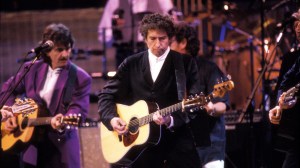
(NO TABLOIDS) George Harrison and Bob Dylan perform during The Bob Dylan 30th Anniversary Celebration at the Madison Square Garden in New York City, New York. (Photo by Kevin Mazur/WireImage) -
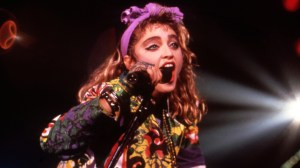
Madonna, who had one of the biggest hit songs of 1985