
Fans still hold fervent hope that Billy Joel might still surprise us and give us another studio album of fresh material. If that doesn’t happen, well, the guy doesn’t owe us anything. Not after delivering 13 stellar studio albums.
His high success rate made it difficult for us to choose just four that would build the best foundation for your vinyl collection of The Piano Man. But we accepted that task and have come up with our choices.
Videos by American Songwriter
‘Turnstiles’
Joel struggled early in his career to define his sound over the course of an entire album. That’s why his first three LPs suffer a bit in terms of his tonal consistency. By the time he made Turnstiles in 1976, he understood that he wanted his band to bring the live energy of his performances to the studio. That meant turning down an offer from George Martin to produce the record because Martin wanted Joel to use session players. Joel also had a consistent point of view on the album, as many of the songs focus on his feelings about moving back to New York after a few years in Los Angeles. No big hits came forth from the record, but Joel has returned to these songs again and again in his live shows because of his understandable affinity for them.
‘The Stranger’
Turnstiles paved the way in an artistic sense for Joel to hit the heights. But he still needed to figure out how to translate that into consistent commercial success. On The Stranger, he figured it out and then some. New producer Phil Ramone, who’d end up being a collaborator all through Joel’s halcyon late 70s, early 80s stretch, helped him unlock some of the nuances that made songs punch through on radio, such as the sneaky crunch of “Movin’ Out (Anthony’s Song)” and the musical build-and-release of “Only The Good Die Young”. Even when Joel wasn’t seeking out hits, he was still at the top of his game on this record. Album cuts like “Vienna” and “Scenes From An Italian Restaurant” combine sweeping music with cutting lyrics.
‘Glass Houses’
Joel may not have agreed with the assessment that Glass Houses was essentially a New Wave record. After all, the big hit “It’s Still Rock And Roll To Me” made the point that categorization was a fool’s errand. But there’s no doubt that the spiky nature of the music matched well with Joel’s tendency to fire out lyrical daggers. On the single front, “You May Be Right” brought the rock thunder and the unapologetic bluster, while “Don’t Ask Me Why” delicately captures a Latin vibe while also calling out a former friend. The album cuts, meanwhile, generally depict a guy trying to make sense of the various romantic entanglements in his life. The honesty of Joel’s songwriting in these moments sticks with you a long time.
‘The Nylon Curtain’
Joel had long been a Beatles admirer. On The Nylon Curtain, he indulged in that fandom, as he and Phil Ramone made their most studio-reliant album. It’s on this record where you’re most likely to notice Joel’s staggering musical genius, as the brilliant foundation of his composing allows for the technical embellishment to take place. For one of the first times in his career, he allowed himself to go slightly issue-based with his lyrics. He rose to that challenge on songs like “Allentown” and “Goodnight Saigon”. Elsewhere, there’s an element of piercing darkness that hangs over the entirety of the album, even on more personal songs like “Laura” and “Where’s The Orchestra?” A tour de force that lives up to the ambition behind its creation.
Photo by Michael Putland/Getty Images
More The List
-
Photo by Rick Diamond/WireImage for BMI Nashville -
IN CONCERT – From London – Shoot Date: June 13, 1974. (Photo by ABC Photo Archives/ABC via Getty Images) BLUE SWEDE -
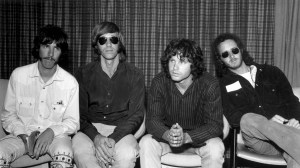
3rd September 1968: American psychedelic rock band, The Doors during a press conference at Heathrow Airport, London (left to right); drummer John Densmore, keyboard player Ray Mansarek, vocalist Jim Morrison (1943 – 1971) and guitarist Robby Krieger. (Photo by Central Press/Getty Images) -
Original Caption) : 1980-Pop singer Linda Ronstadt is shown singing on stage, holding the microphone stand. She wears a gingham shirt with a tie front and askirt with flowers on it in this waist-up portrait. (Photo by Lynn Goldsmith/Corbis/VCG via Getty Images) -
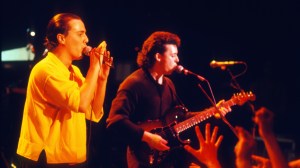
Tears for Fears – Koninklijk Circus – Brussel – Belgium – 21/04/1985 Roland Orzabal, Curt Smith Photo gie Knaeps -
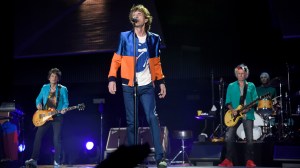
The Rolling Stones at Desert Trip -
Pauk Simon 1965.© Chris Walter. -
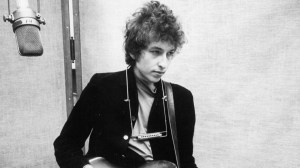
NEW YORK – JANUARY 13-15: Bob Dylan plays a Fender Jazz bass with the harmonica around his neck while recording his album 'Bringing It All Back Home' on January 13-15, 1965 in Columbia's Studio A in New York City, New York. (Photo by Michael Ochs Archives/Getty Images)