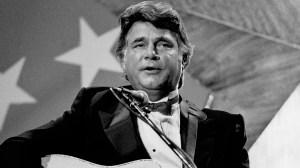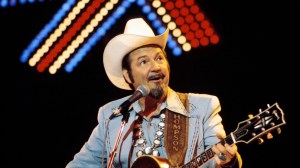
Getting his start as a Jimmie Rodgers imitator, Ernest Tubb eventually developed his own artistic identity. His 1941 hit “Walking the Floor Over You” irrevocably changed country music, giving rise to the rough-and-tumble sub-genre known as “honky-tonk music.” A member of the Country Music Hall of Fame, he also recorded several duets with then-budding superstar Loretta Lynn, including their 1967 hit “Sweet Thang”.
On this day (September 6) in 1984, Ernest Tubb died from emphysema at the Baptist Hospital in Nashville. He was 70 years old.
Videos by American Songwriter
Today, we’re remembering his extraordinary life and career on the 42nd anniversary of his death.
Ernest Tubb: From Sharecropper’s Son to Superstar
Born on February 9, 1914, on a cotton farm near Crisp, Texas, Ernest Dale Tubb spent his childhood working on farms around the Lone Star State.
When he wasn’t performing back-breaking manual labor, Tubb was learning to sing, yodel, and play the guitar — just like his idol Jimmie Rodgers, the “Father of Country Music”.
As a teenager, Tubb took a low-paying gig as a singer at a San Antonio radio station. He supplemented his income by digging ditches for the Works Progress Administration and working as a drugstore clerk.
How Jimmie Rodgers’ Widow Aided Tubb’s Rise to Fame
Three years after Jimmie Rodgers’ death in 1933, Ernest Tubb contacted the “Blue Yodeler’s” widow to request an autographed photo.
He got much more than that, developing a friendship with Carrie Rodgers. Loaning him one of her late husband’s guitars, Carrie convinced RCA Records to take a chance on the young singer.
However, Tubb’s first two albums failed to break much ground. And after a 1939 tonsillectomy stole his yodeling abilities, he shifted his focus to songwriting.
By the next year, however, he was ready to give singing another try, signing with Decca Records.
His Big Break
Known as the “Gold Chain Troubador,” Ernest Tubb was struggling.
With a weekly salary of just $75 and little going on in the way of record sales, he was preparing to leave music behind for a job in the defense industry when lightning finally struck in the form of “Walking the Floor Over You”.
Written by Tubb himself, “Walking the Floor Over You” sold more than a million copies despite only reaching the number 23 spot on the U.S. country chart.
The song’s success opened up a whole new world for the Gold Chain Troubadour. In 1942, he sang in the Western films Fighting Buckaroo and Riding West.
Joining the Grand Ole Opry cast the following year, Tubb would remain a mainstay at the country music institution until his death 39 years later.
Hiring his first band, the Texas Troubadours, he also became a regular on the country charts with songs like “Soldier’s Last Letter” (1944), “Tomorrow Never Comes” (1945), “It’s Been So Long Darling” (1945), “Rainbow at Midnight” (1946), and “Filipino Baby” (1946).
The Texas Troubadours also included several future country stars like Leon Rhodes, Buddy Emmons, Buddy Charleton, and Jack Greene.
Paying It Forward
Never forgetting the help he received from Carrie Rodgers, Ernest Tubb did his best to carry that spirit forward.
In May 1947, he opened the Ernest Tubb Record Shop, which was the first major all-country record store in Nashville. The store gave rise to his popular Midnight Jamboree program, which often showcased up-and-coming country artists.
Tubb boosted the careers of many a country music icon, including Johnny Cash, Patsy Cline, Loretta Lynn, and Hank Williams.
Ernest Tubb continued performing 150 to 200 shows a year until health issues finally forced him to retire.
He made his final Grand Ole Opry appearance on August 15, 1982 — just weeks before his death.
Featured image by Jasper Dailey/Michael Ochs Archives/Getty Images
-

Janis Joplin and Kris Kristofferson at Landmark Hotel Los Angeles Summer 1970. (Photo by John Byrne Cooke Estate/Getty Images) -

A Sho-Bud Pedal Steel Lap Guitar is seen at the preview of Julien's Auctions'Property from The Gretsch Family Archives' in Beverly Hills, California, March 22, 2021. – The auction will take place next March 26 and 27, 2021. (Photo by VALERIE MACON / AFP) (Photo by VALERIE MACON/AFP via Getty Images) -

Noel Haggard, son of Merle Haggard -

UNSPECIFIED – CIRCA 1970: Photo of Dottie West Photo by Michael Ochs Archives/Getty Images -
Sioux City Sue, poster, US poster art, top from left: Gene Autry, Lynne Roberts, bottom left: Gene Autry with Champion the horse, 1946. (Photo by LMPC via Getty Images)