The guitar world is vast, encompassing countless makes and models in even more colors and styles, but for these famous players and their iconic guitars, they found what they liked and stuck with it. Even if they occasionally tried out a different ax for a specific performance or record, these loyal instrumentalists have largely returned to the same guitar throughout their careers.
As any guitar player can attest, having a solid, reliable guitar that can withstand some natural wear and tear and still sound amazing is priceless. Based on these guitars’ track records, we must assume they’re some of the best.
Videos by American Songwriter
Willie Nelson’s Trigger
It’s hard to find a more iconic guitar than Willie Nelson’s trusty Martin N-20, Trigger. A nylon-stringed classical guitar, Trigger boasts all of the jazzy warmth of Nelson’s voice and the kind of rough distressed look that matches Nelson’s outlaw persona. In 1969, a drunk concertgoer stepped on Nelson’s Baldwin electric and caused irreparable damage. Trigger was the Baldwin’s replacement, and it’s been Nelson’s go-to guitar ever since. “When Trigger goes, I’ll quit,” the country icon once said. Indeed, with all of Trigger’s cracks, holes, and general wear and tear, it seems only appropriate that Nelson, an actively performing nonagenarian who has defied all odds in his decades-long career, would have a guitar similar in character.
B.B. King’s Lucille
B.B. King might have been known for having one signature instrument, a black Gibson guitar with a similar body style to an ES-330 without the F-holes. But what the audience saw as one iconic Gibson was a rotating arsenal of multiple guitars, eventually leading to his eponymous Gibson model. The blues player called all of his black guitars Lucille after a woman two men were fighting over in a dance hall in the late 1950s. The men knocked over a kerosene stove and set the hall on fire. King escaped and then returned to retrieve his guitar, almost dying in the process. “Lucille” was King’s reminder to himself never to fight another man over a woman.
Keith Richards’ Micawber
Of the most iconic elements of the Rolling Stones, Mick Jagger’s strut and Keith Richards’ 1950s telecaster have to be in the top five. Micawber, as Richards calls his butterscotch Fender, is outfitted with Gibson humbuckers to give the guitarist more of a bite to his tone. Richards’ use of the telecaster coincided with his move toward open tunings. “The Telecaster really lent itself well to a dry, rhythm, five-string drone thing,” Richards told Guitar World in 2002. And yes, you read that right: Richards opts to remove the low E string to make barred A-shape chords easier to play without having to worry about playing (or omitting) the fifth in the bass.
Brian May’s Red Special
Queen guitarist Brian May’s red special is not only one of the most iconic guitars in rock ‘n’ roll history. It’s also made doubly special by the fact that May built the guitar with his father in the early 1960s. Various pieces of the guitar came from May’s childhood home, including scraps of an old table and his mother’s knitting needles. “I wanted a guitar that would sing and have warmth as well as a nice articulating edge,” May told Absolute Radio in 2014. “We tried to design a solidbody guitar that had all the advantages of a hollowbody—the ability to feedback in just the right way.” Every Queen album featured the Red Special, a May family original.
John Lennon’s Epiphone Casino
Early Beatles fans will likely picture John Lennon, clad in a black suit and leather boots, with a black and white Rickenbacker 325. But in the later Fab Four years—think, rooftop concert era Lennon—the Beatle preferred a natural finish Epiphone Casino. The semi-hollow body style gave it an ideal versatility for the Beatles’ rhythm player, allowing Lennon to tuck it back or turn up the feedback, thanks to the guitar’s two F-holes. This made the Casino an invaluable tool as the band constantly shifted styles in the late 1960s. Interestingly, although we associate Lennon with the Casino, Paul McCartney was the first person to introduce the model to the group while he was playing lead on “Taxman,” the opening track off Revolver.
Photo by Gary Miller/Getty Images
More The List
-

American singer-songwriter Mariah Carey wearing a black leather jacket, UK, 1995. (Photo by Mick Hutson/Redferns/Getty Images) -
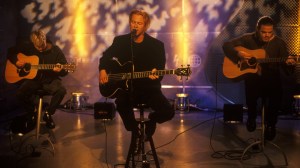
UNITED KINGDOM – JANUARY 01: VH1 Photo of DEEP BLUE SOMETHING (Photo by Patrick Ford/Redferns) -
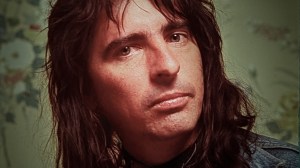
Alice Cooper posing in his hotel room, Amsterdam -
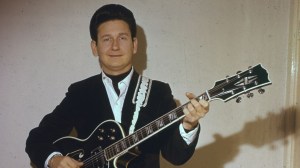
April 1964: Legendary American rock'n'roll singer Roy Orbison (1936 – 1988) at Dolphin Square in London. (Photo by Moore/Fox Photos/Getty Images) -
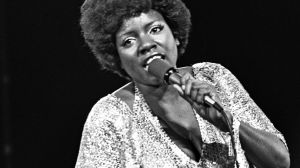
HOLLYWOOD – DECEMBER 13, 1975: Disco singer Gloria Gaynor performs a song on December 13, 1975, in Hollywood, California. (Photo by Michael Ochs Archives/Getty Images) -

Circa 1965, American country singer and songwriter Loretta Lynn performs on stage at the Grand Ole Opry, Nashville, Tennessee, 1960s. (Photo by Getty Images/Getty Images) -
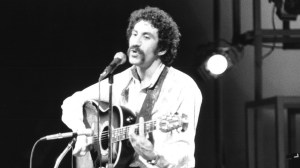
Photo by Michael Ochs Archives/Getty Images