On this day (October 3) in 1967, Woody Guthrie, 55, died from complications of Huntington’s disease at Creedmoor Psychiatric Center in Queens, New York. Universally hailed as the godfather of the 1960s folk revival scene and “the true voice of the American spirit” by devoted disciple Bob Dylan, Guthrie is best known for songs like “This Land Is Your Land” and “Tear the Fascists Down”. Penning more than 3,000 songs during his all-too-brief lifetime, he directly challenged power and gave voice to the disenfranchised. Guthrie’s music was his weapon of choice in the war he waged against fascism and racism.
Today, we’re reflecting on Woody Guthrie’s monumental impact on the 59th anniversary of his passing.
Videos by American Songwriter
Woody Guthrie: A Life Forged in Flames
Named for the then-future U.S. president, Woodrow Wilson “Woody” Guthrie was born on July 14, 1912, in the bustling oil boom town of Okemah, Oklahoma. His father Charles, a prosperous businessman and local politician, taught him Western songs, Indian songs, and Scottish folk tunes.
Ever the astute observer from a young age, tragedy shaped Guthrie’s early upbringing. He was just seven years old when his older sister, Clara, died from burns suffered in a house fire. Several years later, another house fire broke out, this one seriously injuring Guthrie’s father.
When he was 14, his mother, Nora, entered the Oklahoma Hospital for the Insane. (She would ultimately die there of Huntington’s disease — the very illness that would claim her son’s life decades later.) At the same time, Charles had moved to Pampa, Texas, where he worked to repay unsuccessful real estate deals.
This left Woody and his siblings on their own. To support the family, the teenager worked odd jobs around town, frequently begging for meals and sleeping on friends’ couches.
A Life Spent Wandering—and Wandering
When the inevitable oil bust hit Okemah in 1931, Woody Guthrie joined his father in the Texas Panhandle.
Spending his days busking on the streets or reading in the town library, he met and married his first wife, Mary Jennings, the younger sister of his musician friend, Matt Jennings. The couple had three children together.
Disruption arrived again in the form of Dust Bowl storms, and Guthrie took to Route 66, following his innate curiosity all the way to the West Coast. In exchange for bed and board, he painted signs and played guitar and sang in saloons along the way to California.
Arriving in Los Angeles, he landed a radio gig singing “old-time” traditional songs along with some original tunes. Soon, Guthrie and his singing partner, Maxine “Lefty Lou” Crissman, began to attract widespread public attention — particularly from the thousands of displaced “Okies” gathered in migrant camps.
Guthrie also used his airtime to rail against corrupt powerholders and advocate for the rights of migrant agricultural workers.
Leading the New York Folk Revival
Never content to remain in one place for too long, Woody Guthrie left for New York in 1940. That same year, he recorded an album, Dust Bowl Ballads, for RCA Victor. The tracklist included titles such as “Do Re Mi”; “Tom Joad Part 1 and 2”; “So Long, It’s Been Good to Know Yuh”; and “Talkin’ Dust Bowl Blues”.
“I’ve lived in these dust storms just about all my life… I am made out of this dust and out of this fast wind and I know that I’m going to win out on top of both of them if only my government and my office holder will help me,” Guthrie wrote in the liner notes for a 1964 re-issue of the album.
In February of that same year, he wrote his most famous song, “This Land Is Your Land”, as an acerbic response to Irving Berlin’s “God Bless America”, which was popular at the time.
Along with fellow musical outsiders like Lead Belly, Burl Ives, Seeger, and more, Guthrie formed the Almanac singers. Establishing folk as a viable musical genre, they also advocated tirelessly for social causes, such as union organizing, anti-fascism, and anti-war efforts.
By the late 1940s, Woody Guthrie’s health had begun to deteriorate. He eventually received a diagnosis of Huntington’s disease.
[RELATED: Woody Guthrie Initially Wrote This 1945 Song as a Parody of a Popular Patriotic Tune]
Ironically, his music was gaining new ground around the time of his death thanks to artists like Bob Dylan, Pete Seeger, and Ramblin’ Jack Elliott.
Featured image by John Springer Collection/CORBIS/Corbis via Getty Images
-
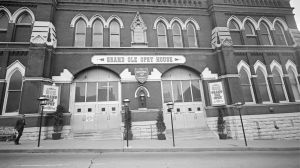
Since 1925, Ryman Auditorium has been the "home" of the Grand Ole Opry and the national headquarters of foot-stomping, tear-jerking country music. By the spring of 1972, the red brick walls and stained glass windows will cease to echo the sounds of western music. At that time, not too far away, will be the new Opry House, surrounded by a series of specialty shops, restaurants, a motel and rides for the kids. -

The Texas Playboys, backup band for the late Bob Wills pose for a Capitol Records publicity still circa 1975. (Photo by Michael Ochs Archives/Getty Images) -
NASHVILLE, TENNESSEE – Ross Copperman accepts Gary Haber Lifting Lives Award at the 14th Annual Academy Of Country Music Honors at Ryman Auditorium on August 25, 2021 in Nashville, Tennessee. (Photo by Jason Davis/Getty Images,,)