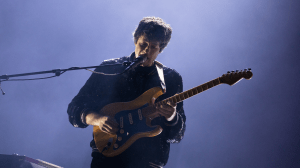
For many jazz fans, the saying goes “it don’t mean a thing if it ain’t got that swing.”
The same ethos does not really apply to heavy metal and hard rock where bombast and intensity are a big part of the equation. But there have been some heavy bands who’ve decided to give their songs a little extra spring with some swing. The following song list features classic heavy rock groups from the 1980s who decided to spice things up with fun musical detours. This isn’t jazz, but some of these tracks do incorporate a jazzy element. It’s interesting to note how most of these nine tracks came out between 1984 and 1986, a period in which more commercial steps were being made in the metal genre.
Videos by American Songwriter
“Teach Us to Survive” by Accept from Metal Heart (1985)
Once known as a West German metal band, Accept combined the swagger of AC/DC with the chug of Judas Priest, but with Metal Heart they brought more of a classical influence to some tracks. However, “Teach Us to Survive” offered an excursion into jazz metal, with a galloping rhythmic feel accentuated by a pre-guitar solo break of jazzy guitar and bass with finger snaps! There are definite jazz undercurrents to the whole track, and it’s a standout from one of Accept’s best albums.
“See the Light” by Aldo Nova from Aldo Nova (1982)
The closing cut of the Canadian singer/guitarist’s debut album feels ‘70s fusion-like with its keyboard sounds, bouncing groove, and agile guitar solo. Nova knew how to combine hard rock flair with hooky songwriting—one could argue he had a little influence on Bon Jovi—and was not afraid to veer from a harder song into something poppier like this.
“Swing Time” by Black ‘N Blue from Without Love (1985)
This Portland, Oregon, band relocated to L.A. and then shot out of the gate with their infectious hard-rocking debut in 1984. By the time they got to their sophomore album, Black ‘N Blue went in a more pop direction. The transition turned out pretty well, and “Swing Time” is the most left-field entry. It was a hard-rocking track with ripping guitars, working off the feel of swing music with tap dancing overlayed throughout the song. Listen to the guitars and simply replace them with a horn section in your mind—this could easily be transposed into a big band format. It’s a cool track and unusual for its time.
“Turn on the Action” by Dokken from Tooth and Nail (1984)
Tooth and Nail is Dokken’s best and most consistent album. The heavy production hits you in the face, but the songs are still loaded with hooks and attitude. The closing track of their Platinum sophomore breakthrough is a hyperkinetic rocker that swings—albeit rather heavily—with gnarly riffs and a fierce solo supplied by guitar master George Lynch. It’s classic Dokken. It swings and stings.
“Get the Funk Out” by Extreme from Extreme II: Pornograffitti (1990)
This may have come out in 1990, but the ‘80s zeitgeist was still going strong then. Hard-driving and grooverific, “Get the Funk Out” showcased Extreme as a smarter alternative to the pop-metal bands that were regurgitating the same Led Zeppelin and Bon Jovi ideas. This single came out before their Everly Brothers-inspired ballad “More than Words” broke this Boston band big. This sassy song also features the stylin’ six-piece Li’l Jack Horn Section, which also played on “Li’l Jack Horny.”
“Don’t Touch the Merchandise” by Helix from A Long Way to Heaven (1986)
Helix, the hard-rocking and humorous fivesome, combined infectious grooves, sprightly riffs, and the brash vocals of Brian Vollmer. This short-and-sweet track offers a boogie-ing blues-rock feel with touches of, no joke, barbershop harmonies that surface in the brief choruses and the song’s post-solo bridge. This was an unexpected element even for an album that was more commercial than some of their previous efforts. It is a standout song in their catalog.
“Stay on Top” by Kick Axe from Vices (1984)
These guys always had a bit of swing through drummer Brian Gilstrom and bassist Victor Langen. While “Stay on Top” opens up with a more straight-ahead metal chord sequence, the rhythmic thrust gives it a much funkier feel. Further, vocalist George Criston actually scats throughout much of the song, which closes out with hopping tom work. This Canadian quintet was vastly underrated at the time and songs like this, even with their party-hearty ‘80s vibe, are still dazzling today.
“Young Blood” and “Hyperactive” by Raven from The Pack is Back (1986)
On their previous album Stay Hard, Raven opened “The Bottom Line” with jazzy bass playing before launching into a fast-paced metal instrumental accompanied by a horn section. This next album ruffled feathers of longtime fans who preferred their pumped-up proto-thrash style. By contrast, these two tracks have a distinctly jazzy feel. While “Youngblood” launches like a Raven rager, the midsection dissolves into mellow jazz before a fusion-like synth guitar solo takes over. Then with “Hyperactive,” the British power trio inject powerful brass over a staccato galloping feel, again straddling the line between two genres. The Uptown Horns appeared on the latter and later toured with The Rolling Stones.
These two clever tracks were reevaluated by some fans in later years. Funnily enough, drummer Rob “Wacko” Hunter—who used to wear hockey gear to protect himself when he attacked his kit, literally—wound up being Branford Marsalis’ studio and live engineer for the last 30 years. He even co-won a Grammy Award for for Best Instrumental Jazz Performance, Individual or Group for co-producing Marsalis’ 2000 album Contemporary Jazz. Spinal Tap’s “Jazz Odyssey” excursion was done tongue-in-cheek, but Hunter successfully transitioned into that world. Respect.
When you purchase through links on our site, we may earn an affiliate commission.
Photo by Toms Kalnins/EPA-EFE/Shutterstock
More The List
-

Photo by Maurice Seymour/Kraftwerk/Getty Images; NEW YORK – CIRCA 1975: German electronic group Kraftwerk (L-R Karl Bartos, Wolfgang Flur, Ralph Hutter and Florian Schneider) pose for a portrait circa 1975 in New York City, New York. (Photo by Maurice Seymour/Kraftwerk/Getty Images) -
UNSPECIFIED – JANUARY 01: Photo of Phil COLLINS (Photo by Ian Dickson/Redferns) -
Waylon Jennings -
Tommy Shaw of Styx at the International Ampitheater in Chicago Illinois , November 24, 1979 . (Photo by Paul Natkin/Getty Images) -
Janis Joplin, who released one of the best songs of 1971 -
American rock group Blue Oyster Cult, USA, 30th July 1976. Left to right: bassist Joe Bouchard, guitarist Donald 'Buck Dharma' Roeser, keyboard and guitar player Allen Lanier, singer Eric Bloom and drummer Albert Bouchard. (Photo By Michael Putland/Getty Images -
English Rock musician Mick Jones, of the group Foreigner, plays electric guitar as he performs onstage at Madison Square Garden, New York, New York, September 12, 1985. Visible in the background are Mark Rivera, on keyboards, Dennis Elliott, on drums, and Lou Gramm (born Lou Grammatico), on vocals. (Photo by Gary Gershoff/Getty Images)