The home state of W. C. Handy, Jimmie Rodgers, Nat King Cole, and Hank Williams, Sr., has a fertile musical history. But while those artists had to venture to Nashville, New Orleans, and Los Angeles to put their stamp on history, in the late 1950s a unique crew of native sons would turn out to have a huge impact on American music.
“The musical history of [North Alabama] has everything to do with the recording studio and very little to do with live playing,” says Ben Tanner, a young Muscle Shoals musician who worked at the historic F.A.M.E. recording studio, and now plays keyboards for the Alabama Shakes. “Back in the real heyday, in the ‘60s and ‘70s, none of those players were really interested in having a live venue. They didn’t care if they had a place to play live.”
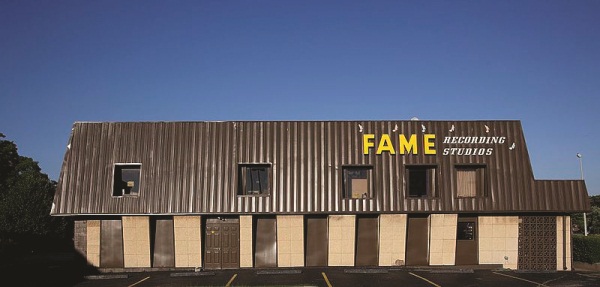
In 1959, three enterprising men formed a partnership in North Alabama, dubbing it Florence Alabama Music Enterprises (F.A.M.E.), after the small town where they set up shop above a local drugstore. They were Rick Hall, Billy Sherrill, and Tom Stafford, though they soon attracted other musicians like Dan Penn and Spooner Oldham. Hall turned out to be the scene’s driving force and firebrand, and soon was pushed out of the partnership, though he took the F.A.M.E. name with him and opened a new studio across the river in Muscle Shoals in 1963.
Hall’s new venture began producing the string of hits that would become known as the “Muscle Shoals Sound,” revered by producers like Jerry Wexler from Atlantic Records. Hall soon brought in a house band that consisted of bassist David Hood, guitarist Jimmy Johnson, drummer Roger Hawkins, and keyboardist Spooner Oldham (later adding keyboardist Barry Beckett), who would become known as the Muscle Shoals Rhythm Section, or The Swampers.
In 1966, Percy Sledge recorded “When A Man Loves A Woman” at F.A.M.E., and in 1967, Aretha Franklin ventured to the Shoals to begin recording her debut album for Atlantic Records, I’ve Never Loved A Man The Way I Love You, cutting the album’s title track and part of the Dan Penn/Chips Moman-classic “Do Right Woman, Do Right Man” before skipping town and finishing the record in New York.
Despite the positive track record, all was not well at F.A.M.E., and in 1969, the Muscle Shoals Rhythm Section defected to open Muscle Shoals Sound Studio, in Sheffield, one of the four closely-linked towns that make up the area commonly referred to as the Shoals.
It was at this Shoals studio that The Rolling Stones came for three days in December 1969, recording “You Gotta Move,” “Brown Sugar,” and “Wild Horses,” in a tour stopover chronicled in both the Maysles Brothers’ film Gimme Shelter and Stanley Booth’s epic True Adventures Of The Rolling Stones. Attracted to the Shoals sound, Paul Simon also traveled to the area in 1973 to record his third solo album, There Goes Rhymin’ Simon.
The Muscle Shoals of today isn’t so different from the Muscle Shoals of the 1960s and ‘70s. Rick Hall still runs F.A.M.E., where Dylan LeBlanc recorded his Rough Trade Records debut, Pauper’s Field, in 2010. The Athens, Georgia, southern rock group Drive By-Truckers also have close ties with the area. The group’s singer, songwriter, and guitarist Patterson Hood is the son of Swamper’s bassist David Hood.
While Ben Tanner says there’s not much of a live music scene, there’s a bevy of local groups like Doc Dailey & Magnolia Devil, Belle Adair, Lauderdale, and The Pollies that call the Shoals home, along with clothing designer Billy Reid, who hosts live shows at his store in Florence.
Though Muscle Shoals Sound Studio moved in the late ‘70s, the original location where the Stones and Simon recorded decades ago still stands, in a building that can only be described as non-descript. The Black Keys channeled the room’s rich legacy when they recorded tracks for Brothers there in August 2009. When the album went gold, the ghosts of rock and roll past were appeased.