
When the Alice Cooper band emerged out of Phoenix, Arizona, they were unlike anything that had come before. Blending catchy and clever hard rock with a theatrical stage show that gleefully depicted scenes of horror and madness, they were the world’s first shock rock group.
Through the early 1970s, this approach earned the band numerous international hits, including “I’m Eighteen,” “Under My Wheels,” “Be My Lover,” “School’s Out,” “No More Mr. Nice Guy,” “Billion Dollar Babies,” and many more. Their output was so successful and influential that, in 2011, they were inducted into the Rock & Roll Hall of Fame.
Videos by American Songwriter
The members—vocalist Vincent Furnier (who took the stage name “Alice Cooper”), lead guitarist Glen Buxton, rhythm guitarist Michael Bruce, bassist Dennis Dunaway, and drummer Neal Smith—had a deep bond, having gone to high school and college together.
But in 1974, the band split, with Furnier continuing on as Alice Cooper, solo artist. Through the years, though, the original members reunited, either writing or recording for one of Cooper’s albums or appearing for various live performances.
And now, five decades after they broke up, they have reunited on a new studio album, The Revenge of Alice Cooper, which is set for release on July 25 via earMUSIC.
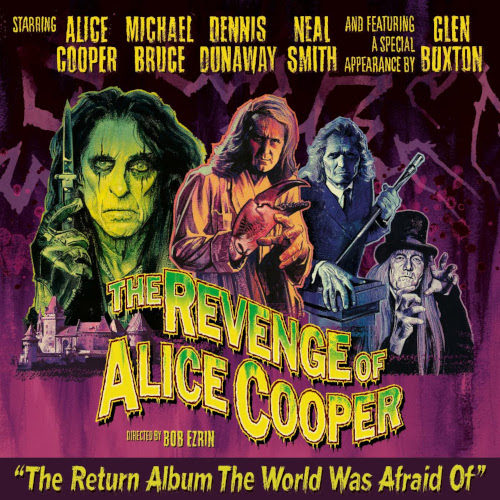
“We broke up as a band, but we never broke up as friends,” says Cooper. “When we separated, it wasn’t because of money. It was just because we got lost out there and couldn’t really find our way back. And maybe now we’ve finally found our way back.”
“I think we all felt it was slowly building,” says Bruce. “We kept the camaraderie up, and it was good. So when we started getting together [to create these new songs], it wasn’t anything that unusual. We were all there, and it gradually gained momentum, and here we are today.”
It was, Cooper says, as if they picked up right where they’d left off. “It felt like 50 years had not gone by. Everybody had the same sense of humor. Everybody had the same mannerisms. Everybody played the way that they always played. And we put songs together the way we used to in 1972. So it really was not any struggle at all. Everybody cooperated on every level.”
As Dunaway says, “It’s always been fully collaborative from the very beginning, and it still is. We have so many good songs to choose from, we could have done five albums. That makes it really exciting.”
These new songs would fit right in with any of the albums that the band created in the 1970s. Smith explains that, in their earliest days, this distinctive sound evolved naturally. “We were pretty much starving early on, and so we had the ground up to go—so what did we have to lose?” he says. “We had a sick sense of humor, we loved horror movies, we loved rock and roll. Put them all together in a shaker and came up with Alice Cooper, and the hits just kept on coming.”
“Spy movies, horror movies, comedies, they all ended up showing up in a lot of our songs,” says Cooper. “You add that to a really Detroit hard rock basis, and it becomes very clever.”
“It wasn’t only horror films,” says Dunaway. “James Bond had a lot of influence. West Side Story had a lot of influence. So a lot of it was just television. We started in this little oasis in the middle of the desert. Phoenix, Arizona, just seemed so far away from the rest of the world at the time. And so all of these movies and things were what was exciting in our life.”
The members all agree that they’ve always collaborated well with each other during the songwriting process, which has usually entailed having one member write the main gist of the song, then bringing it to the others so they can put their unique spin on it.
One of the major reasons for their success with this process is their ability to keep an open mind about the material, no matter who contributed it. “We all respect each other’s ability to write the songs, so we don’t rule out an idea verbally. We have to try it and see,” says Dunaway.
“We were always very generous with having somebody come in to a song we wrote and saying, ‘What if it did this?’ Or, ‘You know what it’s lacking is, it doesn’t go here.’ And nobody would ever sit and argue about that,” Cooper says. “We would go, OK, let’s try that.’ And if it worked, we would keep it in. If it didn’t work, we would all know it didn’t work. After all the songs we’ve written, I don’t think there’s ever been an argument about changing something or moving something around.”
Dunaway adds that the band’s dramatic live performances have also had an important impact on the way the members approach their songwriting: “Once we started building these shows that had these visuals, we started writing songs to be a soundtrack for these different things that we were going to do on stage,” he says.
Lead guitarist Glen Buxton was instrumental in creating the band’s sound—he came up with the iconic riff for “School’s Out,” for example—but he passed away in 1997. He is still included on The Revenge of Alice Cooper, however: the track “What Happened to You” features one of his previously unreleased guitar solos.
This was possible because Dennis Dunaway had kept tapes from the band’s earliest days, so the remaining members combed through those until they found a solo that they could use as the basis for a new song. “We could isolate that, pull it out, and actually write a song that was in that key that needed that kind of guitar break that Glen wrote,” Cooper says. “We needed to use that guitar solo as a blueprint for what that song was going to be.”

It is evident in talking to the others that it was crucially important to make sure to include Buxton on this reunion album. “Glen Buxton was the heart and soul of who we were,” says Cooper. “He was insane. He was funny. He was self-destructive. And at the same time, he was incredibly lovable.”
“He permeates everything, in a way,” Bruce says, and Dunaway concurs: “He’s always there with us whenever we’re doing music. The spirit of Glen was in the studio with us.”
The members also agree that it was imperative to have producer Bob Ezrin work with them on this album. Ezrin had previously produced their most successful albums of the 1970s, and he has also worked with Pink Floyd, Aerosmith, KISS, Peter Gabriel, the Deftones, and Thirty Seconds to Mars, among many others.
Ezrin is, Smith says, “The fifth member of the band” because of his ability to arrange songs so well. “Bob is an equal member to all four of us at this point. He brings his ideas in, and if it works and we’re all comfortable with it, it just makes it that much better.” Cooper agrees: “He’s the guy that kind of glues it together and makes it cohesive.”
The members are aware that there are high expectations surrounding this new album, but they don’t seem concerned. After all, as Dunaway points out with a laugh, defying criticism is nothing new for this band. “Let’s face it, the Alice Cooper group made a career out of bad reviews,” he says. “We had a lot of people who didn’t like us. Even when we were number one [on the music charts], there were still people who really didn’t like us. So we don’t do it for them. If we like it, then that’s the best we can do. We have to suit the opinions within the band itself. That’s what we have to satisfy.”
And, as Smith says, it’s not like they didn’t know they were going to be fanning the flames when they decided to do shock rock in the first place. “We decided to kill our lead singer, for God’s sake,” he says, “and the fans go, ‘Yeah, kill him! Electrocute him! Cut his head off! Whatever it is, we’re going to dig it!’”
“We’re the kids that took Halloween seriously,” Bruce says, before recalling one of their harsher reviews from the 1970s: “Like sitting in on a jam session at an insane asylum.” The others laugh and agree that this is, in fact, a compliment.
“We had very, very thick skin,” Smith says. “All I cared about was our fans that were enjoying us, and were coming by the thousands to see our shows.”
Dunaway says that the fans have always understood that the band was just having fun. “The tongue-in-cheek humor that’s on our albums, a lot of people missed,” he says. “But the people who got it, understood it. It was in a sinister disguise, but it was really just fun.”
And that, Smith says, is at the crux of what makes the Alice Cooper band so unique: “I think our legacy is creating a whole new genre in music, and that will never go away. They can’t take it away from us. And there’s a lot of bands out there that were inspired by us. That’s great. That’s one of the biggest compliments that you can give anybody in a band.”
It’s been an astonishing career for the group of teenage friends who started out in Phoenix all those decades ago: “We all knew each other in high school, and even with this new album, when we get together in a room, all of a sudden, we’re high school kids again,” Dunaway says. “We’re the kids from the back of the class. I think that that makes it into our music, and I think people can relate to that. We’re a bunch of high school kids who had a dream and made it come true.”
More Features
-

Singer-songwriter Paul McCartney and his wife, Linda (1941 – 1998), of British rock group Wings, in a recording studio, 21st November 1973. (Photo by Michael Putland/Getty Images) -
British rock singer and actor David Bowie performs with American pop singer Bing Crosby for the TV special, 'Bing Crosby's Merrie Olde Christmas,' London, England. (Photo by CBS Photo Archive/Courtesy of Getty Images) -
1974: Country singer Dolly Parton performs onstage with an acoustic guitar in circa 1974. (Photo by Michael Ochs Archives/Getty Images) -
Neil Diamond performs on BBC TV show, London, 21st June 1971. (Photo by Michael Putland/Getty Images) -

(Photo by Jim Dyson/Getty Images) -

AUSTIN, TX – FEBRUARY 28: <> at ACL Live on February 28, 2018 in Austin, Texas. (Photo by Gary Miller/Getty Images)