
You might have been reminded of the words of our Founding Fathers at some point, especially the ones about us having the right to life, liberty and the pursuit of happiness. Notice that Thomas Jefferson and his buddies didn’t guarantee us happiness. It’s that pursuit part that sometimes trips us up, but at least it leads to great songs like Simon & Garfunkel’s “America.”
“America” was a centerpiece of Paul and Artie’s fourth studio album, 1968’s Bookends. This was an album in which the duo started to leave behind the folk rock for which they became famous. The pair expanded their musical horizons with innovative arrangements and utilized some of the best session players in the business like drummer Hal Blaine and keyboardist Larry Knechtel. Blaine’s instinctive fills and Knechtel’s soulful runs deepen Simon’s melody on this memorable track, which even makes room for a reverie in the bridge.
The bedrock of it all, of course, is the convergence of those two magic voices. In an interview with Paul Zollo in 1993, Garfunkel explained how the line “And walked off to look for America” was an example of an almost metaphysical synchronization between Paul and him. “That has a real upright, earnest quality because we both have the identical soul at that moment,” Garfunkel said. “We come from the identical place in our attitude, and the spine that’s holding us up, we are the same person. Same college kid, striking out.”
“America” is essentially a road-trip song, but like all road trips, it tends to reveal as much about the participants as it does about the lands being traversed. The narrator and his companion Kathy (a reference to Simon’s 60’s girlfriend Kathy Chitty) board a bus in Pittsburgh with a four-day hitchhike from Saginaw, Michigan already in their rear-view. “Let us be lovers, we’ll marry our fortunes together,” Simon begins, an optimistic opening, but cracks in that optimism will soon start to show.
Passing the time on the bus with little games about their fellow passengers is all well and good, but a kind of ennui soon sets in when the cigarettes are gone and the magazines are read. “And the moon rose over an open field,” Simon and Garfunkel sing, and their voices convey both the awe of witnessing that phenomenon and the melancholy such a sight can bring about in a weary traveler.
Indeed, Simon’s next lines lay bare the extent of his character’s pain: “’Kathy, I’m lost,’ I said, though I knew she was sleeping / ‘I’m empty and aching and I don’t know why.’” With that admission, he becomes another in a long line of wanderers hitting the open road to fill the voids in their souls. Simon makes this connection with the closing couplet: “Counting the cars on the New Jersey Turnpike / They’ve all come to look for America.”
“America” suggests that restlessness is just as much of our unalienable birthright as anything else. To borrow another word from the Declaration of Independence, Simon & Garfunkel’s talent for making such effortlessly vast yet intensely personal statements was always self-evident.
More Behind The Song
-
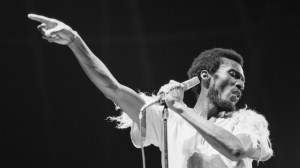
Jamaican singer Jimmy Cliff performs on stage at Porte de Pantin, in Paris. (Photo by John van Hasselt/Sygma via Getty Images) -
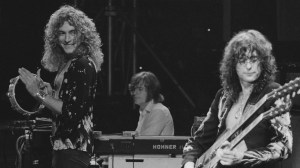
Left to right: Robert Plant, John Paul Jones and Jimmy Page, of British heavy rock group Led Zeppelin, performing at Earl's Court, London, May 1975. The band were initially booked to play three nights at the venue, from 23rd to 25th May, but due to public demand, two more concerts were later added, for 17th and 18th May. Total ticket sales were 85,000. (Photo by Michael Putland/Getty Images) -
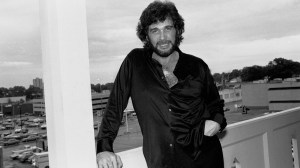
Portrait of country singer Eddie Rabbitt in Memphis, Tennessee, May 31, 1981. (Photo by Paul Natkin/Getty Images) -
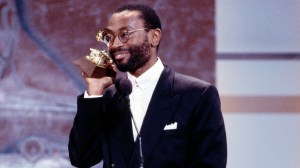
LOS ANGELES – FEBRUARY 22: 31st Annual Grammy Awards. Broadcast February 22, 1989. Shrine Auditorium, Los Angeles, California. Pictured accepting award is Bobby McFerrin. His song "Don't Worry, Be Happy" won Record of the Year, Song of the Year, and Best Pop Vocal Performance, Male. Also Best Jazz Vocal Performance, Male. (Photo by CBS via Getty Images) -
LAS VEGAS, NEVADA – APRIL 03: Singers Mike McGuire (L) and Marty Raybon of Shenandoah attend the 51st Academy of Country Music Awards at MGM Grand Garden Arena on April 3, 2016 in Las Vegas, Nevada. (Photo by Rick Diamond/ACM2016/Getty Images for dcp) -
Photo by Tim Mosenfelder/Getty Images -
The three founding members of Talking Heads on a Manhattan rooftop, US, 1976. (Jerry Harrison would join the group at the beginning of 1977.) (L-R) Bassist Tina Weymouth, singer-guitarist David Byrne and drummer Chris Frantz. (Photo by Linda D. Robbins/Getty Images) -
Patty Smyth of Scandal at the Poplar Creek Music Theater in Hoffman Estates, Illinois, June 3, 1983. (Photo by Paul Natkin/Getty Images)