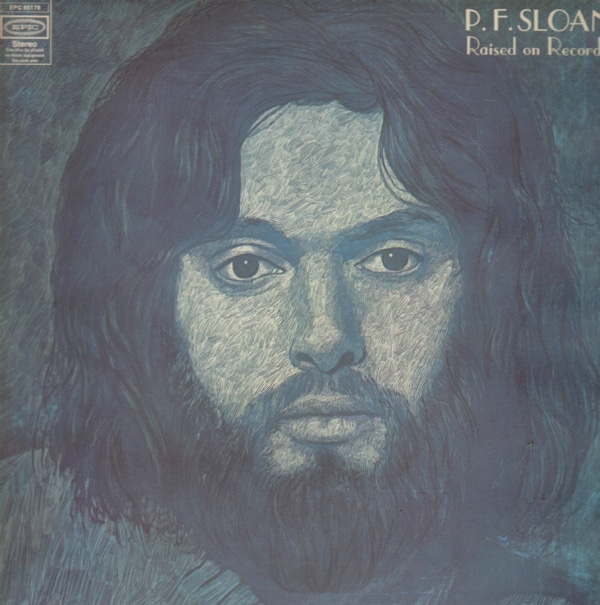
He’s both famous and infamous. Famous as the songwriter of many classic songs, including “Secret Agent Man,” “Eve Of Destruction” and “You Baby,” all co-written with Steve Barri. He’s infamous for disappearing for more than a decade, a mystery made legendary by Jimmy Webb, who wrote the elegiac “P.F. Sloan” about him, which features the lines “I have been seeking P.F. Sloan/ But no one know where he has gone.”
When I first interviewed Webb back in 1988, I had no notion that Sloan was a real person. I assumed that he was a mythic songwriter invented by Webb as a symbol for the waning spirit of the ’60s. I printed my admission in SongTalk magazine, and within days started receiving a deluge of tapes and articles and photos from Sloan devotees the world over, all containing the same message: that P.F. Sloan was one of the great American songwriters.
There was also another message: that Sloan was in Los Angeles, and was ready to be rediscovered. Through a series of maneuvers over a few weeks I finally received a phone call. It was Sloan. “I think the cosmos wants us to get together,” he said. I agreed.
He lived on the west side of Los Angeles, where we met and spoke. The interview’s publication in SongTalk magazine sparked the reemergence of Sloan in the world.
Like Webb, Sloan yearned not only to be the writer of great songs, but also the singer. The industry, back in the early 60s, was only then starting to welcome songwriters – such as Carole King and Neil Sedaka – into the fold of performers. Bob Dylan led the way, and Sloan was in Dylan’s thrall. “Eve Of Destruction,” which became a giant hit for Barry McGuire, was Sloan, in Dylan’s shadow, stepping into the light.
He was born Phillip Schlein in 1945, in Queens, and raised “a wild, corruptible child.” His sister called him Flip, hence the initials P.F. His folks, wanting to keep him from the streets, moved to Los Angeles when he was young. He played violin already, and soon graduated to a one-string uke, which he said he “mastered … I could play every Everly Brothers song on it. It was my great passion. But mostly a secret passion.”
At 13 his dad bought him a guitar, and he never put it down. He taught himself how to play, and how to write songs, by listening to records. “Every time there was a new record it would send shock waves through my system,” he said. It’s a shock that never ceased. “The juice of the original rock and roll,” he said, “is forever.” At 14 he auditioned for Aladin Records, and was given a contract. They asked if he could write songs, and he said sure, then went home and wrote six. “Listening to the format of songs became a school lesson,” he said. “The inspiration took care of itself. You put in the borders and the inspiration filled in all the words.”
When he teamed up with the elder Steve Barri to write songs, Sloan was in his essence. “When we would sit down to work, it was magic, it was electric.” They spent two years writing together, with Sloan working 18 to 20 hours a day crafting words and music. Their first record was “Kick That Little Foot, Sally Ann” by Harry Belafonte. Sloan was 15 when it was recorded.
Like other songwriters, Sloan and Barri were asked to write “sideway songs,” which were imitations of current hits. Often these sideways songs were better than the originals. They also wrote a string of hits for many groups, including “Take Me For What I’m Worth” by The Searchers, “Let Me Be” and “You Baby” for the Turtles, and “Where Were You When I Needed You” for The Grass Roots.
Sloan, being a great and soulful singer, sang lead vocals on all the demos. These recordings were used as the first record by The Grass Roots. But when it hit the Top 40, the record company did not want Sloan to be the star, and removed his vocal. An existing band – The 13th Floor – was brought in to become The Grass Roots. Here Sloan’s greatest dream was to be the singer of his songs, like his idol Bob Dylan, and it was snatched away.
But he kept writing. In one night, while still living at home with his parents, he wrote a remarkable five songs: “Eve Of Destruction,” “Sins Of A Family” and three more. “Eve” became a giant hit for Barry McGuire, and Sloan pushed for the chance to sing his own songs. The company let him record, but only as a demo. Still the record found its way into the world – P.F. Sloan the artist was discovered – and the industry turned their back on him. “I wasn’t taken seriously as a talent,” he said. “Except by Dylan. Dylan told me that the word was out and they were out to destroy me.”
So he disappeared. But fortunately, lifted by the receptive spirit surrounding our interview, he started making music again, and since has recorded several albums, and also written a memoir, to be released by Jawbone Press in June.
The energy of rock and roll, says Sloan, is eternal: “It’s living art, captured for all time.”