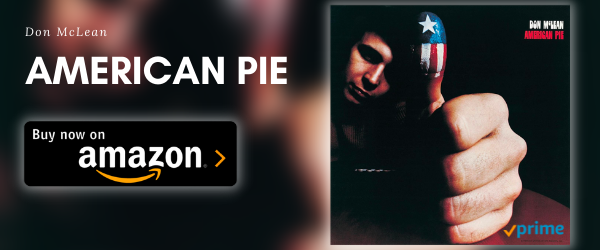
Exactly 50 years ago on January 15th, Don McLean’s seminal song “American Pie” hit No. 1 on Billboard charts. A classic in every sense of the word. A song that is both intimately autobiographical and broadly allegorical.
So what was the song’s original meaning as written by a twenty-four year old McLean? And how do the lyrics speak to us today?
Videos by American Songwriter
How American Pie is about a nostalgia for youthful innocence, for Mclean and America.
The song is about the nostalgia that comes with closing a chapter in time. A chapter that was good, youthful and innocent. The song starts in the late 1950s, where both McLean himself and the post World-War-II American sentiment were still sincere and innocent, if also blindingly naive. And as we know, naivety and innocence are always lost. For McLean, it was lost when he discovered that his favorite musicians, Buddy Holly, Ritchie Valens, and J.P. “The Big Bopper” Richardson, had died in a plane crash—the day the music died. And for America, it came when the utopia of the 1950s was exposed as a veneer, giving way to the more socially conscious, but turbulent 1960s.
And as the lyrics go on line by line…
A less religious America and McLean’s skepticism of 1960s rock.
Can music save your soul? Well one can certainly hope. But as America secularized in the 1960s, fewer and fewer souls found religion, looking increasingly to musicians for spiritual guidance. McLean was skeptical about such idolatry. And even took to calling these rising musicians—Bob Dylan in particular—jesters, when compared to the real king, Elvis Presley.
After all, music is something that makes you physically feel and dance. Not something you ingest and obsess over to inform your worldview, right?
Everything gets political, The Beatles, Kennedy, and Helter Skelter.
Everything became more political in the 1960s. Kennedy was assassinated and the courtroom was adjourned with no verdict, as Lee Harvey Oswald was killed prior to judicial proceedings. The Helter Skelter murders happened during that sweltering summer, which if not expressly political was certainly ideological.
Music was no exception to all the politicization. John Lennon was reading from the book of Marx, as The Beatles released songs invoking revolution and even referencing China’s Mao.
Wasting time on drugs, the death of God, and McLean’s Catholicism.
The 1960s came and went fast. Especially for those who squandered it on drugs, lost in their own headspace under a satanic spell. Those hellish flames climbed high, while the church bells were all broken. Even though McLean admired three men most, the Father, the Son, and the Holy Spirit, it was clear that God had died in the ‘60s. Just like the music. And just like McLean and America’s innocence.
What do American Pie’s lyrics mean today?
One thing is certain – McLean was skeptical of change. And there has been plenty of that lately. Some good and some bad. As for the bad we see today and where it originated, maybe McLean’s old song leaves us hints.
Did the spiritual obsession with musicians that McLean warned against blossom into this twitchy toxic social media culture of celebrities and influencers we have now?
And at a time when politics permeates everything in the culture, even more so than in the 1960s, what place is there for music that is entirely apolitical, and light, for the enjoyment of the masses?
When so many secular souls report wandering listlessly through life with no real purpose, is now the time to reconsider our relationship to religion?
And what if McLean is guilty of something that is anathema to societal progress on the whole, lamenting and romanticizing a less equitable time gone by?
Heavy stuff. But these are just some of the questions the culture will need to grapple with in 2022. And in truth, they are just modern iterations of the same questions McLean was asking fifty years ago. If we look close enough, maybe the answers to these new questions can be found in those old lyrics.
Also read our analysis on the meaning of Neil Young’s “Heart of Gold”
Photo by Central Press/Getty Images

More Behind The Song
-
Portrait of Fastball (Joey Shuffiel, Miles Zuniga, Tony Scalzo) in San Francisco, California, USA, 1998. Photo © Anthony PIdgeon -
THE JOHNNY CASH SHOW – "History of Country Music" – Airdate: January 21, 1971. (Photo by ABC Photo Archives/Disney General Entertainment Content via Getty Images) MERLE HAGGARD -
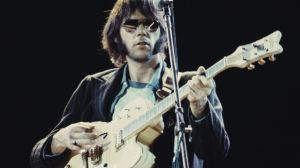
Canadian musician Neil Young of Crosby, Stills, Nash And Young performs on stage at Wembley Stadium, London on September 14th 1974. (Photo by Michael Putland/Getty Images) -
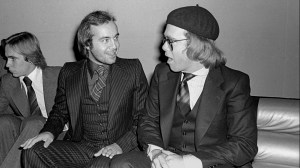
Elton John converses with his songwriter partner Bernie Taupin at his Studio 54 party. -
LOS ANGELES – FEBRUARY 28: The 26th Annual Grammy Awards, presented at Shrine Auditorium, Los Angeles. Broadcast on CBS television on February 28, 1984. An event recognizing the achievements and talents of singers, musicians, and music industry persons. Pictured is Bonnie Tyler. (Photo by CBS via Getty Images) -
American musician Stevie Nicks performs onstage during the US Festival, Ontario, California, May 30, 1983. (Photo by Paul Natkin/Getty Images) -
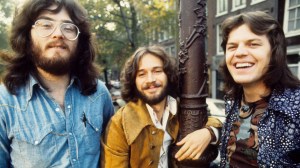
The Stampeders (with Rich Dodson (L)) pose for a group portrait in 1971 in Amsterdam, Netherlands. (Photo by Gijsbert Hanekroot/Redferns)