
By many measures, Shania Twain is one of the most successful musical artists of all time. For example, she is the top-selling female country artist worldwide, selling more than 100 million albums to date.
Despite her iconic status, Twain’s fans still don’t know some pivotal things about her—but that is changing thanks to her seventh studio album, Little Miss Twain, which was released in July (and an expanded version, Little Miss Twain—The Places I’ll Go, that came out in October) via Republic Records. With these new songs, Twain reveals deeply personal details of her pre-fame years.
Videos by American Songwriter
“It’s a long chapter in my life that nobody really knows that much about because I’ve never really written about my experiences in my years as a child and as a teenager, or the whole period up until I signed my recording contract, so that includes everything up to my late twenties,” Twain tells American Songwriter, calling from her home in Switzerland. “There’s a huge developmental period of my pre-recording career that this album is really all reflecting on, so it’s very satisfying.”

Though she’s pleased with the result, Twain says she didn’t deliberately aim for this autobiographical angle with these new songs. “They all trickled in at different points, and not for any particular reason,” she says. “Just me sitting around with a guitar and reflecting on my youth, and not focusing on where those songs would land on an actual recording project. I wasn’t thinking commercially in any way. It was sort of this theme that was sitting on the sidelines, waiting to be recognized.”
She also took a hands-off approach when it came to settling on any specific musical style this time, which is why Little Miss Twain explores country, pop, soul, and Americana. “I wasn’t going for any particular genre. I was really mixing the genres all the way through it.” In this way, she adds, the album is a good reflection of the diverse musicians who inspired her during the formative years that she describes in these songs. “It really includes a very colorful spin of artist influences.”
Growing up in Timmins, Ontario, Twain adored Dolly Parton, Stevie Wonder, Kris Kristofferson, and the Bee Gees. She also, because of her parents’ and grandparents’ listening tastes, learned about Eddie Arnold and Johnny Cash.
“It really does make sense to me that I ended up being a crossover artist because it’s always been what has influenced me since I was a very young child,” Twain says. “I grew up listening to one radio station in my little town, and it would play everything from Fleetwood Mac to Gladys Knight to the Mamas and the Papas, and then you would hear Tammy Wynette and George Jones. It was whatever the hits were. To me, it was just all great music.”
Twain also had a particular fondness for Tanya Tucker’s music. “Tanya Tucker had a very rock and roll edge to her voice, even though she was singing very country songs. I admired her.” In a sweet full-circle moment, Tucker sings with Twain on the title track for Little Miss Twain. “I got the courage to ask her, and the only date that really worked out for us [to be in the recording studio] was on her actual birthday, and so she came and spent her birthday with me,” Twain says, still sounding awed about this. “It was wonderful. And she brought me a gift! Special lady.”
[RELATED: Remember When Shania Twain Scored Her First Hit Single in 1995?]
When Twain was a child, though, her respect for Tucker—and her own burgeoning talent—prompted her mother to encourage her to aim for a music career. “My mother’s dream was that I would be the next Tanya Tucker,” Twain says.
Twain estimates that she was three years old when her mother realized that her daughter had an unusual affinity for music. “So she encouraged me to refine it and to discover all kinds of music, and I was obsessed,” Twain says.
Twain was only 10 years old when she started writing original music. “The very first song I ever wrote was called “Just Like the Storybooks.” It was just like it sounds: it was very naïve, and it was about fairy tale love,” she says with a laugh. “It was, ‘A princess meets a prince, and then he breaks her heart.’”
Musically, Twain’s early songs were quite simple, but she was determined to expand her knowledge. “They were at most five chords, [and] usually three chords. D, G, and A—those were the chords that I wrote in the most when I first started writing. And then I started to introduce E minor and A minor. That was very exciting!”
As it became clear that Twain was a natural singer-songwriter, her mother persuaded her to start performing at the local bars and made sure she followed through by driving her to the gigs. Twain resisted it at first, but now says she is grateful she was forced out of her comfort zone in this way. “That did not come naturally to me at all,” she says. “That was not anything that I would have ever done without my mother’s guidance and tugging and pulling and pushing.”
With time, she realized that her mother was teaching her that performance anxiety was worth enduring if she wanted to make her music dreams come true. “We need our parents to get us over that hump, so we realize not only that we’re capable, but to the point that we discover that we love it enough to go through the pain of it,” she says. “So the pain for me was getting in the spotlight, and I had to push through it.”
This was, she concedes, not always easy. “I developed stage fright because I was just uncomfortable,” she says. “I was breathing in really heavy, thick smoke because everybody smoked in those days in those bars. And most people were intoxicated. The majority of the audience were men at that time of night. I would normally go on at midnight when the bar actually closed, so the environment was inappropriate for my age. Also, I was going to be tired the next morning for school.
“But the good side of it is that I realized that I was good at it,” she continues. “People were responding. They were applauding, and they were acknowledging that I was a standout. I realized, ‘OK, I guess I’m doing something right.’”
It was especially gratifying when she started slipping her own songs into the set lists. “I would bring my chord charts with me,” she says. “I’d give them to the bands, and then I’d give them the key, and off we would go. It was quite fun. Sometimes, if the audience was tolerant, I would be able to maybe do three songs in a night of my own original music.”
This time in the bar scene also taught Twain how to interact with an audience and build a rapport, how to handle hecklers, and various ways to communicate her stories. “That served me well,” she says. “I was so prepared by the time I got to Nashville. I had no anxieties about those things, so I was very ready, and I wasn’t going to be overwhelmed, the same way somebody just coming out of college and starting their career would be, maybe.”
Her self-titled debut album came out in 1993, but it yielded only a couple of minor hits and grazed the upper end of the charts in a handful of countries. Despite her years of experience as a songwriter by this point, only one song she co-wrote, “God Ain’t Gonna Getcha for That,” ended up on this album. Still, it did well enough that her record label kept her on the roster.
That confidence in her paid off. With Twain’s next release, her career suddenly skyrocketed. She wrote, or co-wrote, every song but one on The Woman in Me, and when it came out in 1995, it was the breakout hit that she’d needed. “Whose Bed Have Your Boots Been Under?” became her first single to achieve gold sales status. “Any Man of Mine” followed and was her first No. 1 hit in the U.S.
Twain’s next album, Come On Over (1997), made her a worldwide country-pop superstar thanks to a dozen singles that charted in numerous countries. In particular, the songs “Man! I Feel Like a Woman!,” “You’re Still the One,” and “That Don’t Impress Me Much” became so popular that they each remain signature songs for her to this day.
Five years later, her double album Up! became her first No. 1 album in the U.S. After that, she took a long break to raise her son, but she returned in 2017 with Now, which also topped the charts. All of her albums—including Little Miss Twain—have charted in at least a half-dozen countries.
In 2005, Twain was invested as an Officer in the Order of Canada, one of the highest honors in her native country. She was inducted into the Canadian Music Hall of Fame in 2011. She has also received significant accolades in the U.S., including an exhibit about her at the Country Music Hall of Fame from 2017 to 2018. Twain has won five Grammys and also received numerous awards from the Canadian Country Music Association, the Academy of Country Music, and the Nashville Songwriters Hall of Fame, among many others.
While Twain’s popularity is undeniable, and her crossover appeal has won her fans across the globe, some country music purists have objected to the way she blends country music and pop rock. She doesn’t take it personally, though. “I think there’s always a certain part of any culture that wants to preserve things, and that’s healthy,” she says, adding that it’s equally important to have “a good balance of those who invite innovation, and who invite change and progress. But that’s not my style.
Even when she first came to Nashville, she says, she remembers thinking, “I’m not here to tip the balance. And I’m not here to bulldoze my way through, because that’s foolish. I’m just here to introduce what I’ve got with confidence.”
Still, when asked if it was vindicating to earn such enormous success as soon as she was allowed to contribute her own original material to her albums, Twain responds with a heartfelt, “Oh, it was! It was such a great feeling”—but then quickly adds, “I didn’t resent it. I was already quite professional by then. By the time I got to Nashville, I was already quite savvy about, ‘Everything is a stepping stone. You’ve got to work your way up the ranks.’”
Besides the usual struggles aspiring artists face in Nashville, Twain points out that she had the added complication of adjusting to culture shock as she went from Canada to Tennessee. Also, she had no safety net if things didn’t go her way, because her parents had been killed in a car accident several years before. Despite these obstacles, she says, “I was prepared for the marathon; I knew it wasn’t going to be a sprint. So I was patient about it.”
One thing that did throw Twain for a loop, she admits, was learning to deal with sudden stardom. “I was ready for what was coming, as far as the demands on my writing and performance,” she says. “That was OK; I was all ready for that. But fame was a different part. Fame is a big distraction for an artist. If you’re a really creative person, you really just want to spend all of your time creating, not being a star.”
Still, she is happy to contend with that if it allows her to connect so strongly with so many listeners: “My intentions were always the same: to communicate things that I believe I have in common with others. I think that made the music very communicative. It was just very open communication, open dialogue.”
Beyond that guiding principle, Twain says she doesn’t follow any particular method in how she approaches her craft. “I don’t have any one way of writing a song, so every song I’ve ever written, it never starts the same way. It’s almost like a recipe: it’s whatever I’ve got in the fridge,” she says with a laugh. “Whatever’s on my mind, whatever is inspiring me in the moment.
“If I have my guitar with me, then that’s wonderful,” she adds. “I will sit down alone with my guitar, and I will just tinker away. That might mean I write a melody first, or it might mean I write a chord progression first. If I don’t have my guitar with me, I will often just write down concepts. Other times I write poems, and then the poem dictates the cadence and the phrasing of whatever melody I might come up with at some point later on.”
For lyrics, Twain says she has historically tried to make sure that people can connect with what she’s trying to express. “Normally, I’m really intentional about being relatable with my fans, because I want to share it with as many people as I can,” she says. “It’s like having a conversation: I don’t want to have a conversation that’s not relatable. Whoever I’m sitting in a room with, I’m going to want to have a conversation that’s compatible, where we have a lot in common, and then it’s more of a mutual conversation. So I do write a lot with that intention.
“I believe in having a sense of humor, too—I think that’s a really good way to communicate, maybe even some sassy things. I’m not trying to be confrontational, but I like to be honest about what I’m thinking and my stance on things.”
With Little Miss Twain, though, she deliberately tried a different approach to her lyric writing. She included references to obscure things from her childhood—for example, mentioning “Cherry Blossoms,” which was her mother’s favorite kind of candy, even though she knows many fans will have no idea what that is.
“There’s just a lot of things in this album that other people don’t know about my personality, or they don’t know about my upbringing or my influences. Or what day-to-day life might have been like when I was a kid or a teenager,” she says. “It’s fun to be really, really literal, and maybe it makes people want to investigate what that is, or it makes it a little bit more of a treasure hunt out of certain things. The intention behind this album was to just be my eclectic self and not over-explain myself.”
Releasing this album is making Twain take a look back at her career and her legacy. Her conclusion: “I think it’s been a really, really long journey. It’s been super long, and I feel like Little Miss Twain gives some perspective to that journey. There are so many chapters and volumes between the bookends that I’m not sure people realized. Or, the only volumes that they’re aware of are the ones since I became a recording artist. This album is all about explaining that in song.”
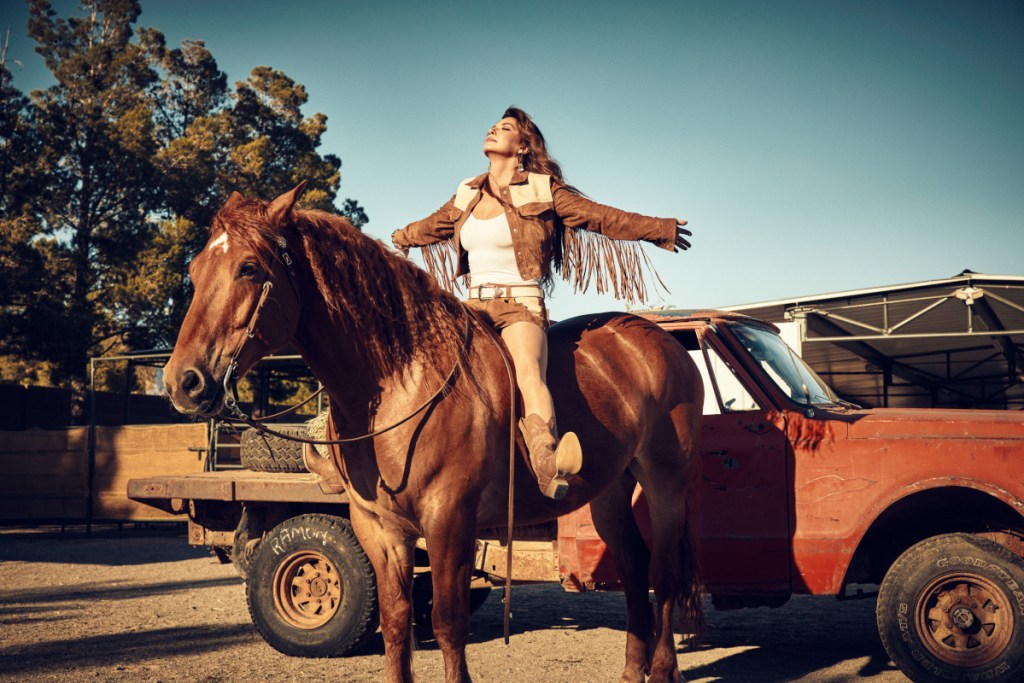
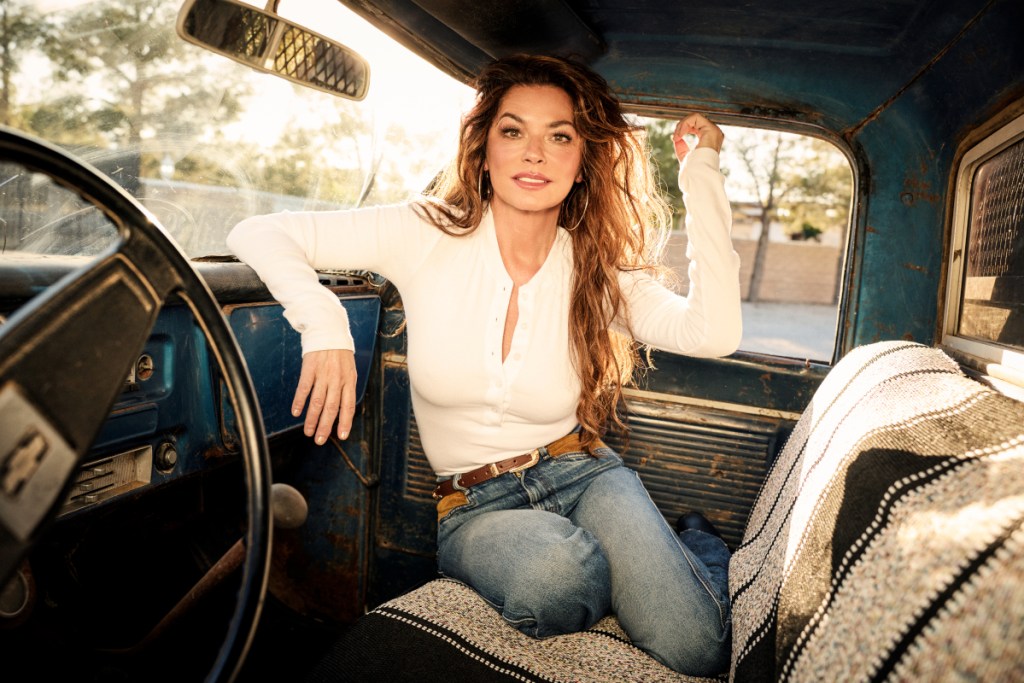
Photos by Pamela Littky
More Features
-

Photo by Jeff Gentner/Getty Images -

Photo by Rick Diamond/WireImage -

Photo by Michael Ochs Archives/Getty Images -

UNSPECIFIED – JANUARY 01: Photo of CHUMBAWAMBA (Photo by Mick Hutson/Redferns) -

Duran Duran are mobbed by fans as they arrive back at Heathrow from Miami. After the scenes in the long-distance terminal, a senior British Airports Authority Security Officer called the group's management irresponsible for allegedly asking newspapers to publish their arrival time, 19th July 1983. (Photo by Peter Stone/Mirrorpix via Getty Images) -
JUN 1972, JUN 26 1972, JUN 27 1972; Charlie Walker sings his biggest hit song, "Little Old Wine Drinker Me." Walker is a regular performer on the Grand Ole Opry's stage for country music, Nashville, Tenn.; (Photo By John G. White/The Denver Post via Getty Images) -
American Rock Singer and Guitarist Jimi Hendrix (1942-1970). (Photo by Avalon/Getty Images) -

NASHVILLE, TENNESSEE – Bill Anderson accepts the ACM Icon Award onstage during the 19th ACM® Honors™ at The Pinnacle on August 19, 2026 in Nashville, Tennessee. (Photo by Jason Kempin/Getty Images for ACM)