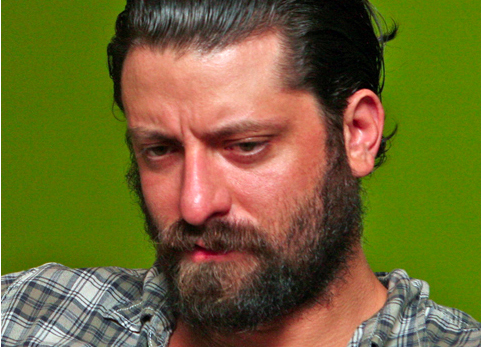
“I’ve always wanted to be Andy Friedman.” Sufjan Stevens said that. The Brooklyn singer-songwriter, illustrator and former New Yorker cartoonist will release his third studio album, Laserbeams and Dreams, which he recorded in a mere 24 hours, on April 5. We asked Friedman about the confluences between his twin crafts, and the last song to spill out of his brain.
Compare and contrast the art forms of songwriting and cartooning.
Well, if by cartooning you’re talking about the creation of one-liner gag cartoons—like the kind you see clipped from the New Yorker and scotch taped onto refrigerator doors or pinned to bulletin boards—then I will say that at its essence there is not too much of a difference, for me, between the two forms. I submitted regularly to The New Yorker as a gag cartoonist under the name Larry Hat between 2002 and 2005, during which I may have sold and published about a dozen.
There’s a chapter in the great book In The Country of Country: A Journey Through The Roots of American Music by Nicholas Dawidoff, which profiles the iconic Nashville country songwriting genius Harlan Howard. In it—and if you’ll permit me to paraphrase—Dawidoff accompanies Howard and a group of other well-known Nashville writers on a lunch expedition, one that they would make each week after making the rounds to all the labels and publishing houses with their song ideas with the hopes of a sale. When the waitress offers up a clever quip, everybody leans to one side to reach for the little notebook in their back pockets. “Already wrote it, boys,” Howard announces to the group, and everybody leans back into their seat.
Later, back at Harlan Howard’s home, Dawidoff notices the writer scribbling something into a pad. “What is it,” asked Dawidoff. “That thing the waitress said,” answered Howard. “I thought you said you already wrote it,” inquired Dawidoff. Howard answers, “a writers’ got to protect a good idea when he hears one.”
The New Yorker cartoonists do the same kind of thing. They go out to lunch every Tuesday as a group after dropping off their ideas with Bob Mankoff, the magazine’s Cartoon Editor. I’m sure the quip from many a waiter or waitress has been spun into New Yorker cartoon gold, and that formula, for me, holds true when I’m writing songs. It’s all about walking the streets and roaming the earth with your antenna up and ready, like a big butterfly net on the top of your head catching everything of interest. I was never the kind of cartoonist that would lock himself in a room with white walls and think of cartoons, nor am I that kind of songwriter. I let the rest of the world do the work, and I’m just there to catch it, one line at a time, and you know it when you see it.
Now, if you’re talking about the art of illustration, which I also am proud and lucky to contribute in the form of editorial portraits for the New Yorker and many other fine magazines, well, then that’s got nothing to do with songwriting, and there’s no similarities except for that I enjoy doing both.
Take us through the arc of your career so far. How did you end up on a label?
I came to music as a painter, a fine artist, and an academically trained one, at that. I aspired (and still aspire, though I haven’t put paint to canvas in about fifteen years) to be the next Vermeer, Velazquez, or Carravaggio. But I was raised on rock n’ roll and concerts and the album experience of leafing through liner notes and liner note art and photography. I knew I was not a musician, but I also knew that the idea of hanging a painting on the wall seemed boring to me. I wanted to travel with my art, look the people in the eye, and get on stage. Conversely, I wanted those experiencing my art to find it while they were at home, not in the confines of a gallery or museum. I envisioned those people having the same album experience with my paintings as I always had with those records. In 2001, I put out a book of pencil drawings, Polaroids, and poems—long out of print—called Drawings & Other Failures. It was, ostensibly, my realized album of visual art. The 30-page poem served as the lyrics to the music that were the images, and sort of tied everything together as a conceptual whole. I tried to shop it around but nobody would touch it, so I bought some ISBN numbers and made my own publishing house called City Salvage Records to release it. Around this time my good friend, college buddy, and fellow musician Paul Curreri was looking to put out his first album, the profound From Long Gones To Hawkmoth, for which he also could not find a home. So I put it out on my label, and shortly after that his new girlfriend (now his wife) Devon Sproule wanted to put out her Upstate Songs, which also found a home on City Salvage. From there, things grew, and that’s how I got a record deal—I made a label.
Who are your most profound musical influences?
It’s cliché, but I’m not going to beat around the bush: Bob Dylan. From him, I got into everything that mattered, backwards and forward. I remember reading the liner notes to his 1985 Biograph collection. In it, he calls “the real stuff,” guys like Leonard Cohen and David Allen Coe. Voila! That’s how that started, and from those two guys you probably know where things went, and it wasn’t long until I read the Anthony Scaduto biography that recounts his early years listening to all the old blues musicians from the Mississippi Delta. Bam! From there you can guess where that road led, and it wasn’t long before I got to the classic country stuff and found Dawidoff’s book: George Jones, Merle Haggard, Johnny Cash, Hank Williams, the Louvin Brothers. And on to the great rockabilly acts.
But my foundation—really—my core (and I’m quite lucky for this) is the American Popular Songbook. My father is a gifted and enthusiastic purveyor of those traditions including his being a graduate from the Manhattan School of Music as a vocal major. I grew up listening to Jonathan Schwartz every weekend on WNEW and then WQEW out of New York City: Ella Fitzgerald, Frank Sinatra, Tony Bennett, Chet Baker—all of them. But I still like to call the basic food groups of my influence the early 1970’s singer songwriters: Joni Mitchell, Jackson Browne, Paul Simon, and Randy Newman. I like Dory Previn a lot, too. That Mystical Dreams & Iguanas record is insane. And Rickie Lee Jones. And recently got into John D. Loudermilk’s Open Mind album—lookout world.
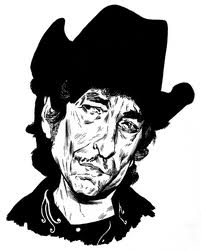
(Friedman’s illustration of Bob Dylan)
Who are some of your influences lyrically?
Really—it’s those great American country bluesers, particularly from the Mississippi Delta. The reason is because those songsters instilled in me the confidence to tackle songwriting and singing in the first place. That, I would think, constitutes tremendous influence. Before I heard that stuff I didn’t think I had a musical bone in my body. I didn’t. I never thought to sing in to a microphone let alone talk into one, and the idea of playing guitar was absolutely the furthest thing from my mind. In fact, it’s insane to me that I’m even discussing this with your magazine. I’ve only been playing guitar for not even six years. I never touched a guitar before 2005. I was a painter and a poet, and mostly a painter, and that’s it. But the music from that period helped inspire me to hit the road with a clunky old slideshow poetry show whereby I accompanied projections of my pencil drawing and Polaroids with readings of my poems. That kind of music is without pretense or ego—it is what it is because it needs to be. Every word. There is no choice to it. It’s born from oppressive lives during five minute break intervals. There’s no time for anything but soul, and no time to judge or self-edit. That’s why it’s so believable. It’s not the kind of music where you need a degree from Julliard to be able to play it. You just need to be in that unobstructed, uninhibited place of need to be able to deliver it. Contrary to what has been said, you don’t need to be broke, hurt, alone, or oppressed to play it or make it: you just need to be in that place of needing to express what you need to express the way you express it. And following that formula I figured, well, I can’t play a guitar or sing, but I have paintings, poems, a slide projector and a car, so I’ll just do it. If Jesse Fuller can do what he did I’ll just do what I do, and if people think it’s funny then they’re not my demographic! And lyrically, it’s the same formula: I don’t write anything that doesn’t need to be written.
What was the last song you wrote? Tell us about it.
That’s actually one of the most challenging questions anyone’s ever asked me to answer. I don’t want to tell you about it! That’s why I write the songs. To me its like each song is a delicately balancing tower of playing cards, and your question is like, “that card in the middle there, take it out and show it to us!” But I think I know what you want, and so I’ll take a stab at answering. I sort of write them in order, and so really the last song I wrote was the last song on my new album, Laserbeams And Dreams, called “Down By The Willow.” But I can’t get into dissecting it or this will go on for pages and pages and I’ll say too much. That is a wicked, wicked song and I pretty well wrote it for over a year. It’s almost like all the songs on that album were written while I was writing “Willow,” and trying to figure out what the heck I was trying to figure out by writing that song.
So, technically, it’s the first song I wrote from this batch as well as the last, so let me share a story about a different song from this record, which is one of the last ones I wrote: “Quiet Blues.” That song was written in almost the amount of time it takes to sing it. I was just sitting there on the front porch in the summer cottage where we stay in July to get out of the gritty city. That big willow tree was waving at me and taunting me. It was quiet and I was all alone. I was so happy. And then the cell phone rang and I got so very, very depressed. [And I swear to you my phone just rang as I’m typing this, which completely just blew my flow, and now I’m not so much depressed as downright angry, and where was I?] — and that’s the point of the song. There’s no more quiet! There’s no more alone! And if you turn off the phone you miss out on a job, or money, or someone’s hurt and they need help and you made it worse for them somehow. It’s a screwed up thing, and at the same time I could not be doing what I’m doing out there on the road without all the scanners, cell phones, and wireless connections. I turn in a lot of my illustration work from hotel rooms between gigs. I couldn’t do that without all the technology I complain about. Quiet blues—I got ‘em for sure.
What’s a song on Laserbeams you really want people to hear, and why?
“Quiet Blues,” because now I got them all excited about it! But the thing to know is that the song was recorded about two to five seconds after we recorded “Roll On, John Herald,” which is the song before it on the album. We barely took a break, and when you hear the two together you’ll appreciate the biathlon-like energy and focus it took to pull that off, which was just a lot of spiritual fun—going from 350mph to 55mph like that at the drop of a hat. We were literally trembling—or at least I was—during the recording of “Quiet Blues.” And what made it even more special was that Jen Chapin lent me her father’s guitar (Harry Chapin) for the recording of those two songs. That was very special.
What’s a lyric you’re particularly proud of on the album?
“O’Keefe said it right/you ain’t a kid at 33
That’s Danny not Georgia/Though Georgia might agree”
Are there any words you love, or hate?
Absolutely. Love: Dimple. Hate: pimple.
How do you typically write songs? Words first, or melody?
I will quote the great Memphis songster Furry Lewis: “I just think of things and rhyme ‘em up.” Man, that’s great. And the melody just—I don’t know how the melodies happen. I don’t know where they come from. Nor do I really know where the words come from.
Do you find yourself revising a lot, or do you like to write automatically?
I like to write automatically, but I do revise a heck of a lot. I remember reading a Jack Kerouac quote—or rather his whole modus operandi, as it were—“first thought best thought.” And I like what my friend Paul Curreri said about that: “Just because it’s your first thought doesn’t mean it’s your best thought!”
Who’s an underrated songwriter, in your opinion?
Probably someone neither of us have yet to have heard about. Have you heard Caleb Stine’s songs? It’s hard for me to call him underrated because so many people love his songs, but if we’re talking about being at a level where tens of thousands of people should be seeing his shows each night but are not, well, then he’s someone who should be playing to tens of thousands of people a night. And when that happens, can I open for him? I could use the boost.
What’s a song you wish you’d written?
“Help Me Make It Through The Night,” by Kris Kristofferson. Can I say one more? “My Cricket,” by Leon Russell. That song is hysterical.
More Writer Of The Week
-

Photo by Jesse Spencer -

Photo credit: Sean Brackbill