
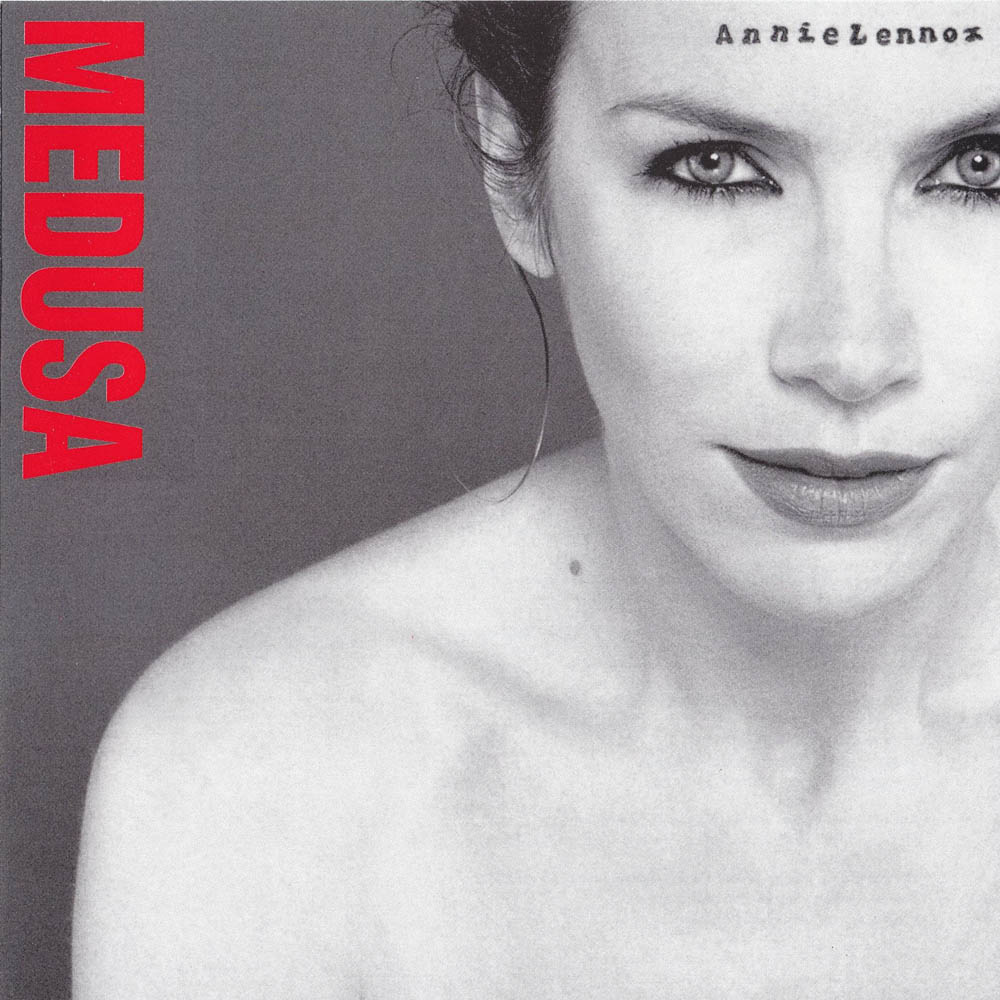
Annie Lennox recorded 10 cover songs on her 1995 album Medusa, which was trashed by many critics but is mostly recognized as a great album today. Never mind the critical reception though — the public and NARAS didn’t have a problem with the album, which entered the UK charts at number one, sat on the Billboard 200 chart for over a year, sold six million units and won a Grammy. One of the songs on the album was originally a male-sung composition that Lennox turned into a feminist anthem of sorts, “Thin Line Between Love and Hate.”
In 1971 the song was a hit single by the New York-based vocal group the Persuaders (not to be confused with another New York vocal group, the Persuasions), with lead singer Douglas “Smokey” Scott spinning a tale of how his neglect and mistreatment of his woman landed him in the hospital. “Thin Line” was written by Richard Poindexter, Robert Poindexter and Jackie Members, none of whom were members of the group. On Medusa, Lennox reworked the lyric to be sung from the second-person point of view of a narrator who could be either male or female, as he or she sang to that song’s male character. For instance, the lyrics originally sung by Scott from the male first-person are:
Here I am laying in the hospital
Bandaged from feet to head
Ya see I’m in the state of shock
Just that much from being dead
I didn’t think my woman could do something like this to me
I didn’t think she had the nerve, so here I am
I guess action speaks louder than words.
But in Lennox’s version, she substitutes “you” for “I,” and in place of “action,” she humorously sings “accidents.” And then, in lines of her own that she adds after what had been the end of the Persuaders’ song, Lennox reveals that she, the narrator, is actually the female lover/assailant in question, and she finishes the song in first person with:
Come on, baby, baby
If you won’t give a damn about me
Come on baby, baby
You don’t really care about me
Lennox sings this song like she’s lived it, but in the original version, Scott also delivers a remorseful gut-wrenching vocal, so it’s fun to compare the two. Production-wise, the cuts are different as night and day, with the original Persuaders version getting a somewhat typical early ‘70s soul/R&B treatment, while Lennox uses great synth patches and voicings and a blazing harmonica to create a track that sets up her powerful vocal attack. The song is a classic about domestic violence, a timeless subject that isn’t covered often in popular music, and in the end, as in real life, nobody wins. “Thin Line” hopefully has generated substantial publishing income for its writers over the years, as it has been sampled by various acts, and was also cut by the Pretenders and by R&B trio H-Town for the Martin Lawrence movie of the same name. And Lennox’s version sounds as fresh today as it ever has.
More Behind The Song
-

Musician Toby Keith performs on stage during the 2009 CMT Music Awards at the Sommet Center on June 16, 2009 in Nashville, Tennessee. (Photo by Jeff Kravitz/FilmMagic) -
(Original Caption) 2/17/56-Hollywood, California: Singing actress Doris Day models one of the American-girl-look outifts she's designing for Little Miss English Ltd. The full skirt and matching sleeveless camisole blouse are of silk-finish cotton satin in a leaf print on soft blue. The companion sweater, a feature of all Miss Day's designs, picks up one of the leaf colors and is trimmed with French cuffs and Peter Pan collar of the print material. The three pieces may be bought separately. -

Tom Jones at the Metro in Chicago, Illinois, December 2,1994. (Photo by Paul Natkin/Getty Images) -
LOS ANGELES – SEPTEMBER 1: Fleetwood Mac (L-R Stevie Nicks, Lindsey Buckingham, Christine McVie, John McVie and Mick Fleetwood) backstage at the Los Angeles Rock Awards on September 1, 1977 in Los Angeles, California. (Photo by Richard Creamer/Michael Ochs Archives/Getty Images) -

Luther Vandross on stage at the 2002 American Music Awards at the Shrine Auditorium in Los Angeles January 8, 2002 (Photo by KMazur/WireImage) -
circa 1940: The Three Stooges turn plumbing equipment into musical instruments in a still from an unidentified film. L-R: Curly Howard (1903 – 1952), Moe Howard (1897 – 1975) and Larry Fine (1902 – 1975). (Photo by Hulton Archive/Getty Images) -

TODAY — Pictured: Keith Urban on Thursday, August 2, 2018 — (Photo by: Nathan Congleton/NBCU Photo Bank/NBCUniversal via Getty Images via Getty Images) -

LONDON – 1964: Rock and roll band "The Beatles" poses for a portrait with their producer George Martin. (L-R) Paul McCartney, George Harrison, Ringo Starr, producer George Martin, John Lennon. (Photo by Michael Ochs Archives/Getty Images)