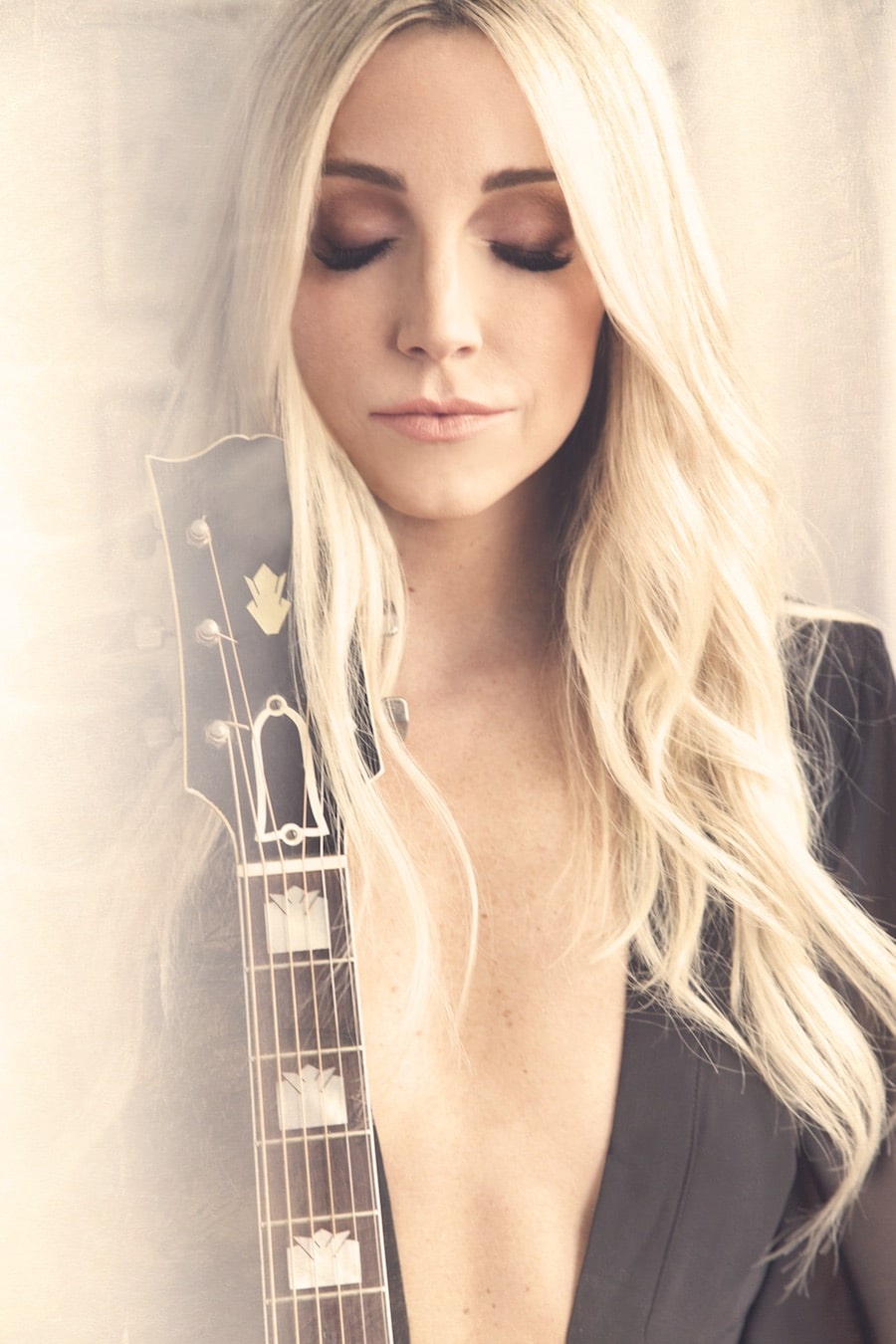
Ashley Monroe had been visiting her relatives and childhood stomping grounds in Knoxville in the East Tennessee mountains in 2016. As she drove back to Nashville with her husband, ex-Chicago White Sox pitcher John Danks, they came down off the Cumberland Plateau and saw the exit for Rockwood. Seeing that sign, she flashed back 17 years to when she was a 13-year-old girl and her mom had had a nervous breakdown at the very same exit. In her mind, she started singing to her mother, and the more she sang the more she realized that she had become her mother’s daughter.
Ashley was now a married woman with a thriving career, and by the time she got around to recording the song “Mother’s Daughter” for her new album, Sparrow, she would be three months pregnant with her first child, the now-10-month-old boy Dalton. For all that, however, she still carried her mom’s vulnerability, a temptation to flee from problems. She had long shied away from those traumatic events of her adolescence, but now it was time to face them. The exit sign had triggered something, and she started scribbling down lyrics as fast as she could.
“Songwriting is a gift,” Monroe declares; “I’m not in control of it at all. I get a feeling, and suddenly I have all these ideas I didn’t have three seconds before. I had got back from four days of intense therapy, grieving for my dad, which I had never done properly, and forgiving my mom, which I had never done properly. Things were stirred up, a lot of acknowledging past pain, so the songs came pouring out.”
The first thing that had emerged, even before “Mother’s Daughter,” was not a lyric but a melody that captured all the loneliness she’d felt back then. Her father had died from cancer when Ashley was 13, and her mother, now left single with two teenage children, was thrown for a loop. The older woman eventually recovered, but for a few years there, Ashley felt as if she were on her own. She found the refuge she needed in singing and songwriting. And here was a musical hook that brought that feeling back.
“I had that melody months before I had any words,” Monroe recalls. “It gave me chills, because it felt the way I felt as a girl. I grabbed my guitar and recorded it instantly. One morning before I had a writing appointment with Gordie Sampson and Paul Moak, I woke up with this melody strong in my head, and I knew I wanted to work on it that day. I’m unsure of who said what, but someone said the word “orphan.” That seemed right, and when Paul hit that chord for the chorus, it all melded together.”
Monroe hadn’t been an actual orphan, but she’d felt like one for a while, and now she was using the fictional devices of songwriting to get at a greater truth. The new album begins with a cello playing a somber melody over stark piano chords, and Monroe’s soprano, easy and tender even in its higher range, ponders, “How does a sparrow know more than us? When a mother is gone, it learns how to fly.” As a string section swells over a muscular electric bass, she shifts to the chorus: “Nobody told me what I should do when the world [started] to rumble and shake.”
It was instinct, the song implies, that led the 14-year-old Monroe to turn to music as a way to get through her teenage crisis, and it was instinct that led her to the songs on her new album. She co-wrote all dozen of the songs, but each song began with a melodic hook or a lyric catchphrase that came to her and resonated with some feeling that was hard to talk about — whether it was the complicated give-and-take between parents and children or the mysterious stirrings of physical desire.
“All the songs on this record started with an idea of mine,” Monroe explains, “because I had so many. I was so excited. I’d have this melody pulsing in my brain, and I’d call Waylon Payne, Brendan Benson or Jon Randall to come over right away so we could turn it into a song. I’ve been in this town for so long that I’ve found the writers who are just magic, people who aren’t afraid to be crazy and say anything whether it follows any rules or not. With them, there’s an energy in the room that just feels different.”
Monroe and Randall co-wrote “Hands On You,” the album’s first single, while she was pregnant. Nonetheless, it’s a steamy confession of regret that she hadn’t seduced a particular man when she had the chance. Over the spiky strings and choppy guitar of vintage R&B, Monroe purrs, “I wish I would’ve pushed you against a wall, locked the bathroom stall … I wish I was still half drunk, still tangled up.” Monroe, Payne and Benson co-wrote the similar “Wild Love,” another throbbing R&B reverie that describes sexual arousal as, “Under my skin, fire is risen, dangerous kind.” Ironically, marriage and childbirth have made Monroe more not less willing to explore carnal desire.
“I don’t know why those songs are coming out now,” she says, “especially at this time in life, but I’m more comfortable singing about things like that. I feel more like a woman, because I have a child and a husband, so I can sing about every aspect of being a woman now. I went to the airport, and this lady, a TSA agent my mom’s age, ran after me and said, ‘I love your song ‘Hands On You.’ A lot of women have told me that; they’re just happy to hear women sing about those things.”
When she had about 20 songs ready, she was ready to go into the studio. She wanted to record with Dave Cobb, Nashville’s omnipresent producer who’s worked with Jason Isbell, Chris Stapleton and Lori McKenna. Monroe barely knew him, but she knew the records he’d made.
“I loved his records,” she says. “They’re all different, but they all had this classic undertone. We went to dinner one night, and everything seemed so easy. He loves music like I do; that’s why we do what we do. He feels it and gets excited in the studio; I love that. He’s Southern like me, so the communication was so easy.”
It was during pre-production meetings that Monroe and Cobb settled on the sound of the record. She wanted that sultry groove of Shelby Lynne, who comes out of country music but spices it with a strong R&B flavor. Monroe was especially fond of Lynne’s I Am Shelby Lynne, the album that was her declaration of independence from Music Row, and Just A Little Lovin’, Lynne’s tribute to Dusty Springfield. Cobb readily agreed and suggested they reinforce that sound with live strings.
“We were listening to a lot of records,” Monroe remembers, “Glenn Campbell’s ‘Witchita Lineman,’ Elton John’s ‘Take Me To The Pilot’ and Waylon Jennings’ ‘MacArthur Park,’ and when the strings came in and it was ‘Bam!’ ‘Wow!’ Dave suggested we use strings like that, because they pull so much emotion out of the songs. When they were doing the strings on ‘Orphan,’ I had to hold onto the console because it was so intense.”
The result is a masterful work of adult emotions, a far cry from the dewy-eyed, round-faced 15-year-old Monroe who convinced her mom to move to Nashville in 2001. She was home-schooled in the mornings, and she visited clubs in the afternoon, asking the bands if she could sing a song with them. Her persistence paid off, and by 2005, she’d signed a publishing/recording deal with Sony Music.
The title track from her debut album, Satisfied, was released in early 2006, but it only made it to #43 on the country charts. A follow-up duet with Ronnie Dunn, “I Don’t Want To,” only made it to #37, and Columbia decided not to release the album. When it was finally released as a digital-only album in 2009, the impressive collection not only included spirited remakes of songs associated with Lucinda Williams and Kasey Chambers and a duet with Dwight Yoakam, but also seven co-writes by Monroe in the same spirit.
Monroe dealt with the non-release of her debut album by throwing herself into songwriting. She wrote with everyone she could, and she started getting cuts from the likes of Carrie Underwood, Jason Aldean, and Miranda Lambert. One of her frequent co-writers was Vince Gill, who’d been impressed by her even before she signed with Sony. He helped her get a new contract with Warner Bros. by agreeing to co-produce her next two albums: 2013’s Like a Rose and 2015’s The Blade.
“Vince has kept a watchful eye over me since he first heard me when I was 15,” Monroe says. “He’d always been one of my musical heroes, and then he became a friend. He always saw something in me that he believed in. When I made those two records with him, I finally felt I could breathe. He made my voice sound better than anyone. He’d play me an Emmylou record and say, ‘Listen, she doesn’t do a lick on every line; sometimes she just holds the note.’ Things like that helped me become the artist I am; he whittled me into this shape.”
Two more of Monroe’s co-writers during that 2006-2013 period between albums were the equally obscure Angaleena Presley and the blossoming superstar Miranda Lambert. The three women soon found that the give-and-take of co-writing was very different from that with their male collaborators. The three women gave each other permission to write things that women had always wanted to say but were discouraged from singing in public. That license led to songs such as “Takin’ Pills,” “Being Pretty Ain’t Pretty” and “I Feel A Sin Comin’ On.”
“I’ve been friends with Ashley for seven years when we were both on Sony,” Lambert told me in 2011. “She said, ‘You have to meet this girl Angaleena; we’ve written a great song.’ They played it for me and it was great. Before long we were singing together. I said, ‘Why don’t we turn this into a group.’ The feeling just came over me; the music was too good to not take it to the world. Fortunately, I have a manager that when I say, ‘This is a priority for me,’ she says, ‘Then it is for me too.’”
“When you get around other gals,” Monroe says now, “you can be honest. We’d say, ‘You feel that? I feel that too! Maybe other women want to hear that.’ Everyone’s obsessed with being perfect — pretty, smart and strong — and they forget what’s real. The thing about the Annies is how crazy it is that people can feel something individually from each of us but also something that none of us have alone. When we come together, it becomes something stronger.”
“It’s so awesome that this slumber-party project turned into a record that come out and went to number one,” Lambert added in 2011. “It gets lonely on the bus when you’re the only girl with all these guys for years. I was so happy when the Pistol Annies got on the bus too; not only are they girls but they’re amazing songwriters and singers. We’ll literally be on the bus painting our nails, talking about what girls talk about, and a line we’ll pop out. We’ll say, ‘That might be a song,’ and we’ll grab our guitars.”
The Pistol Annies released Hell On Heels in 2011 and Annie Up in 2013, but the increasingly busy solo careers of all three delayed a third album till this year. The three Annies are now writing for the next album, which they hope to record this summer and release later in the year.
“We’re all ready to make another record as the Pistol Annies,” Monroe confirms. “We hadn’t done it in so long, so when we got together we wondered if we still had the magic. We did, and we wrote four songs at our first get-together, one after the other. We’re still in the writing stage right now, but we’re not too far away from booking some studio time and some dates. Angaleena is a mom now, so she’s my mom friend as well and my wild artist friend.”
In the meantime, Monroe has a new solo album to be proud of. After years of shying away from the fall-out from her father’s death and her mother’s breakdown, she is confronting them head on. She addresses her feelings of abandonment on “Orphan” and her bittersweet inheritance as her “Mother’s Daughter.” But she celebrates the joys of motherhood on “She Wakes Me Up,” and ends the album with two songs, “Daddy I Told You” and “Keys To The Kingdom,” that thank her parents for encouraging her interest in music, which proved her salvation in difficult times.
“I was handed keys to the kingdom,” she sings. “I was given a haunted guitar. It made me sing every song it ever wrote.”
More Features
-
Garth Brooks, who had a major hit with the Dewayne Blackwell song "Friends in Low Places" -
Dave Matthews of Dave Matthews Band during Dave Matthews Band in Concert at CBGB's – 1992 at CBGB's in New York City, New York, United States. (Photo by Steve Eichner/WireImage) -

Tom Higgenson, who wrote "Hey There Delilah" for the Plain White T's -
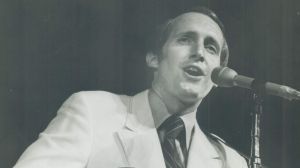
CANADA – SEPTEMBER 03: Country Singer George Hamilton IV (Photo by Harold Barkley/Toronto Star via Getty Images) -
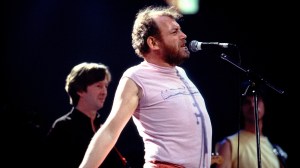
British musician Joe Cocker performs on stage during an ARMS (Action into Research for Multiple Sclerosis) Charity Concert, Dallas, Texas, November 27, 1983. In the background are fellow musicians Eric Clapton (left) and Jeff Beck. (Photo by Paul Natkin/Getty Images) -
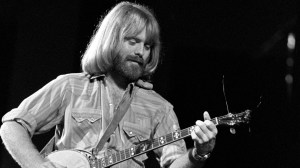
ATLANTA – NOVEMBER 12: Singer-songwriter Michael Martin Murphey (FKA Michael Murphey) performs at Symphony Hall on November 12, 1975 in Atlanta, Georgia. (Photo by Tom Hill/WireImage) -
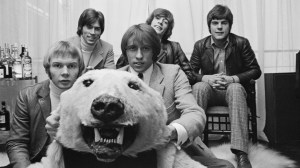
Pop group the Bee Gees posed with a stuffed polar bear in an office in London circa April 1968. Members of the band are, from left, Colin Petersen, Barry Gibb, Maurice Gibb (1949-2003), Robin Gibb (1949-2012) and Vince Melouney. (Photo by Ivan Keeman/Redferns)