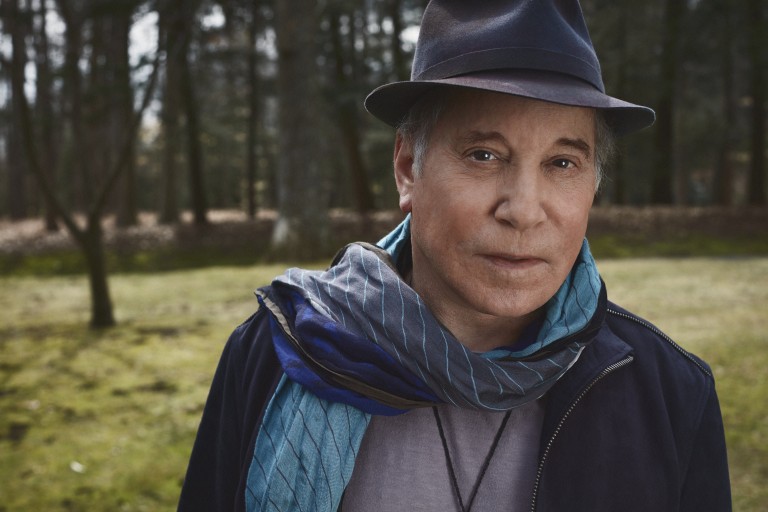
Paul Simon is dancing. With cajun accordion pumping to the fat zydeco groove of “That Was Your Mother,” from Graceland, Simon is exultant, stretching out the lyrics as he spins: “Dancing to the tunes of … Clifton … CHENIER!”
Rarely has this man, who once was considered dour and even called “Mr. Alienation,” ever been quite so jubilant. It’s the second night of four at the Hollywood Bowl on Simon’s farewell Homeward Bound Tour. Though proclaimed as Paul’s final tour ever, at no point did he seem ready to retire. At the center of a band as big as a small village, Simon seemed more relaxed, happy and in the groove then ever.
“Hello friends!” he said smiling with arms outstretched here at the historic Hollywood Bowl where he’s performed many times over the years, and once on tour with Bob Dylan. With an exceptional and expansive band, augmented by the orchestral sextet yMusic (a string trio with clarinet, flute and trumpet), Simon fluidly covered and merged all the various musical journeys on which he’s been for these past decades. Not only did we get early Simon & Garfunkel classics such as “The Sound of Silence,” “The Boxer” and the transcendent “America,” with which he opened the show, he also led us through all the famous chapters of his life, as well as some lesser-known ones. These included “Rene & Georgette Magritte With The Dog After The War,” from Hearts and Bones, and “Can’t Run But,” from Saints, both of which were beautifully realized with yMusic.
His songbook, which always contained depth and brilliance, has expanded over the decades in terms of sheer exuberance and joy.
He was relaxed and funny all night long. After welcoming the crowd he explained, as if letting us in on a secret, that he always loved second night audiences more than the first. “The first night is always about those first-nighters being there, getting their tickets. They’re not really music-lovers. But you second night audiences, you’re all about the music.”
By merging most (though not all) of his famous songs with many gems rarely performed in concerts, the evening went a long way in expressing the fullness of this one man’s remarkable songwriting journey. Unlike so many great artists who began in one musical place and never left, Simon has been around the musical globe many times. Though long known as a folky for his frequent proximity to an acoustic guitar, he wrote rock and roll such as “Red Rubber Ball” and “Hey Schoolgirl” before ever composing folk-rock classics like “The Sound of Silence” or “The Boxer.” Always hungry to expand his songs musically and lyrically, as well as the production and sonics of his records, he traveled around the world tirelessly to find fresh musical ideas. On Bridge Over Troubled Water, he first expanded his opus with “El Condor Pasa,” wedding his lyrics with the Peruvian music of the group Urubamba. On his first solo album he created the mysteriously poignant “Mother and Child Reunion” by going to Jamaica for an authentic ska rhythm and spirit long before reggae was big in America. That was just the start – he also went to the roots of American music, to Muscle Shoals, to New Orleans, to gospel and Chicago soul, to New York jazz, and beyond.
From there the journey never really stopped, it just kept expanding, and all these global streams merged in his ever-expanding songbook. Then came “Late In The Evening” with its big street-party vibe and celebration of music wed to a Latino horn-section hook written by Dave Grusin (who first collaborated with Paul on the soundtrack to The Graduate). Then of course came the rhythmic and sonic expansions of Graceland and The Rhythm of the Saints, merging a whole new dimension of world music to Simon brilliance, and his songbook – and concerts – expanded profoundly.
All his concerts in recent years have reflected this great range, and have been exultant with so many of those celebratory, upbeat songs, and more. From this once tender folky, we now get concerts which are sparked throughout, and which culminate, with all the inspirational vigor of a Springsteen show.
Much of the beautiful intricate guitar grace of his music over the last decades has been due to the presence of Vince Nguini, from the Cameroons, who died earlier this year. Since Vince’s beautifully etched guitar parts, which sparkled over all the recent records and concerts with a distinctive and delicate shimmer, were such a rich and consequential element of the Simon sound, how Paul would replace him remained an open question. His style, after all, was African, and removed from conventional American approaches to guitar. Though using standard tuning, Vince had an alternate universe of chord voicings and rhythms which has delighted Simon for decades, creating a beautifully elegant and exotic counterpoint to Simon’s guitar parts. Although Graceland and its great follow-up The Rhythm of the Saints were created by first recording tracks with musicians in Africa and Brazil before coming home to make songs out of them, for subsequent albums Paul mostly made these tracks at home. His secret weapon was Vince, who brought as much guitar magic in New York as in the Cameroons, as well as his constant vibe of blissful calm. How would Paul continue without him?
That problem was solved handily with the discovery of Biodun Kuti, a remarkable young guitarist from Lagos, Nigeria, who played all of Vince’s parts with joyful fidelity, and also let us hear – with big, beamish pride – bold riffs and electric leads very much his own. When it comes to finding musicians of the highest artistry and with genuine reverence for music, Simon’s always been brilliant.
That brilliance shone brightly all night.
Merging the remarkably intense rhythmic duo of drummer Jim Oblon and percussionist Jamey Haddad, who cook up every groove to fiery levels, with the expansive jazz flourishes of Mick Rossi on organ and piano, the vivid accordion exuberance of Joel Guzman, the horn section, and yMusic, all anchored by the phenomenal fluid bass of Bakithi Kumalo (who has been with Paul since Graceland), this was an immense but graceful musical engine that could go anywhere musically, and often many places at once.
The mighty Mark Stewart acted as the captain of Paul’s giant ship, and also looks like an old ship’s captain with his long hair and giant Victorian sideburns. The man makes an impact. He’s also a remarkably diverse musician of multitudes who holds down many guitar parts and vocal harmonies as well as saxophone, cello and maui xaphoon. On the song “Rewrite” (from So Beautiful or So What), which is based on a repeating, very fast guitar line that seemed to have been sped up on the record, Stewart played the part precisely four times to launch the song. As Paul once said, a lot of his songs have elaborate guitar parts that are hard for him to do live while singing. “So I can always give those to Mark,” he said. “He can play anything.”
Since 1969, when Paul realized his guitar-born ballad “Bridge Over Troubled Water” would sound best with a piano at its center instead of guitar, he’s worked with great keyboardists. But few have brought as much miracle and wonder to his music as Mick Rossi, who can play perfectly the famous parts from records, but also brings his own dimensional brilliance to everything. On piano, electric piano, organ, harmonium, celeste, percussion, and a beautifully dreamy expanded solo on prepared piano (an acoustic piano that has its sound altered by objects on or between its strings).
For example, in the super-charged globally-inspired song epic “The Cool, Cool River,” with its African and Brazilian rhythms and guitar parts intertwined with Simon’s singular voice and poetry, as well as on “Mother and Child Reunion” and “You Can Call Me Al,” Rossi burned with improvisational jazz lines on piano and organ. The result was a remarkable and sometimes dizzying rainbow of homespun and world music combined, connecting American folk and pop with New York jazz, funk, African, Brazilian and more. And it worked. Though Paul never claimed to be fluent on the musics of other countries, he said he could speak “broken music” and connect, with passion, all those streams of music into one very cool river.
One of his most explosive and expansive songs, “The Cool Cool River” is an absolute songwriting tour de force, and was performed with an intensity that matches the simmering rage of the lyric: “Moves like a fist through traffic/anger and no one can heal it…”. With his voice as vigorous as ever, Paul powerfully punched out the lyrics with fierceness, landing on a hopeful and loving resolution: “I believe in the future/we may not suffer no more/ maybe not in my lifetime, but in your’s, I feel sure…”
Andy Snitzer, who plays saxophones and flute in the band (and previously played with the Rolling Stones), is always great live, but on this night was on fire. When it came to his moment to play the famous sax solo after the famous bridge of “Still Crazy,” played on the record by Michael Brecker, he lit into it with an amazing intensity. Starting with the same notes as the record, delivered with an almost religious fervor, he soon soared off. It was exceptional, and the crowd felt it, cheering even before it was done.
As mentioned, Simon delivered several songs rarely performed in concert, such as “Rene and Georgette Magritte” from Hearts and Bones, one of those ingenious songs so singularly suited to Simon. Mysterious, surreal, historic, funny, and dimensional all at once, and wrapped in a beautifully plaintive folk-jazz melody, it’s a song which is essential Simon.
He even made fun of its singularity. Famously happy to poke fun at himself (remember him in the turkey suit singing “Still Crazy” on SNL?) he mocked his own inclination to write songs with such bizarre and unlikely titles and subjects. Of course, this inclination is nothing new. He wrote the singularly elegiac “So Long, Frank Lloyd Wright” back in 1969. He’s been on his own turf for a long time.
“Now I’d like to do a song with one of the strangest titles ever,” Simon said. “Rene and Georgette Magritte with their Dog after the War.” The crowd roared, and Simon said, with a laugh, “I love how you said ‘yeah!’ As if that makes perfect sense.” [Big laughter].
He then explained its origins.
He saw a photograph in a book of the artist Magritte at Joan Baez’s house. “And the caption on that photo,” he said, “was `Rene and Georgette Magritte with their Dog After The War.’ And I said to myself, ‘What a great title for a song!’ [Huge crowd laughter]. I said, ‘What could that song possibly be about?’ It’s a surrealist painter so maybe it should be a surrealist song. So maybe I’ll put in four of my favorite old R&B vocal groups from the ’50s, The Penguins, The Moonglows, The Orioles, The Five Satins. I’ll just mix them in and make a song. And that’s what we’re about to play.”
Then in a hushed setting, yMusic became a small mini-chamber orchestra sitting in a semicircle. They matched with haunting, soulful precision every guitar part and rhythmic accent and guitar as Simon, in the center, delivered this surreal song with loving and focused purity. It was stunning. yMusic, which is made of C.J. Camerieri on trumpets, french horn; Rob Moose on violin, Hideaki Aomori on woodwinds, Nadia Sirota on viola, Gabriel Cabezas on cello and Alex Sopp on flutes, then joined him on another mysteriously compelling and often unsung song, touching on the impact of the Chernobyl disaster, “Can’t Run But.” On “The Rhythm of the Saints,” its tapestry of polyrhythms spelled out with amazing layers of percussion and guitars. Here the orchestral instruments played all those interlocking rhythmic parts, and the result was extraordinary, as was Simon’s passionately pointed delivery.
Several of his songs which were never hits have become concert highlights. “The Obvious Child” is the perfect example. Another mysterious and rhythmically-compelling song, it was originally recorded to the exotic, thundering drumming of the Brazilian bloco-afro group Olodum. It’s a rhythmic groove which is big – bigger than rock and roll, even – it starts rolling and won’t stop, and even speeds up in tempo. On this night it was so fun for both band and audience that Simon asked if they should do it again. The crowd roared with approval, and they did it over. Wonderfully. It was that kind of night.
He bookended the concert with two essential American songs, the first, as mentioned, was the hopeful “America,” which is maybe his most beautiful song ever. And towards the end came the the sobering, elegiac “American Tune,” which was stunning, yet so sadly connected to the reality of present-day 2018 America, all these years beyond the season of its creation. Those lines of resignation, written decades earlier, struck home more than ever, that no dream lasts forever and we have no choice but to keep going: “It’s alright, it’s alright, you can’t be forever blessed/ still tomorrow’s gonna be another working day and I’m trying to get some rest…”
Yet, that sorrow was replaced profoundly by the cumulative joy generated by this concert and this extraordinary band. That songwriting and musicianship on such an elevated artistic level still not only exists, but flourishes with such genuine passion and love, is truly inspirational, and a good reason to rejoice. Also, the good news which is that Paul is not retiring entirely from music, only from doing immense tours like this one. He’s got a new album coming out in September. This remarkable journey, fortunately, is not over yet.
Most Viewed
-
UNSPECIFIED – JANUARY 01: Photo of Jessi COLTER; posed, (Photo by Charlie Gillett Collection/Redferns) -
Beatles tour of USA 1964. Left to right: Beatles members Ringo Starr, John Lennon, George Harrison and Paul McCartney wave to fans prior to boarding their plane at London airport for their tour of USA. 18th August 1964. (Photo by Eyles/Daily Herald/Mirrorpix via Getty Images) -
1967: Superstar group "Buffalo Springfield" pose for a portrait in 1967. (L-R) Stephen Stills, Neil Young, Dewey Martin, Richie Furay, Bruce Palmer. (Photo by Michael Ochs Archives/Getty Images) -
NEW YORK – CIRCA 1979: Musician John Lennon and his wife artist Yoko Ono walk down the street in circa 1979 in New York City, New York. (Photo by Michael Ochs Archives/Getty Images) -
UNITED KINGDOM – JUNE 01: (left to right) Boz Burrell, Paul Rodgers, Simon Kirke and Mick Ralphs of Bad Company perform on the BBC television show 'Top of the Pops' in June 1974. (Photo by David Redfern/Redferns)