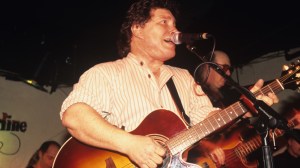
Grammy Award-winning musician Victor Wooten can distill his unique talents down to one simple skill. The artist, who has won five Grammys, published acclaimed books, toured the world, taught at both prestigious universities and summer music camps, says one thing amongst all of his attributes has led to the reality of these accomplishments: listening.
Wooten, who made his classical music debut with the Boston Symphonic Orchestra over the Halloween weekend, released his latest book, The Spirit of Music: The Lesson Continues, earlier this year in February. For the renowned artist, listening is the key to conversation, and indirectly to creative prosperity. The more you listen, the less you need to say; if you listen you can talk to anyone. But the idea is about active listening. And that’s what, Wooten says, is leading him in part to undertake more teaching engagements amidst his busy tour schedule, which had him in Seattle, Washington over the November 5 weekend.
Videos by American Songwriter
“I have a lot of things I still want to do in life, musically,” says the 57-year-old Wooten. “A few more books, more music camps, and hopefully a lot more teaching.”
Perhaps as much as any artist, the Idaho-born Wooten is mystical; as much a Jedi as a jazz player. He is both calm and open, as well as wise and experienced. The root of this composure likely comes from the fact that, as Wooten says, he was quite literally born into a band—his family. As an infant, he was born into a family of musicians. His three oldest brothers, who were already regularly playing even though the eldest was just eight years old, had chosen Wooten’s path, he was to be a bass player.
“My path was chosen for me,” Wooten says. “And I’m very happy about that.”
Only two years separate those older Wooten brothers, Reggie, Roy, and Rudy. Reggie played guitar; Roy, who would later join Victor in Bela Fleck’s band, drummed; Rudy played Sax. Joseph, a fourth older brother who was a bit younger than the eldest three, had also started to play keys. All they needed was the low end and that’s where Wooten came in. Wooten says he was happy about the bass assignment. For him, music is like language. Just as infants enter their families and pick up language (without knowing any formal grammatical rules), he learned and picked up music.
“I’m two and Reggie is 10,” Wooten says, remembering the early, early years. “He’s a grown man, in my mind. And here’s my chance to be grown with them. I learned early on before I even knew what I was learning.”
If his brothers had spoken Russian, he might have picked that up instead. Or if basketball or football had either been the family focus, so to speak. But it was music, and in this way, Wooten says, the instrument was almost insignificant. It was bass and that was fine; he was born with it like he was born with vocal cords or fingers. Though, Wooten remained unique about how he approached it. He wasn’t the type to labor in a bedroom alone, scratching out ideas or stumbling over techniques. Again, he equates it to learning to speak one’s native tongue.
“When you were learning to speak English,” Wooten says, “how much did you sit in a room and practice? Very little, if any. The goal wasn’t to get ‘better’ at English—it was, how can I express this?”
With the family band, Wooten learned pieces of music if that’s what a given job, like a wedding, required. But he wasn’t sitting there like an athlete in the weight room for 12 hours a day. Instead, he was playing. Learning his own voice, where he liked to go, and what he could bring to the proverbial game. Later in life, with a foundation of his own personal expression, he began to study scales and such. While Wooten knows that theory is necessary at some point in one’s musical journey, it’s not what should be inundated at the outset of a child’s entry into art.
“We’re always making young musicians learn our stuff,” he says, “what we want them to learn.”
When people speak or play music, they are invariably expressing ideas, Wooten philosophizes. And if that’s the case, then they are expressing flashes of the mind—but what are those? Now, he says, the conversation lands on the subject of the mind, the essence, the spirit of a person. Wooten, who was featured on a prominent live album from Dave Matthews Band in the early aughts (see below) and has long played with Bela Fleck and the Flecktones, has become a well-known improviser and composer as a solo artist, too. Collaboration, he says, is about sharing unique voices, together.
“Our voices are different,” Wooten says, “that’s what makes a band better. Different voices. Dave [Matthews] doesn’t bring me on stage to sound like anyone else but me.” He adds, “When you sound like you so well people will love it—people will at least take note.”
For Wooten, individuality is crucial. We are all unique, from plants to animals. We’re born that way; the trick is listening to yourself and discovering it fundamentally. The beauty of that is that you can do it every day, like a blossom blooming over and over again. What helps is being around people with whom you can exchange ideas. That’s a major reason Wooten enjoys teaching. The endeavor, he says, is taking precedent on his personal to-do list.
“The future to me looks bright,” Wooten says. “I’m seeing young musicians in single digits—8, 9 years old—playing things I can barely play. That lets me know the music is safe. But these young people need experience. They can imitate the same way a child imitates how his parents talk. But I want to make sure they have good things to imitate. Because us adults can act silly sometimes; we storm capitals if we don’t get our way.”
Wooten quotes his mother, who was fond of saying, “There are enough people leading the way down but not enough people leading the way up.” Wooten says he aspires to be one of those upward heading folks. She would also say, “What does the world need with just another good musician? What the world needs is good people.” As such, Wooten cares about those essential aspects of a person’s—his—spirit. If you listen to that, everything else will follow in harmony.
“Music brings people together,” Wooten says, “without force.”
(Photo courtesy LPC Media)
Most Viewed
-

SAN FRANCISCO – NOVEMBER 25: (L-R) Richard Manuel, Dr. John, Neil Diamond, Joni Mitchell, Neil Young, Rick Danko, Van Morrison, Ronnie Hawkins, Bob Dylan, Robbie Robertson and Eric Clapton perform onstage for the rock and roll group "The Band's" "The Last Waltz" concert at Winterland Ballroom which was later turned into a film by Martin Scorsese on November 25, 1976 in San Francisco, California. (Photo by Michael Montfort/Michael Ochs Archives/Getty Images) -
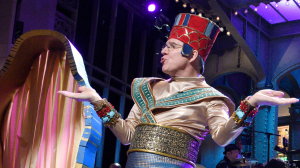
These 1970s parody songs beat all the "real" music on the charts. They blurred the lines between fake song and true hit. -
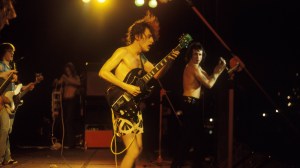
AUSTRALIA – JANUARY 01: Photo of AC DC and Angus YOUNG and AC/DC and Mark EVANS and Bon SCOTT; Mark Evans, Angus Young (playing Gibson SG guitar), Bon Scott – performing live onstage, c.1975/1976 (Photo by Bob King/Redferns) -
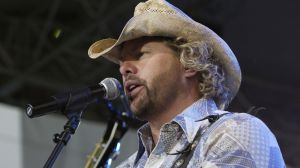
THE TONIGHT SHOW WITH JAY LENO — Episode 2947 — Pictured: Musical guest Toby Keith performs on June 8, 2005 — (Photo by: Paul Drinkwater/NBCU Photo Bank/NBCUniversal via Getty Images via Getty Images) -
UNSPECIFIED – CIRCA 1970: Photo of Don Gibson Photo by Michael Ochs Archives/Getty Images -
Motown singing group The Supremes perform on a TV show circa 1964. (Photo by Michael Ochs Archives/Getty Images) -

Blake Shelton and Gwen Stefani