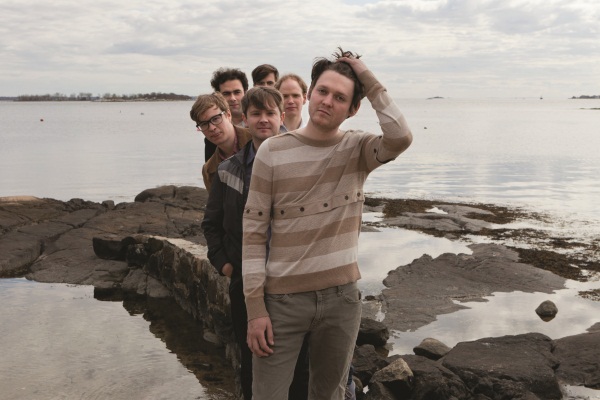
Beirut, the band born out of the bedroom of Santa Fe teenager Zach Condon in the early 2000s, has come a long way fast. The night after I spoke with Condon by phone from his hotel in Belgium, where he was situated for a European press junket, Beirut played a show with Arcade Fire in London’s Hyde Park. (“I didn’t know [it was happening] until an interviewer mentioned it this morning,” admitted Condon, who says he’s notorious for not paying attention to schedules.)
While 2007’s Gulag Orkestar put Beirut on the map with its charming lo-fi production, catchy songwriting, and obvious nod to Eastern European folk music, the group’s new album, The Rip Tide, is what Condon classifies as “the Beirut sound crystallized into its purest form.”
“I’ve always had a fascination [with Europe],” says Condon. “I never meant to be an ambassador for Balkan music or French music. At the core of my music, I was always writing very American pop music. I was just using all these different palettes to keep it interesting.” So instead of the eight multi-tracked trumpets that bay out at the start of Gulag, The Rip Tide’s brass is more like the clean, simple lines you’d hear in a Motown song.
Condon first started recording music after his brother left for college and bequeathed him a Fostex four-track. He bought some Oberheim organs, a BOSS DR-202 Dr. Groove sampler, and a desktop Mac with Pro Tools and a soundcard in the back that you plugged two RCA cables into. He started trying to cure his teenage insomnia by recording late at night.
On Gulag, Condon enlisted A Hawk And A Hacksaw (and former Neutral Milk Hotel) multi-instrumentalist Jeremy Barnes to play drums in the studio, and got fellow Elephant 6 acolyte Griffin Rodriguez to mix the album. It was the first time Condon had seen the inside of a studio.
“I remember I was obviously very nervous and very excited,” says Condon. “They were miking the drums and every time we did takes it felt wrong. I had to convince [the engineer] – and, trust me, it was difficult because I’d never been in a studio before and he obviously knew that – but I walked into the room and took two microphones and placed them five feet away from the drums at waist-height. And it sounded amazing. It sounded so raw and real. It’s something that we’ve done ever since.”
Condon and Rodriguez, who fronts Chicago-based Icy Demons and was a member of the free-jazz group Bablicon with Barnes, have been recording partners ever since, and continue to employ Condon’s drum miking technique.
After Condon finished writing the songs for The Rip Tide, he convened Rodriguez and the rest of Beirut for two weeks at Old Soul Studios, a recording studio in upstate New York. Condon would sit at the piano while the rest of the band gathered around him and they’d go through one song a day from one in the afternoon until five in the morning.
“I spent so many years multi-tracking. You get one person in [the studio] and you wait ‘til they get the right take and you move on. But when everyone is playing, you always get these subtle variations.”
“I started with purely electronic, then moved somewhere in the middle,” Condon says about the evolution of the Beirut sound. “Around Gulag, I split completely and did the entire thing [acoustically]. There’s a drum machine behind some songs but it’s very subtle. [On The Rip Tide] I’m trying very hard not to rely on electronics as the rhythm section. I want the rhythm section to be totally natural.”
There is one song, “Santa Fe,” with its warm electronic opening beat, where Condon’s original demo served as a foundation for the other parts.
“I was visiting my parents and they kept my old bedroom exactly as it was,” he says when asked about the song’s origin. “There were two organs, a Farfisa and this other brand, and then a piano on the other wall, and a few other instruments lying around. I was playing with those organs and I got that repeater melody going. The organ has a program where you can hold down the drum machine and the chords at the same time.”
But, true to the acoustic purist in him (then as now), Condon says if he could play just one instrument for the rest of his life, it’d be an upright piano. “What would keep me entertained the longest and has the most versatility? I would have to say piano. It defines music for me.”