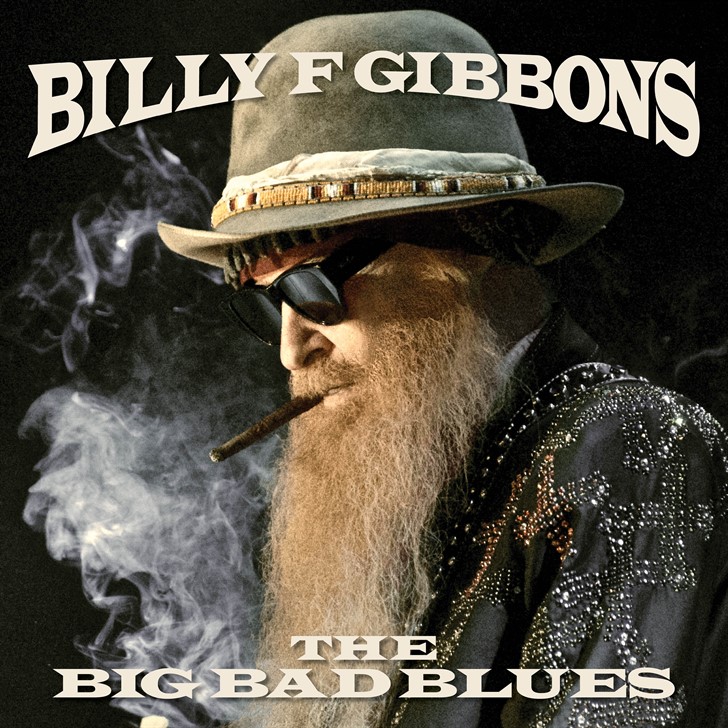
Billy F. Gibbons
The Big Bad Blues
(Concord)
Rating: 3.5 out of 5 stars
ZZ Top has never strayed far from the blues. Even in their slick, synthesizer-enhanced MTV “Gimme Me All Your Lovin’” days, the band always kept “one foot in the blues,” even naming an album that way. So it’s little wonder that Top’s iconic frontman/singer/guitarist Billy F. Gibbons would revert to that straight-ahead Chicago sound when given a chance to follow up his successful 2015 solo debut. It’s only surprising this set of covers and originals didn’t happen sooner.
Perhaps the idea was sparked by the Rolling Stones, whose 2016 Blue & Lonesome found Mick, Keith & the boys also digging back to their roots with startling commercial and artistic success. Like them, Gibbons isn’t trying to reinvent the genre wheel here. Why should he? After all, Top’s first major hit “La Grange” was little more than an amped up John Lee Hooker-styled boogie retread. But even though there are no surprises in the straightforward approach to this purely American art form, Gibbons more than acquits himself. Between his instantly recognizable swamp-drenched guitar and raspy vocals that have always seemed as if he gargled with the grimy mud of the Mississippi delta, Gibbons dives head-first into covers from Bo Diddley and Muddy Waters (two each), and cranks out a bunch of originals with the passion and low-boil intensity that has kept his band relevant for nearly 50 years.
There’s as much subtlety to simplistically titled songs like “My Baby She Rocks,” “That’s What She Said” and the opening “Missin’ Yo’ Kissin’” (a rare writing credit for Gibbons’ wife Gilly) as the music behind them, which isn’t much. But with a crack band that includes harmonica ace James Harman and producer/bassist Joe Hardy, the music breathes and pulses with the dark swagger that characterizes the finest blues. Go to any beer joint in your town and you’ll hear similar riffs played by local musicians, trying their best to pay tribute to the lowdown gutbucket approach found on Chess, Delmark and Cobra record labels in the ’60s. But you won’t hear the authority and sheer loose-limbed ability of these 11 performances.
Sure, no one’s going to best Muddy Waters at his own game. Yet Gibbons’ versions of the staggering slow beat of Waters’ “Standing Around Crying” and classic “Rollin’ & Tumblin’” (given a shot of frantic Johnny Winter-ized adrenaline), are as vibrant and truthful to the music’s organic spirit as any of the dozens of covers generated of these tunes throughout the decades. The Latin rhythms of Diddley’s “Crackin’ Up” closes the proceedings on a frisky note, lightening the vibe while maintaining the grimy mojo that has typically seeped out of Gibbons’ bearded pores. When he digs into the grunge of “Mo’ Slower Blues,” there’s a gutsy filth to the attack that can only be generated by Gibbons’ dusky voice and grinding guitar.
He’s clearly infatuated with this raw sound and, like the Stones, at this late stage in his career, isn’t concerned with moving units or getting radio play. All of which speaks to the honesty and love of blues exuding from every track on this heartfelt tribute to the music that has always inspired Billy Gibbons’ best work.