Bill Black — who pioneered the distinct “slap bass” technique that helped define Elvis Presley’s early sound — would have turned 100 years old today. Born September 17, 1926, in Memphis, Tennessee, Black made up one third of the King’s Blue Moon Boys trio alongside Presley and lead guitarist Scotty Moore.
After leaving the Blue Moon Boys in the 1950s, Black joined a group of musicians which became Bill Black’s Combo. With them, he recorded more than 20 albums, toured the United States and Europe, and won awards as the best instrumental group in America in 1966 and 1967.
Videos by American Songwriter
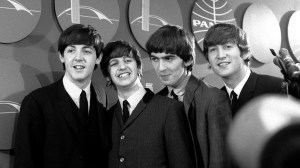
Bill Black was just 39 years old when he died of a brain tumor on October 21, 1965, in Memphis. However, a piece of the rock-and-roll icon plays on today, as ex-Beatle Paul McCartney received his main stand-up bass as a birthday present from wife Linda in the 1970s.
Today, we’re exploring the life and legacy of Bill Black.
Remembering Bill Black
The oldest of nine children, music was an early fixture in William Patton Black Jr.’s life. His father, a motorman for the Memphis Street Railway, entertained the family by playing popular songs on the banjo and fiddle.
When he was 14 years old, Bill Black Sr. fashioned an instrument from a cigar box with a board nailed to it and strings attached. It was on this makeshift creation that Black Jr. first learned to play music.
By 16, he’d graduated to a real guitar, often performing honky-tonk music at local bars.
Black met wife Evelyn while stationed with the U.S. Army in Fort Lee, Virginia. They married in 1946 and returned to Memphis, where Black worked at a Firestone plant.
The “Slap Bass” Technique
In the 1950s, Bill Black began perfecting his famous “slap bass” style on the upright double bass. He modeled this technique after his idol Fred Maddox, of Maddox Brothers and Rose.
Taking another page from Maddox’s book, Black cultivated a “stage clown” persona, performing as a hillbilly with blacked-out teeth, a straw hat and overalls. He would carry this sense of irreverence into his time with the Blue Moon Boys, pumping the crowd up before Elvis took the stage.
The Blue Moon Boys
In 1952, Bill Black began playing clubs and local radio stations with guitarist Scotty Moore. Two years later, Sun Records founder Sam Phillips asked them to play backup for an unknown artist named Elvis Presley.
While the young crooner didn’t make much of an impression on either Black or Moore, both agreed to one studio session. So they met at Sun Records on July 5, 1954, to test their chemistry.
The session wasn’t going particularly well, so they decided to take a break. Presley used this down time to “act the fool”, singing Arthur Crudup’s “That’s All Right (Mama)”. The other two musicians joined in, and Phillips taped the song.
“Damn,” remarked Black. “Get that on the radio and they’ll run us out of town.”
Reconvening the next day, the trio recorded four more songs, including Bill Monroe’s “Blue Moon of Kentucky”. (And yes, that’s where they got their name.)
At Black’s initiation, they transformed the mellow waltz into an uptempo blues-rock number that soon surpassed the original on the charts.
Over the next 15 months, the trio released five singles, toured across the South, and performed regularly on the Louisiana Hayride program.
In addition to playing upright bass on tracks like “Jailhouse Rock” and “Heartbreak Hotel”, Black hammed it up onstage, developing comedy routines with Presley.
“That was necessary for us because we played for a lot of country crowds that weren’t used to people jumping up and down on stage,” drummer DJ Fontana said.
His Post-Elvis Career
The rest of his success came with the Bill Black Combo, which he formed in the late 1950s. The band’s 1959 instrumental “Smokie” sold more than 1 million copies and reached number 17 on the pop chart.
With that group, Black had several other instrumental hits, including the top 10 hit “White Silver Sands”.
In 1964, Bill Black’s Combo opened for the Beatles on The Ed Sullivan Show. Tragically, Black died the following year during a third operation that doctors hoped would permanently eradicate his brain tumor.
Featured image by Michael Ochs Archives/Getty Images
-
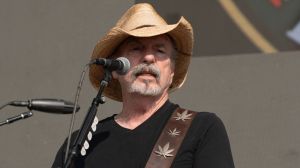
TWIN LAKES, WISCONSIN – JULY 20: David Bellamy of the Bellamy Brothers performs onstage at Country Thunder Wisconsin on July 20, 2024 in Twin Lakes, Wisconsin. (Photo by Joshua Applegate/Getty Images) -
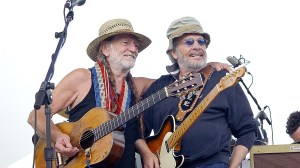
Merle Haggard and Willie Nelson -
Screenshot from Jessidaniel / YouTube -
July 1967, California Beach Boys L-R: Wilson, Al Jardine, Brian Wilson, Mike Love, Dennis Wilson