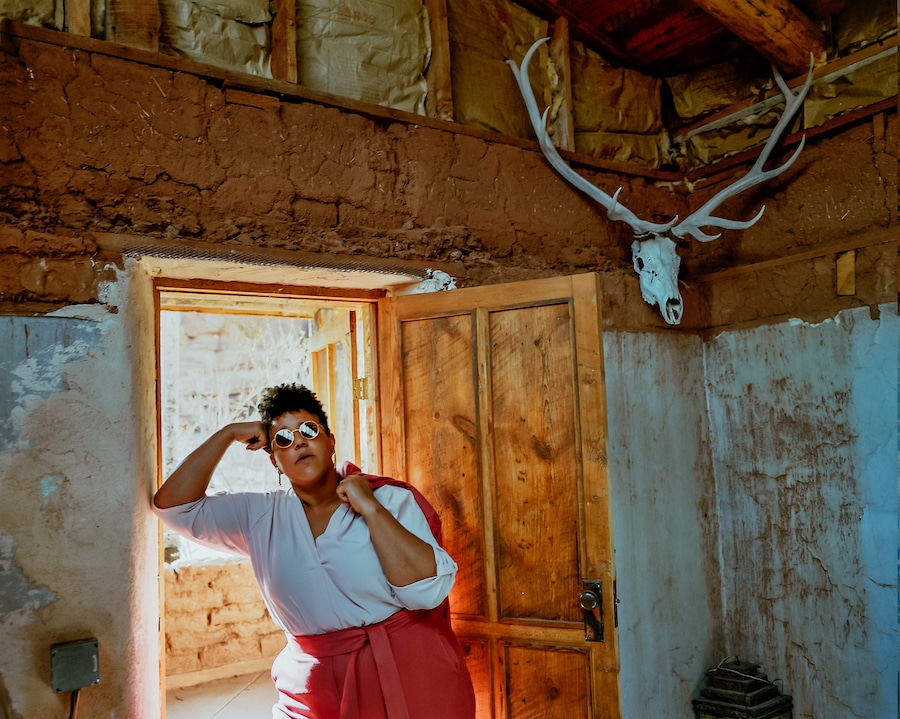
During the summer of 2018, the Alabama Shakes’ lead singer Brittany Howard decided to leave Nashville, where she’d been living, and drive to Topanga Canyon, just west of Beverly Hills. As she drove cross-country with her girlfriend, she saw rundown trailer parks and boarded-up storefronts but also “huge pink mountains, seemingly endless lakes, soaring redwoods and yellow plains that stretch for thousands of acres.” Howard was a few months shy of 30, and the empty landscape allowed her to contemplate the next stage of her life.
“My partner was asleep in the front seat while I was driving,” she remembers, “and I asked myself, ‘Okay, what do I want to do next? An Alabama Shakes record? A Thunderbitch record? A Bermuda Triangle record? I decided, ‘No, I want it to be a ‘me’ record. I want to be in charge and say what I want to say.’”
Videos by American Songwriter
Since the last Alabama Shakes album, 2015’s Sound & Color, Howard had released a 2015 album as a member of Nashville’s punk-rock garage band Thunderbitch and three singles in 2017-2018 as a member of the female folk trio Bermuda Triangle with Jesse Lafser and Becca Mancari. She had contributed tracks to John Legend’s Darkness And Light, the soundtrack from Joy and American Epic: The Sessions. But it all seemed like low-profile side projects after winning four Grammys with the Shakes. But before she could return to the band that made her famous, she had to do a solo album to sort out some issues for herself. She calls it Jaime.
The record is named after Brittany’s older sister, the one who showed a four-year-old girl how the social stigma of having a black father and a white mother can be flipped from disadvantage to advantage through music. Jaime turned her kid sister onto Prince and Elvis Presley, encouraging her to sing and play guitar like they did to express her feelings. She eventually discovered that her background gave her “a duality of perspective,” a broader perception of the world than most. And that duality is what she wanted to explore on a solo album before returning to a band format.
“I’ve been poor; I’ve been rich,” she says. “I’ve been in straight relationships; I’ve been in same-sex relationships. I’m half-white, and I’m half-black. I’ve lived in the South, and I’ve lived outside the South. So I have a duality of perspective on the world. When you’re like that, it can be hard to describe your identity to other people, because they don’t want to accept that you can be everything.
“Some folks like to live in a box where a lot of people are, because there’s safety in numbers. It’s a place where a lot of people will say you’re doing it right, because you’re doing it like everyone else. Some people, all they want is the car, the house, the $900 hoodie. But I wasn’t like that, and sometimes that felt lonesome. But I found there are other folks who don’t want to live in those boxes, and we tend to gravitate to one another.”
Howard created her newest songs the same way she built her earliest efforts: one track at a time on her home computer. These days she uses the Logic software program plus a variety of outboard gear such as the Distressor. That’s a compressor that crunches the sound to a tiny, highly distorted signal. “It sounds real trashcan,” she says, “but it sounds good to me.” She manipulated that until she had a drumbeat she liked, then added a guitar part. Then it was time to add some lyrics.
“‘How funny would it be,’” she asked herself, “‘to celebrate not going to church for a positive reason?’ I listen to a lot of music, and people do a lot of the same topics. So I ask myself, ‘What haven’t I heard before? What would I like to hear? What would make me keep listening to the end of the song?’”
The finished track, “He Loves Me,” opens with the aforementioned drumbeat and guitar part underneath a sample of an African-American preacher berating those who miss church. Then Howard sings sweetly over multi-tracked Laurel Canyon harmonies, “I don’t go to church anymore; I know He still loves me … when I’m smoking blunts, loves me when I’m drinking too much … He doesn’t judge me, yes, He loves me.”
“He Loves Me” combines the garage-rock thrash of Thunderbitch and the feathery female vocals of Bermuda Triangle to sound unlike anything Howard has done before. Recreating the drum track is jazz star Nate Smith. Recreating the bass line is Zac Cockrell, the first person to join Howard in what became the Alabama Shakes. Playing and singing everything else is Howard herself. This trio is the core of most tracks on the album, though keyboardists such as Nathan Horton, Lloyd Buchanan and jazz star Robert Glasper often join in.
“I don’t know how you can be into music and not be into jazz,” Howard says. “I grew up on Louis Armstrong. I’m big into Charles Mingus. Nina Simone introduced me to Betty Carter. I find out about new artists the old, natural way. I’ll be hanging out with someone and say, ‘Have you heard Christian Scott aTunde Adjuah?’ They’ll say, ‘Yes, but have you checked out so and so?’”
It is also one of many attempts on the album to make sense of her duality. She may be alienated from the church, but she’s not alienated from God. The world may see her as black, but she has a white mother and white bandmates in three different bands. The world may see her as a powerful woman with a powerful voice, but she can feel helpless when she gets a crush on a woman. When she laments the pattern where “History repeats and we defeat ourselves,” she compares her repetitive mistakes in romance to our society’s recurring mistakes in governance.
“Goat Head,” one of the album’s crucial tracks, retells a true story from her childhood. When she was an infant, the family lore goes, she was living with her sister and mother in an apartment where her father hadn’t joined them yet. One night he came to visit and parked his truck outside. When he came back down in the morning, his tires were slashed and someone had put a bloody goat’s head in the back. The incident remained a nagging memory, reminding Howard that some folks resented her very biracial existence.
“When I first got made,” she sings over Smith’s percussion and Glasper’s Fender Rhodes chimes, “guess I made these folks mad.” What makes them mad, she implies, is the way she falls in the cracks between America’s binary racial classification system. With the image of that severed animal head in her imagination, how does she identify herself? “I’m brown; I’m not black,” she sings, “but who said that? See, I’m black; I’m not white, but I’m that.” She’s all of it — and that’s a hard knot to untangle, especially now that she has to do it without her sister.
“One morning, when I was six or seven,” Howard remembers, “Jaime woke up and was blind. She’d been born with retinoblastoma; she had a tumor in the retina and unfortunately it spread into her brain. She died when she was 13 and I was almost nine. It was the single most dramatic moment of my life — except maybe for starting the Alabama Shakes. While my parents went into panic mode, rushing around from doctor to doctor trying to help my sister, I was left on my own a lot. All I had to do all day was listen to bands, learn to play guitar and write my own songs. Or at least that’s what I chose to do.”
When she was 15, Howard turned her bedroom into a home studio and slept in the closet. She didn’t have any money, so she borrowed stuff: a drum kit from a music teacher, a keyboard from a friend and a microphone from another. She used a broomstick as a mic stand and the cheapest recording software she could find on a really old computer. With this unlikely gear, she demoed her earliest original songs.
She burned a CD of those songs and played it for Cockrell, an older kid in her psychology class at East Limestone High School outside Athens, Alabama. He said, ‘Yeah, that’s pretty cool; I’ll come over and play with you.” Cockrell, a bassist, recruited drummer Steve Johnson and guitarist Heath Fogg. Fogg invited the fledgling ensemble to open a show for his other group, Tuco’s Pistol, the area’s best cover band. Fogg played with both bands that night, and from the reception, he knew that Howard’s group wouldn’t be opening shows for long.
“It started off as goofing around,” Cockrell told me in 2012. “We had the advantage of living close to each other and of having a computer to record on. If I had an idea, I’d show it to her, and she’d do the same. I’d have a bass part and an idea for different changes; she’d play the changes on the piano and the guitar. The words may have been something she already had, or she’d come up with something on the spot. If a song felt like it needed something, we’d come up with it. After a while, we had songs with all these nice, little appealing parts. Once everyone was on the same page, it started to feel really good, like we might have something here.”
The Drive-By Truckers’ Patterson Hood, a fellow Alabaman, became an early advocate and helped the Shakes sign with the Truckers’ management team and label, ATO Records. The 2012 debut album, Boys & Girls, hit #6 on Billboard’s pop album chart and won the band the Best Emerging Artist award at that year’s AmericanaFest. The 2015 follow-up, Sounds & Colors, debuted at #1 on Billboard and won three Grammys. But despite that incredible, out-of-the-gate momentum, the Alabama Shakes have been missing in action since they wrapped up their 2016 tour.
“The band’s current status is it’s on hold indefinitely,” Howard reports over the phone during a June visit to Nashville. “I sat down and talked with the guys about doing this project. And they were supportive; they all said, ‘Go do it.’ I was surprised by how gracious they were.
“They’re all still playing music, and they’re all new fathers, so they’re spending time with their beautiful families. Everybody’s still close to the hometown except me. If I had a family, I’d probably have it in Athens, Alabama. It’s home. All my family still lives there; it’s a simple, uncomplicated place. I love going back; in fact, I’m going back tomorrow.”
Howard credits all her different projects with keeping her inspired, filling her up with things to say. When she’s with the Alabama Shakes, she’s back home. When she’s with Thunderbitch, she’s living the rock-and-roll life, “running the streets till five in the morning.” When she’s with Bermuda Triangle, she’s hanging out with her female friends, talking late into the night about their deepest feelings.
“This project grew out of those conversations,” Howard says. “Becca and Jesse encouraged me to write songs and tell my story, to be brave and do something different. They let me see that there’s more to me than Brittany Howard the singer. I have something to say.”