
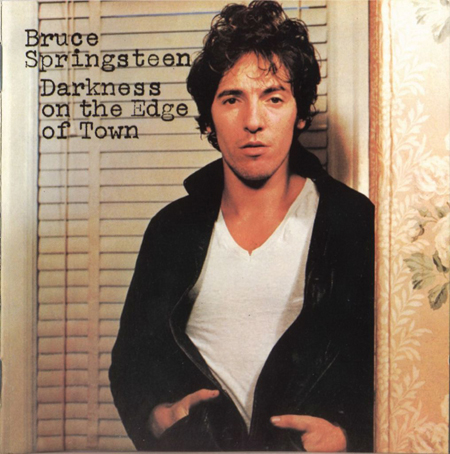
Bruce Springsteen
Darkness on the Edge of Town
Columbia
[Rating: 5 stars]
Loyal tramps the world over knew Bruce Springsteen was holding a nugget or two (hundred) back when he compiled his triple-disc Tracks box set in 1999. The only arena in which Springsteen ever showed such restraint was in that of song selection. How he could just cast off cuts like “The Promise” or “Rendezvous” and leave winners like “Because The Night” or “Fire” in the hands of another artist – like The Pointer Sisters – is simply staggering. With this sprawling reissue of his fourth record, Springsteen delves back into the vaults – where things like four different versions of “Racing In The Street” can only be found – to give fans the ultimate Darkness On The Edge Of Town.
On Darkness, Springsteen wrote dozens and dozens of songs to arrive at the ten that would comprise the final record. Perhaps that explains why, for years, talk of the phantom Darkness box has, among E Street faithful, achieved a status as mythic as Springsteen himself. In considering its 21 previously unreleased songs from the dawn of The Boss’s most fertile, and prolific period – which will also be made available as its own release – it’s no wonder why his fans see this as their SMiLE.
Originally released in 1978, Darkness – the first record to truly feature the classic lineup of the criminally uncredited E Street Band – showed the still bloodthirsty songwriter at his leanest, angriest and most savagely passionate, his anger fueled by the frustrations of a legal battle that kept him out of the studio for three years. With no outlet for his rapidly growing arsenal, he had amassed ten records of material when the time came to make one.
While few fans can imagine a version of Darkness that didn’t include, say, “Prove It All Night,” the fact that Springsteen let a gem like “Breakaway” slip through the cracks shows no song was safe from his hatchet. Of course, the ones that did make the final cut were not only among the best of the lot, but among the best the Boss ever penned. Like the indelible “Badlands,” a classic anthem of carrying on with life in the face of defeat. Or “Candy’s Room,” in which Springsteen answers drummer Max Weinberg’s marching orders with the most brutally assaultive guitar solo he ever committed to wax. Or “Adam Raised A Cain,” in which the complexities of father-son relationships are addressed in biblical proportions. Or the title track, which reconciles the fairy tale of boundless, unconditional love with the fear of sacrifice and realities of responsibility.
It’s material that saw Springsteen’s souring worldview impress itself on his characters, resulting in an album that defied the grandiosity and optimism of his breakthrough, Born To Run. Here, his Marys, Terrys, Wendys and big men begin to merely see hope as a mirage, after too much time spent coming of age beneath the glow of that Exxon sign made their romantic dreams of escape give way to raging compulsions to blow their whole town apart. Yet, as their hopes and dreams taunt them from the darkness beyond a life they can’t escape, they still believe in the promised land.
Of course, if you didn’t already know all that, you’re probably not interested in a deluxe edition of the album that extrapolates its ten songs into a six-disc box set, including a remaster of the album, the aforementioned bonus tracks, three DVDs – featuring a making-of documentary, 2009 start-to-finish performance of the album and complete, “bootleg” concert film from 1978 – and an 80-page book of liner notes, alternate lyrics, and photos. One can only imagine what the Boss has in store for The River.
More Reviews
-

Lower Town Arts and Music Festival, 2026 (Photo by Paducah Convention and Visitors Bureau) -

John Oates performs with The Good Road Band on March 15, 2026, at The Cabaret Theatre at Mohegan Sun in Uncasville, Connecticut (Photo by Khoi Ton/Courtesy of Mohegan Sun)