
Buffy Sainte-Marie entered the folk music scene in the early 1960s with the song “Universal Soldier,” the now-iconic anti-war anthem fueled by the United States’ growing involvement in, and the government’s denial about, the war in Viet Nam. It’s not only a great example of a heartfelt, well-written protest song, but of how music has been used to rebel against war and the flaws in the human condition.
The premise of the song is that, for time immemorial, war has existed, and that it’s not just the fault of those politicians who make the decisions and have the most to gain, but of all of us. The verse construction is a little unconventional but not unheard of, with six verses, no chorus or bridge, and “universal” lines like
Videos by American Songwriter
He’s five feet two and he’s six feet four
He fights with missiles and with spears
He’s all of 31 and he’s only 17
He’s been a soldier for a thousand years.
The native Canadian songstress told Juliette Jagger of Canada’s National Music Centre’s Amplify earlier this year how she came to write the song and the thoughts behind it.
“I had been traveling from Mexico to Toronto and had a layover in San Francisco,” recalls Sainte-Marie. “In the middle of the night a group of medics came into the airport wheeling wounded soldiers and we got to talking. I asked one of them if there really was a war in Vietnam because the politicians at home were saying there wasn’t one. The medics assured me there was indeed a huge war going on. I started writing the song in the airport and on the plane, and I finished it in the basement of the Purple Onion in Toronto.”
“The protest songs that I’ve written about hard issues, I didn’t write them to offend anyone or hurt anyone’s feelings or embarrass anyone, I really thought, ‘If people only knew, they could help,’” she explains. “So that’s the attitude I took. I wasn’t trying to get people to stick up their noses as at how terrible colonialism was. I just don’t come from that place – I’m a teacher. I don’t try to punish my students, I try to give them information they can’t get anywhere else, which will hopefully be enlightening.”
“I wrote ‘Universal Soldier’ as a gift really to people who I thought ought to know about this way of thinking. I wrote it like a college student determined to get an A from some professor who doesn’t like me and also doesn’t like my topic. I thought, ‘I’d better make it factually bulletproof, and charming on top of that, because Professor X is a tough old bird embedded in the system, with an ego, a legacy, and a heritage like tough old birds before him.’ The thing is, if you have bad news to give your students, you don’t give it to them in an enema,” she says jokingly. “If you really, really mean it, then you don’t have to be afraid of the facts, you can just list them. That’s all they are, listed facts, these songs, and if you’re genuinely empathetic to your audience and you’re really trying to inform them and not hurt them, that’s really the important part.”
The song was allegedly blacklisted by the White House, preventing it from getting much radio play. But anti-war listeners in the know were spreading the word about the song. A year later it was covered by Donovan, who had more mainstream success with it than Sainte-Marie did, and over the decades it’s been cut by everyone from the late Glen Campbell to First Aid Kit. Sainte-Marie would go on to win an Oscar and other awards as the co-writer (with Will Jennings and Jack Nitzsche) of the Joe Cocker-Jennifer Warnes hit “Up Where We Belong.” She’s still active at 78, playing live shows as well as making music (2017’s Medicine Songs).
More Behind The Song
-
Left to right: Robert Plant, John Paul Jones and Jimmy Page, of British heavy rock group Led Zeppelin, performing at Earl's Court, London, May 1975. The band were initially booked to play three nights at the venue, from 23rd to 25th May, but due to public demand, two more concerts were later added, for 17th and 18th May. Total ticket sales were 85,000. (Photo by Michael Putland/Getty Images) -
Portrait of country singer Eddie Rabbitt in Memphis, Tennessee, May 31, 1981. (Photo by Paul Natkin/Getty Images) -
LOS ANGELES – FEBRUARY 22: 31st Annual Grammy Awards. Broadcast February 22, 1989. Shrine Auditorium, Los Angeles, California. Pictured accepting award is Bobby McFerrin. His song "Don't Worry, Be Happy" won Record of the Year, Song of the Year, and Best Pop Vocal Performance, Male. Also Best Jazz Vocal Performance, Male. (Photo by CBS via Getty Images) -
LAS VEGAS, NEVADA – APRIL 03: Singers Mike McGuire (L) and Marty Raybon of Shenandoah attend the 51st Academy of Country Music Awards at MGM Grand Garden Arena on April 3, 2016 in Las Vegas, Nevada. (Photo by Rick Diamond/ACM2016/Getty Images for dcp) -
Photo by Tim Mosenfelder/Getty Images -
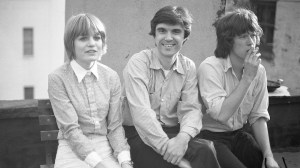
The three founding members of Talking Heads on a Manhattan rooftop, US, 1976. (Jerry Harrison would join the group at the beginning of 1977.) (L-R) Bassist Tina Weymouth, singer-guitarist David Byrne and drummer Chris Frantz. (Photo by Linda D. Robbins/Getty Images) -
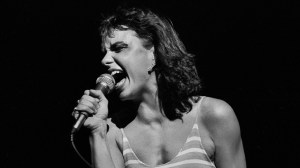
Patty Smyth of Scandal at the Poplar Creek Music Theater in Hoffman Estates, Illinois, June 3, 1983. (Photo by Paul Natkin/Getty Images) -
Photo by Michael Ochs Archives/Getty Images