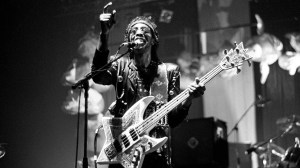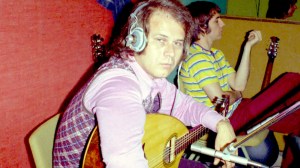
Although it’s hard to imagine the Godfather of Rock and Roll as anything but a rock and roller, Chuck Berry originally wanted to pursue a different career than music. In fact, Berry wouldn’t pick up an electric guitar until he was in his mid-20s, having only known how to strum out chords to pop songs for backyard parties before then.
Indeed, it’s funny how the universe seemingly falls into place in just the right ways, like when it whispered whatever whim Berry needed to hear to transition from one creative passion to another.
Videos by American Songwriter
Chuck Berry’s Original Career Choice Ran In The Family
Before Chuck Berry became the Godfather of Rock and Roll, he was the third of six siblings growing up in one of the few areas of St. Louis, Missouri, where the city permitted Black families to own property. Born October 18, 1926, Berry grew up with two working parents. His mother was a teacher, and his father was a contractor and church deacon.
The “Johnny B. Goode” singer ran into trouble with the law when he and some friends tried robbing a barbershop to make quick cash. He spent three years in jail from the age of 18 to 21, after which he began picking up odd jobs with his friends and family. The future rock and roll star made money helping his father do contract work, working at a Fisher Body automobile assembly plant, serving as a janitor, and, in an ironic twist of fate given his arrest record, cutting hair.
One of Berry’s biggest passions, however, was photography. He joined his high school’s photography club and did a pseudo-apprenticeship under his cousin, Harry Davis, a professional photographer. Berry did some freelance photography work of his own, using music to make money for cameras and other photography equipment.
In The End, Chuck Berry Chased Down The Money
The late Chuck Berry had earned a bit of side money by playing pop songs on an acoustic guitar at backyard parties around the city, but the tides of music history turned forever when he purchased his first electric guitar from local guitarist Joe Sherman while working as a janitor at the WEW radio station. Berry quickly found that the electric guitar’s neck was easier to play and began practicing incessantly.
Eventually, Berry began playing electric guitar around the city, where he quickly realized the more popular your music became, the more money you made. For the rest of his career, that’s what he would be chasing: a bigger paycheck. His attitude toward finances beget his infamous “no pay, no play” rule, where he demanded venues pay him in full before he ever took the stage.
Photographer Alec Byrne captured this attitude both on film and in spirit for the Rock Photography Museum, later writing, “I was in [Berry’s] dressing room…as he was about to go on stage. Then, I remembered there being a little bit of a kerfuffle. People were moving around; voices were being raised. Chuck Berry wanted cash before he set foot on stage. He wasn’t going on.”
“The management and the promoter were there, and I can remember Chuck Berry turning around and heading back towards his dressing room,” Byrne continued. “Everyone was looking at each other, going, ‘That’s it? He’s not going to go on?’ And then, somehow, an envelope appeared with the cash. Chuck Berry turned around, went back on stage, and gave an amazing performance.”
If only Berry had his photography equipment so that he could’ve taken a photo of the look of relief that undoubtedly spread across the promoters’ faces.
Photo by Terry Fincher/Daily Express/Hulton Archive/Getty Images
More Features
-
Photo by Michael Ochs Archives/Getty Images -
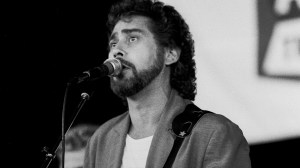
American country music singer Earl Thomas Conley (1941 – 2019) performs at the Poplar Creek Music Theater in Hoffman Estates, Illinois, May 26, 1985 in Hoffman Estates, Illinois (Photo by Paul Natkin/Getty Images) -
American funk band Cameo (American singer Charlie Singleton, American singer and musician Larry Blackmon, and American singer and musician Tomi Jenkins) in the press room of the 1987 Soul Train Music Awards, held at the Santa Monica Civic Auditorium in Santa Monica, California, 23rd March 1987. Cameo won the awards for 'Album of the Year (Group, Duo, or Band)' for 'Word Up!' and 'Best Single (Group, Duo, or Band)' for 'Word Up'. (Photo by Vinnie Zuffante/Getty Images) -
UNITED KINGDOM – JANUARY 01: Photo of Pete SEEGER; Pete Seeger performing on stage at a Paul Robeson benefit concert (Photo by Brian Shuel/Redferns) -
UNSPECIFIED – CIRCA 1970: Photo of Diana Ross Photo by Michael Ochs Archives/Getty Images -

The British singer Kate Bush poses for a photo shoot. Great Britain, 1980 (Photo by Angelo DeligioMondadori via Getty Images)