
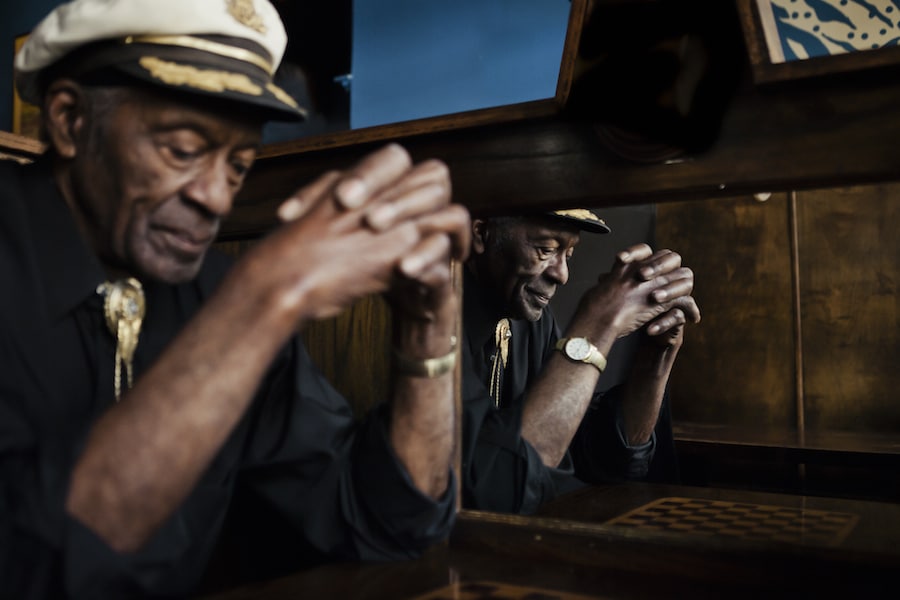
“That’s called … titillating!” Chuck Berry exclaims from the stage at Blueberry Hill, a small club just outside of St. Louis and his favorite venue in the world. He bends guitar notes into balloon animals and even provides his own randy commentary, a wink to the boisterous hometown crowd, as he stomps through “3/4 Time (Enchiladas),” a song about life and how to live it. There’s no film of the performance, so we can only imagine what gestures accompanied his guitar solo. The octogenarian probably wasn’t duckwalking across the stage anymore, but he might have been sliding into his patented splits stance, his feet sliding further and further apart as though trying to take up as much of the stage as possible.
This live version of “Enchiladas” anchors Berry’s first collection of new material in nearly 40 years, simply titled Chuck and arguably the most anticipated album of 2017. It’s the final testament from one of rock and roll’s founding fathers, a man whose influence on American music and popular culture is so incredibly vast that it can only possibly be understated. He was rock’s first singer-songwriter, arguably its first auteur, certainly its first guitar hero, and the art form’s most acute and insightful commentator on class and race. Chuck engages with his history and legacy, but that doesn’t mean it’s not lively and thrilling and lascivious: looking to the past but grounded in the present.
In other words, nowhere on the album does Berry sound like a man in his 80s. Even on “Enchiladas” he sounds like a showman whose vitality and energy have not diminished an iota from his heyday. “Blueberry Hill was absolutely his favorite venue to play,” says Charles Berry Jr., his son and sideman for the last 20 years. “My dad has played in front of half a million people, but he loved to get back to that intimate small-room setting, where he could see everybody’s face in the crowd, people up at the bar, screaming for ‘Johnny B. Goode’ or whatever.” Berry played 209 shows at the venue over the last 20 years and served “Enchiladas” to thousands of people.
The version on Chuck sounds off the cuff, relaxed but vivacious, as Berry is joined by his longtime drummer Keith Robinson and bass player Jimmy Marsala. Berry Jr. played rhythm guitar that night, but later made the decision to take himself off the final track. “It’s not because I thought I sucked,” says Charles Jr., “because I though I did pretty good on that one. But my playing was more of a distraction than an enhancement to what he was doing.”
It wasn’t even Berry’s song, but “Enchiladas” is now. It was written in the early 1970s by Tony Joe White, the swamp rocker famous for “Polk Salad Annie” and “Rainy Night In Georgia.” It took a long, weird route from his pen to Berry’s mouth. “When I wrote that tune, me and Waylon were touring together,” says White. “He was doing some hard-rock country back then, and I was doing my swamp stuff, and it all fit together good. I wrote it as a two-part song for him and ol’ Willie, but he never cut it.” The song was eventually recorded by Ray Charles in the early ’80s, scoring a modest country hit and making one of the very first country music videos. That’s most likely where Berry heard it, and later in his life he included it in live shows. “Man, how cool. The very last rocker on the planet, and all of a sudden he does one of my tunes. It really knocks me out. I didn’t even think he knew I was alive.”
Berry commands the song, essentially rewrites “Enchiladas” in this live setting, vamping on that waltz-time beat and playing up the r&b and c&w elements until they’re indistinguishable. In other words, he sings the hell out of it. Every syllable becomes something of a symphony as Berry wrings simple words like “old El Dorados that shine” for maximum exclamation. The fun is contagious, even communal, and you can sense the excitement channel from artist to audience and back again. Few performers have ever sounded so excited to be on stage. “I love what I’m doing,” Berry declares. “Hope it don’t end too soon!”
///
Chuck Berry died on March 18, 2017, at his home in St. Louis. He was 90 years old. It was just weeks after the announcement of his first album in nearly 40 years, and just a few months before its release. Along with Jerry Lee Lewis and Dion and Wanda Jackson, he was one of the last surviving members of rock and roll’s first generation, who came of age in the late 1950s and had the opportunity to set the rules for the new musical form. Berry was the man with the guitar and the voice and the songs and all the attention, every eye on him. He showed us how to be a rock star, but perhaps more crucially, he showed us how to be a rock songwriter. He wrote with verve and clarity, borrowing from the American songbook and using “Wabash Cannonball” and “Old Brown Jug” as the raw materials for modern stories about fast cars, ugly teachers, pretty women, and rock and roll music — “any ol’ way you choose it.”
Aside from Bill Haley, every one of Berry’s contemporaries were teenagers or young men when they started making records. Already an established entertainer in St. Louis, Berry was in his late 20s when popular music caught up with him; he was 29 when he trekked up to Chicago to record “Maybellene” for Chess Records, 31 when he recorded “Johnny B. Goode.” With an arsenal of outrageous onstage moves, he had energy and charisma and an ear for teen anthems like “Sweet Little Rock & Roller” and “School Days (Ring Ring Goes The Bell).”
SIDEBAR: FIVE OVERLOOKED NUGGETS FROM CHUCK BERRY
He also made cars the centerpiece of songs like “Maybellene” and “You Can’t Catch Me,” not only reflecting a newly industrialized postwar United States but capturing something undeniably American in the freedom of a Coupe de Ville on an open road. “The Promised Land,” his 1964 single ostensibly chronicling the rigmarole of nonstop touring, rattles off a grueling travel itinerary from Virginia to California, coast to coast: “I woke up high over Albuquerque on a jet to the promised land,” he sings, alluding to the westward migration of African Americans after World War II or perhaps to the civil right marches toward equality and liberty. For Berry and later for the rest of the world, pop songs became a vehicle for discussions of race and class — most notably on his 1956 hit “Brown Eyed Handsome Man,” which toasted the sexual prowess of African American men only a year after 14-year-old Emmett Till was lynched in Mississippi for allegedly talking to a white woman.
Berry’s string of hits continued well into the 1960s with “No Particular Place to Go” and “You Never Can Tell” (most famous for its use in Quentin Tarantino’s Pulp Fiction). The Beatles were fans and included numerous Chuck Berry tunes in their early sets, most notably “Roll Over Beethoven”; the Rolling Stones’ first single was a cover of Berry’s “Come On.” Toward the end of that decade, following a stint in jail for violating the Mann Act and transporting a minor across state lines, Berry remained a popular live draw and even dabbled in psychedelia and heavy rock, for example on the 18-minute fretboard freakout “Concerto In B. Goode,” released in 1969 at the apex of the counterculture. Yet, Berry’s only number one came three years later, almost by accident: “My Ding A Ling” was a novelty hit, previously recorded as “My Tambourine” and such an obvious dick joke (“I want you to play with …” that even 40 years later it’s still shocking radio would spin it.
He spent the next four decades touring heavily and playing wild sets with pick-up bands around the world. “The audience reaction was pretty much the same wherever he went,” says Berry Jr., who started playing in his father’s band in 2001. “From the first note of his guitar, people were totally captivated. To this day it still blows my mind the way my father could work an audience. He could mesmerize people. He could get them dancing at will, just based on what he played and how he played it.”
///
Chuck is a fitting coda on that incredible career, an album full of energy and smarts, joy and humor, clarity and wisdom, sharp guitar riffs and rambunctious vocals. It also demonstrates Berry’s remarkable range, which is something rarely noted in recent obituaries. He’s best known for rollicking rockers with four-bar intros and succinct guitar solos, a template he set as far back as “Johnny B. Goode” in 1957. The new album certainly has its fill of rockers that sound immediately and giddily familiar, like opener “Wonderful Woman” and “Big Boys,” the latter a multi-guitar jam featuring Tom Morello, Gary Clark Jr., Charles Berry Jr., and even Charles Berry III. But there’s also the talking blues of “Dutchman,” a calypso ballad called “Jamaica Moon,” slow songs, fast songs, bawdy rave-ups like “Big Boys” and gentler tunes like “Darlin’,” a lovely duet with daughter Ingrid.
These songs slyly comment on Berry’s legacy, especially “Lady B. Goode,” which chronicles the hard times experienced by Johnny B. Goode’s wife. If that character was a loose stand-in for Berry himself, then Lady is a fictionalization of Themetta “Toddy” Suggs Berry, Chuck’s wife of nearly 70 years. The song becomes an acknowledgement that his fame took its toll on those who loved him. It’s tender and remorseful, sidestepping self-mythology for something more personal and haunted.
Even so, Chuck sounds of its moment — not necessarily its historical moment, not 2017 or 1957 or any time in between, but of the moment it creates within these. This is an end-of-life album that documents the joy Berry took in performing, in hamming it up for an audience, in strumming his guitar and unspooling a story in rhyming verse. In that regard, it makes a convincing argument that rock isn’t dead. It never dies. It lives in these moments it creates. It’s always present tense, and Chuck Berry is always 80 going on 19. “Music keeps you young, no doubt about it,” says Jimmy Marsala, who played in Chuck Berry’s band — and often was Chuck Berry’s band — since the early 1970s. “The mind never gets old. It might get damaged a little bit, but it never gets old. Chuck’s mind was still like a teenager.”
Berry had been working on the record since the 1980s, back when he was not especially tardy following up 1979’s underrated Rock It, his penultimate studio album. He was always recording in his studios around St. Louis, where he could tinker with ideas until they became songs. His progress was piecemeal, as he was still a working musician well into the 21st century. That meant touring took priority over everything else, even recording. “He wasn’t Michael Jackson famous at that point, but he was still popular,” says Berry Jr. “The phone would constantly ring and he would accept or reject contracts to do shows, but as soon as the money was there, he was like, I gotta go. He stayed pretty busy well into his 60s and 70s, and he was still doing 70 or 80 shows a year.”
Berry played nearly every continent on Earth, from Moscow to the Grand Canary Islands to Montevideo to Oslo to 209 shows at Blueberry Hill outside St. Louis. There was no down time, no moment when he was not working, when his brain wasn’t devising some new riff, some catchy hook, some sly turn of phrase. “He was always writing lyrics,” says Marsala. “When we’d go on trips, he wouldn’t just do the shows. He would carry around a legal pad. He’d always be writing verses and songs. That went on constantly. He never went anywhere without his legal pad and briefcase. If we were on a plane, even just a short one-hour trip, he’d be writing, creating stuff.”
Some songs from Chuck, including first single “Big Boys,” date back as far as the 1980s, when Berry started toying with ideas at his studio at Berry Park, just outside of St. Louis. But the earliest versions were lost when a fire destroyed the studio in 1989. “All the tapes he had out there got burned up,” says Berry Jr. “All that stuff was lost. He went about the process of rebuilding that studio, but he had several around town, so he could re-create some of that stuff over time.”
Berry was undeterred. “All things change; nothing remains the same,” was his cryptic comment to the St. Louis Post-Dispatch at the time. “There’s no way to put a value on it.” He simply moved the sessions to a different studio in town and kept plugging away. “I didn’t always know what I was working on,” recalls Marsala. “At the time it was just some songs. We would run through stuff. We didn’t have titles for anything. Some of those songs are on the album, and some are still in the can somewhere. I couldn’t tell you where.”
Chuck was methodical in the studio, laboring to capture the best version possible of these ideas. “Chuck wanted it to be a really good album,” says Marsala. “He was concerned that maybe it wasn’t as good as some of the other stuff he did, and he wanted to make sure it was better than what he did before.”
It would take decades before Berry was willing to part with the tapes. In 2014 he gave control of the album over to his family, entrusting them to mold the songs into something that would complement and continue his legacy. That’s when Dualtone Records stepped in. The Nashville label was keenly interested in adding the rock legend to its roster of Americana artists, which includes the Lumineers, Shakey Graves, and the late Guy Clark. On a certain level Berry is a roots artist, so the pairing made sense.
“We knew from the beginning this album would be a piece of culture and rock history that we would be honored to be associated with,” says Paul Roper, Dualtone president. “Finishing the record was very important to him. There is definitely a perspective here that is a new element to his songwriting, a reflective component that comes with the age he was when working on the record. You can hear that in songs like ‘Eyes of Man’ and “Darlin’.’”
But the tapes, Roper says, were “not mixed very well. Chuck’s guitar work and sometimes his vocals were pretty buried behind the Blueberry Hill band.” To remedy that, he recruited Jeremy Lutito, one half of the Dualtone-signed band Leagues, to re-produce and essentially re-mix the songs. “They sent me a song called ‘Wonderful Woman’ as sort of an audition,” says Lutito. “I remember sitting there and for the first time I’m hearing Chuck Berry’s guitar come through the speakers of my tiny, behind-the-house East Nashville studio. That was wild. There was a lot of really exciting energy, but there was also a lot to clean up. I just spent some time with it and spruced it up, making moments shine the way I felt they should.”
Making them shine meant highlighting Berry’s loyal band as well as bringing in a few carefully selected guests. In addition to Morello and Clark — who are, similar to every other rock guitarist ever, hugely influenced by Berry — Chuck features backing vocals by the Tennessee-based folk-rock group the New Respects and the St. Louis singer-songwriter Nathaniel Rateliff, who fronts the breakout soul-rock band the Night Sweats. But perhaps the most significant guests on Chuck are the three generations of Berrys who jam with the rock legend. Charles Jr. and Charles III both play guitar throughout the album, which is dedicated to Themetta. “You’re father’s growing old,” he counsels his daughter Ingrid Berry at the beginning of their duet, “Darlin’.” Their voices blend lovingly as they comfort each other, and she ends the song with a simple “I love you” that sounds ad libbed. It’s a poignant moment, and it sounds all the more devastating after March 18.
Berry is humanized by their presence on Chuck, a legend rendered flesh and bone, the man emerging from the myth he spent decades erecting. His death prompted a multitude of obituaries and thinkpieces that grappled with his legacy, that weighed his accomplishments against his crimes (grand theft in the 1950s, corruption of a minor in the 1960s, and worse). In each his impact on popular culture seemed understated, as though his influence were incalculable. Chuck sounds like Berry’s own essay on celebrity, its boundless opportunities and its heartbreaking drawbacks.
“It’s from the perspective of a wise man,” says Berry Jr. “Not that my father wasn’t wise previously, but he had the benefits of age and experience that he didn’t have when he was in his 20s writing ‘Maybellene.’ All of his music is fun music, and so is Chuck. But the slower songs, the bluesier numbers are a reflection of someone who had lived a good, long life.”
His death was felt publicly, but he was mourned privately. Chuck makes clear what was lost when Berry died, but it also makes clear who suffers his absence most acutely: his family. “Until you lose someone that close to you, someone you loved unconditionally, someone you thought of as a superhero,” says Charles Berry Jr. His voice trails off, leaving the thought unfinished. “He showed me how to be a musician and how to be a man, and he prepared me for the day when he wouldn’t be around anymore to give me advice.” For that reason Chuck is all the more precious to those survived by the rock and roll legend. “His personality permeates each and every one of these songs. Listening to this album is like having a conversation with him.”
More Features
-

Bassist Daryl Stuemer, guitarist Mike Rutherford, singer Phil Collins of the band Genesis perform during the Atlantic Records 40th Anniversary celebration called "Its Only Rock and Roll" at Madison Square Garden on May 14, 1988 in New York City, New York. (Photo by Larry Busacca/Getty Images) -
Photo by Larry Hulst/Michael Ochs Archives/Getty Images -
Otis Redding performing at the Monterey Pop Festival, 1967 -

UNITED KINGDOM – MAY 03: HAMMERSMITH ODEON Photo of BACHMAN TURNER OVERDRIVE (Photo by David Redfern/Redferns) -
American singer-songwriter Tracy Chapman plays her Fender acoustic guitar at a recording studio in Los Angeles, California, circa 1988. (Photo by Lester Cohen/Getty Images) -
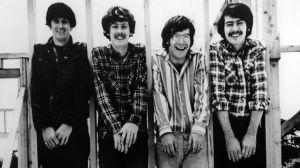
UNSPECIFIED – JANUARY 01: Photo of John SEBASTIAN and Zal YANOVSKY and LOVIN' SPOONFUL; Posed group shot, (Photo by Charlie Gillett Collection/Redferns)

