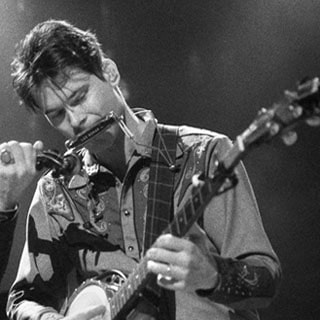
As the frontman for Old Crow Medicine Show, Ketch Secor has proudly carried the flag for the beauty and charm of old-time music while giving it a modern-sounding edge. Secor and his bandmates revel in the rawness of acoustic sounds- banjos, violins, acoustic guitars and harmonicas. We caught up with the Grammy-winning artist for his thoughts on roots music and how the harmonica lets him display a freewheeling range of emotion.
Q: Who are your musical influences?
Ketch Secor: I have always been drawn to a lot of artists and bands from the 1920s, like Dock Boggs, The Carter Family, Jimmie Rodgers, Clarence Ashley, and lesser known performers like Uncle Eck Dunford, Jimmy Thompson, Dave Macon—there were so many great entertainers from this period. This was the Golden Age of Folk Music.
As a harmonica player, I have listened to a lot of Nashville’s greatest players, including Deford Bailey, a real “wizard.” Like most harmonica players of that era, his playing is unruly and wild, and that’s what resonates for me. I especially like untrained harmonica playing, and the harmonica itself is an instrument for the untrained.
Q: You have such a great appreciation for roots music, what draws you in?
KS: I like the raw and primitive sounds of American Folk music, because it’s elemental. For me as an artist, it’s better to draw from the elemental than the stylized. It’s good to really listen to the bedrock of American music. If you build off of the elemental, it is easier to be original. If you are trying to build a new house, it behooves you to start from the ground up. In the musical world, we are all passing along the same information. There aren’t really any original ideas in music anymore. So it’s easier to put your own stamp on it when you draw from our early music.
I don’t think it takes a PhD, or musicologist, to see yourself in the roots. I’d like to think that anyone—whether you’re white, black or brown, regardless of age, linguistics or background—can turn on a record by Jaybird Coleman, for example, and experience the evidence of the beauty of man’s artistic ability.
As Americans, we are the descendants of music’s greatest zenith: the music of the twentieth century. I don’t think there will ever be anything as powerful as what Americans did with popular music during this period. The unique sound has to do with who lived here, and the story of people coming together— for better or for worse. So much of what makes old-time American music so profound is that it embodies and brings together two different forces, the music of Africa and the music of Europe. It is the joining of the Bohemian accordion with the fiddle, singing in Crow, Shoshone, Cajun French, Southern Appalachian, Elizabethan Hillbilly…so many different flavors. It’s the whole concept of a melting pot, that’s best tasted in sound.
Q: So how did you discover your love of harmonica playing?
KS: I first picked up a harmonica when I was eleven. I’d played a jaw harp, and then one day, I got a pin-whistle and a harmonica. As a young teen, I had a mentor, a local coffee house performer who was five years older than me. He could play guitar and a rack harp, and I would watch him at open mic night, and just stare. He’d play Neil Young’s Heart of Gold, a song that exemplifies the power of melodic hooks with harmonica playing. And then… I discovered Bob Dylan.
Q: So what is it about the harmonica that you love?
KS: It’s that wild, unruly abandon that a harmonica makes possible. The harmonica is an instrument that lends itself easily to display a freewheeling range of emotion. It’s a really good complement to the music, the kind of instrument that translates emotion so well. Whether it’s a really happy staccato burst or a frantic run, I have always thought of the harmonica as a punctuation mark to a song.
Q: Lee Oskar was thrilled to join you and the Old Crow Medicine Show on the stage of the Ryman Auditorium in Nashville to ring in the New Year in 2015! And, we’re delighted to know that you’ve always played Lee Oskar Harmonicas from the start.
KS: Yes, the first Lee Oskar Harmonica I ever bought was in Harrisonburg, Virginia in 1989, right across from the courthouse, where I bought a hot dog (for a dollar) and a harmonica. As soon as I finished the hot dog, I blew that harmonica all the way home. I’ve been playing Lee Oskar harmonicas for more than 25 years now. I never really set out to be a good harmonica player, I just played it everywhere, and did not even know I was practicing, and then one day I realized, I am really good at this……
Hands down, Lee Oskar makes the best harmonicas, anywhere. It’s a well-built little machine. Because I started out playing on street corners, I had to play loud, and no other harp could get to the decibels like Lee Oskar Harmonicas.
What makes Lee Oskar Harmonicas so great is that they come from Lee himself. When you play folk music, sometimes the story that is embedded in the instrument is more important than the sound it makes. In this case, you know you are getting something that Lee has personally designed and has spent more than 30 years constantly improving.
Check out: http://leeoskar.com/featured-artist-ketch-secor
Sponsored content from Lee Oskar Harmonicas