First agenda item of the day: try not to kill Dave Rawlings.
It is early afternoon in East Nashville, and Rawlings and I are cruising down Fatherland Street on a roundabout path to the house he shares with his creative partner, Gillian Welch. A minute ago, I had confessed to the lanky, denim-covered singer-songwriter – seated in the passenger seat of my Prius, trying to find space for his boots next to my toddler’s Elmo books – that I am not the most confident driver. This does not seem to alarm him one bit.
“Oh, you’re fine, you’re fine,” he says, chuckling, telling me to take a right, and then a left, adding, “but if we got into an accident, that would be really good for album sales. And you’d be, like, the person who killed that songwriter guy!” Since Rawlings and Welch have a new Dave Rawlings Machine LP out in a few weeks, Nashville Obsolete, I feel all the more nervous at the mention of such a ghostly scheme, gripping the wheel tight as he instructs me to pull into an alleyway and park on the grass behind a mustard-colored garage. It’s never smart to be responsible for the life of a man who loves a good murder ballad. Just listen to “Caleb Meyer,” off of Welch’s Hell Among The Yearlings: a woman slices a man’s throat with a shattered bottle shard.
Welch, riding by herself, beats us there. I’d met them both a few minutes ago in the vestibule of Woodland Studios, their beautifully rehabilitated recording mecca in the Five Points area of East Nashville which they own and operate their label, Acony Records, out of next door. Rawlings hadn’t wanted to do the interview there, but, when he called me earlier in the day to set a place, he said he didn’t have any good ideas yet for a setting. He did know, however, that I should probably start by talking to him and Welch separately. “Speaking to the two of us together is like having both of your parents on the phone at the same time,” he said, punctuating it with a laugh, as he tends to do. There is such an immediate friendliness to his tone you could assume he’s lost track, occasionally, of the fact that he’s on the record. But maybe no mistake: Rawlings is always very, very aware.
It is unclear, at first, exactly where we are going. At the studio, there is talk of a “house” we can use, which may or may not have some white wine sitting in the fridge. Rawlings and Welch look at each other, engaging in their usual quick-wit chatter that would make Aaron Sorkin drool, deciding that, yes, we can go there and yes, that wine is probably too old to drink. When we pull up, Rawlings and I have a seat on some wooden benches on the patio, facing a small lawn with a couple of planting boxes. I ask if this is their house, and he nods – smiling, because he’s often smiling, big and toothy – but with a glint of trepidation. Welch and Rawlings are no Mac Demarco, publishing their address in the liner notes of their albums. Nor do they ever care to discuss their romantic status.
The patio door swings open, and Welch appears. She is wearing a pastel-colored dress with wooden, Tootsie Roll-shaped buttons at the shoulders and boots, her red hair parted down the middle and paling around the crown.
“Are you going to talk to him first, and then me?” she asks, settling on this plan and offering us something to drink.
“I’ll have one of those cold things,” Rawlings tells her, which prompts Welch to bring us a pitcher of water and two glasses, one of which has a picture of President Lincoln’s head on it.
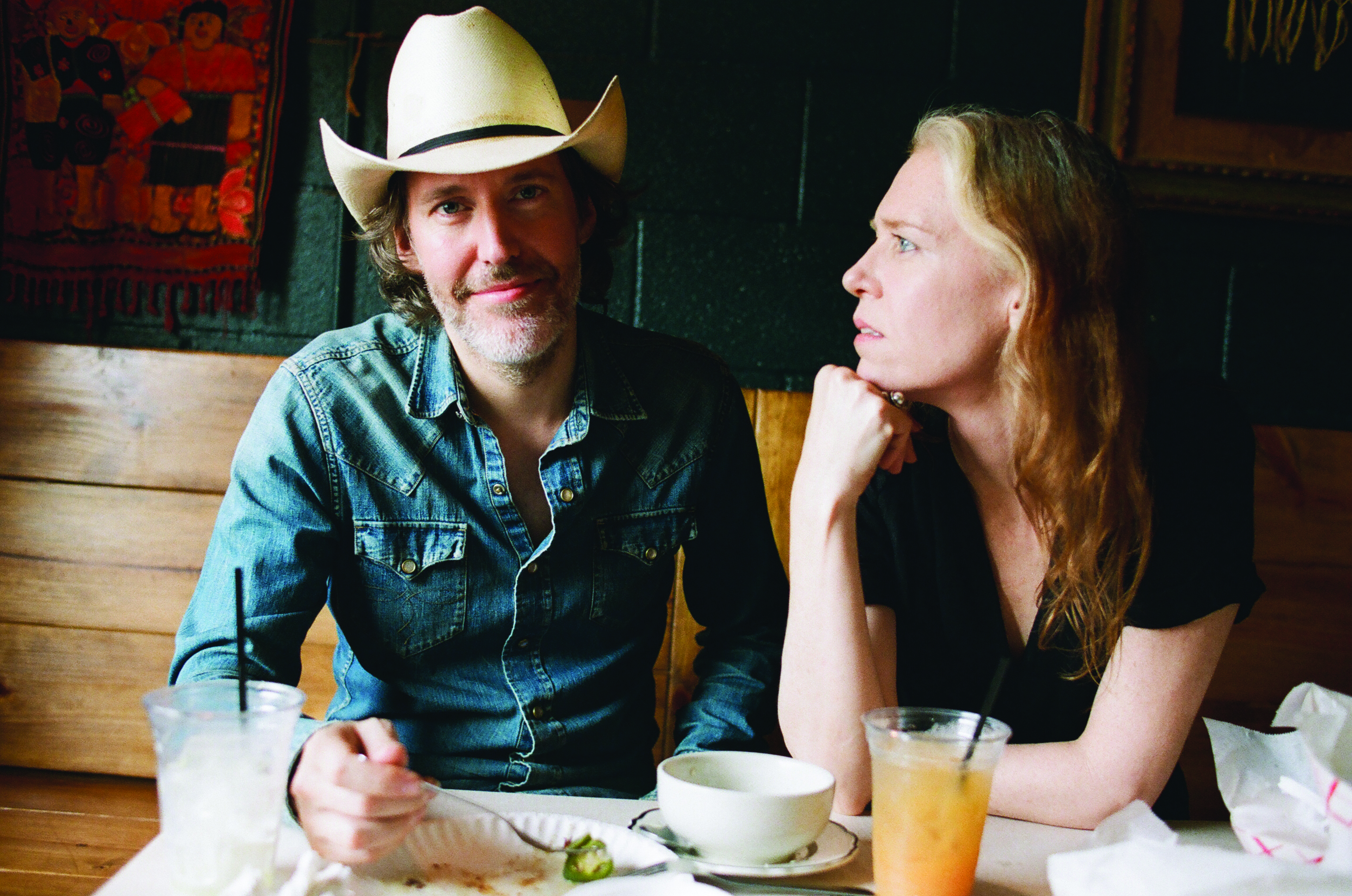
It is early September and still rather warm in Nashville, but Rawlings is in that head-to-toe vintage blue he’s almost always seen wearing, along with his signature white hat that casts a shadow on his brown-gray scruff – today, he has added a pair of rose-tinted sunglasses to the mix. As thin and tall as he is, and as big as that brim is, he looks like some sort of exaggerated cartoon character – a bit of a cowboy Gumby, maybe, especially as he walks with his shoulders always pitched out in front of the rest of his body, like his feet are racing to catch up with his head.
This is a similar outfit to what he is wearing on the cover of Nashville Obsolete, the twosome’s second album as Dave Rawlings Machine after 2009’s Friend Of A Friend – shot in Daguerreotype style, he poses with Welch and two new borrowed band members: Willie Watson, formerly of Old Crow Medicine Show, and Paul Kowert, of Punch Brothers. It is, from the first note of the opening rock-grass song, “The Weekend,” far different than the last Machine LP, but also rooted in the Welch-Rawlings core: there are tight harmonies, but lush strings too. There are rolling narratives and themes of restlessness and renegades, but also chirpy, quirky songs like “Candy” that sound like melodies out of the great American Songbook. And then there are tracks like the winding, weird “The Trip,” which Welch claims to have spat out in twenty minutes – double the song’s actual length.