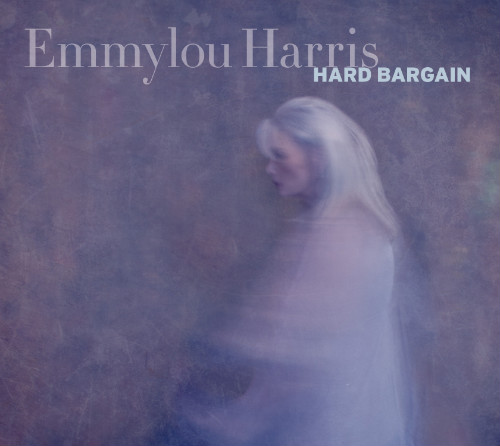
Emmylou Harris
Hard Bargain
Nonesuch
[Rating: 3 stars]
It’s surprising the American Association of Anesthesiologists hasn’t chosen Emmylou Harris as the best voice to hear when awakening from surgery. It’s hushed and wistful, pining and a little dreamy, expressive yet not declarative, and snakes in and out of a song’s melody, unexpectedly dropping off an occasional syllable. All in all, it’s a pretty good vocal approximation – soothing, reassuring but with an edge of anxiety and doubt – of what it’s like to slowly emerge back into consciousness after being “away” for awhile.
Because of that ethereal quality, which came to the fore when she worked with producer Daniel Lanois on 1995’s atmospheric Wrecking Ball, Harris has come to be regarded as an art singer – a long way from the folk-rock-friendly country star she was in the 1980s. And she’s labored to produce albums worthy of her new status, painstakingly writing songs and developing recordings that had the proper dramatic import. (On Wrecking Ball, she only shared a three-way writing credit on one song.)
The new Hard Bargain is only her fifth album since Wrecking Ball, counting the live Spyboy. And unlike her previous ones, she didn’t labor so much on it –writing/co-writing 11 of the 13 songs since 2008’s fine All I Intended To Be, and making the disc in just a month with Jay Joyce (Patty Griffin, Cage the Elephant).
What’s striking here is how Joyce, while not rejecting the ephemeral, soothingly mournful quality of Harris’ “art voice,” has given this a pop sensibility. And he’s done it without getting mired in a big, loud, hard sound – Joyce plays electric guitar, Harris acoustic and lead and harmony vocals, Giles Reaves all else.
The unprocessed guitars and clear, hard drumbeats on “The Road” – a remembrance of her start long ago with Gram Parsons – make it rock reasonably hard, while still leaving her room to embrace the ghostly qualities of the subject matter on the choruses. The spare stateliness with which Joyce offers reverb guitar for the ballad “Lonely Girl” recalls “By the Time I Get to Phoenix.” It’s reflective and introspective, but also straightforward and upfront.
The irresistible banjo figure that underlies the title song, a Ron Sexsmith composition, makes it bright, warm and cheerful – while being true to the mysteriousness of Harris’ voice. And in the sprightly “New Orleans,” a celebration of the city’s survival, there’s an insistent percussive kick and a chiming happiness.
Besides “Hard Bargain,” only one other song among these 13 is a cover – the romantic Joyce-written “Cross Yourself.” (But Harris worked with Will Jennings on three songs.)
As a writer, Harris sometimes stumbles. In “My Name Is Emmett Till,” she takes the voice of the martyred black youth (lynched in Mississippi in 1955) to awkward effect. And in “Six White Cadillacs,” the imagery never takes hold and the song feels like filler. But she’s also gained strength in addressing personal sadness – her tribute to the late Kate McGarrigle, “Darlin’ Kate,” movingly balances tender reminisce with wishes for a good afterlife.
Harris’ vocal approach to her folk-based songs, ballads or mid-tempo, is infused with the presence of a time-traveler, visiting modern America from a pre-pop-culture place where music is in the air rather than the airwaves. To that special, rarified quality, Joyce makes these songs sound contemporary, like records you like to hear on the radio. He’s a good match for her.
More Album Reviews
-

Photo via cover of ‘Butter Miracle, The Complete Sweets!’ by Counting Crows -
Photo by Will Von Bolton -

Will Heath/NBC via Getty Images