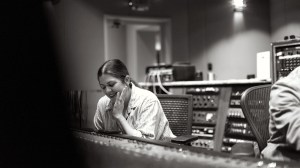

Tracy Newman is an award-winning songwriter, TV scribe, and former member of the Groundlings, which she attended with her sister, comedienne Laraine Newman. We talked to Newman, whose song “Table Nine” made the top three in our September/October 2011 lyric contest, about songwriting, comedy, and her excellent folk album, A Place In The Sun.
Is this album, A Place In The Sun, your debut full-length record?
Yeah. I did that in 2007. By the way, I’m just about to release my next one. You want the title? Oh, don’t do this to me! I’m still struggling with the title right now. It might be called Two Hearts, but I don’t know.
Are you still planning on a kids’ record as well?
I’m actually doing three CDs at the same time, which is only partly why it’s taking me a long time. I think the real reason is I loved my first CD so much and I was so proud of it that I’m feeling, I think, a common pressure. You don’t have to have a hit record to feel this way. I just feel like I have something to live up to, a standard I set for myself.
This record is on Kabeauty. Is that your own label?
Yeah.
How, as an independent singer-songwriter, are you making your career happen?
I have a big television career to draw from. It gives me entre into certain things, but in other things it doesn’t matter at all. I think it creates a bit of curiosity though. Why would someone leave a successful television career to go back to funky little clubs and start over? How do you do it – you just get out there and you want to do it. I guess that’s it.
I did music in the ’60s and I really wanted to do it professionally, but you couldn’t make a living. Only a handful of artists made a living back then, and I found it easier to make a living writing television. I had a lot of fun doing that. Then when we sold According to Jim, and I thought, “Wow, this show could stay on a long time, and I’m getting up there.” I’m doing what a lot of people who were doing music in the ’60s and ’70s are doing. We had another career then realized, “Hey, music’s what I really always wanted to do. And I was writing all along. I mean, it’s not like I stopped playing and writing. I just wasn’t performing. That’s another thing – I started this career very prepared.
Going back to the ’60s for a minute, can you tell us the story of how you went to Tucson to be a songwriter, and your mother tried to get you to move back…
Oh, God. I was starting to be a folk singer here, but I also applied to college when I got out of high school. My mother thought when I went away to college that I would give up whatever show business was back then – folk music as a way to make a living. She would have rather seen me be a dental hygienist than that. She didn’t care what I did as long as it was something I could make money at. I went to University of Arizona and at that time, Linda Ronstadt was around there. There were people there who were pretty big folk singers at the time. I don’t want to name them necessarily because you might not know them. I got involved with that community pretty much, and I really almost never went to class. I didn’t bother to drop out either, so I got a whole semester of Fs. Not even Incompletes, I don’t think. When my mother saw that she freaked out, came to Arizona, dragged me to the airplane, and I went into therapy. I’m sure it’s like what happened to people over the years who were gay – when their parents found out, they took them to therapy. I think I got treated like I was insane because I wanted to be a folk singer.
Did she put the same amount of pressure on your sister for wanting to be a comedian?
No, that was an entirely different thing. I don’t know if you know anything about The Groundlings, but it’s like the farm team group here for Saturday Night Live. I’m not saying it was created for that, but it became that. Phil Hartman’s from there and Jon Lovitz and Will Ferrell are too. It’s like a who’s who of comedy. We started The Groundlings in the early ’70s, Laraine and I and a bunch of other people. Lorne Michaels came to the show and picked like four people. Three of them turned it down, but Laraine took it because she didn’t have anything going on here. So Laraine was just sort of coming into classes at The Groundlings, and she was amazing. She had studied with Marcel Marceau in Paris and had been in all the plays at Beverly Hills High School. I think the writing was on the wall with Laraine much more clearly than it was with me. There was no question whether she would succeed or not. I think my mother was so excited with the fact that Laraine was on Saturday Night Live, it wasn’t an issue anymore. But, however, it was at dinner. Whenever we had dinner as a family, she did not want us to talk about show business. Really that was all we cared about, so it was always a struggle.
In The Groundlings, were you a performer as well?
Yeah, I was. We were like founding members. Really it was just a class, and I was a member of the class. Then when we started to do shows, yeah, I was very prominent in the show as was Laraine in the very beginning. She didn’t stay in The Groundlings very long, maybe a year. But I was there for 15 years. I performed and taught. I worked a lot – I did a lot of TV shows and commercials. But when you’re doing something you really, really love – that’s when you can get competitive, but I don’t think acting was something I really loved. Anytime we were dealing with music in The Groundlings, I was the musical director and sort of very jealous and competitive, but when it came to being onstage as a performer doing improv, I would rather MC. I enjoyed being out there as myself. I didn’t know how to do characters. It was not comfortable for me. So, yes. I was a performer in The Groundlings, but I drifted toward directing, writing, teaching and also MC-ing. I became the MC there for like 10 years.
Does having that background in improv help you write songs?
It’s hard to determine how important it is, but it’s massively important, yes. Being onstage for 10 years as an MC is hugely important, too. I’m very comfortable onstage and a lot of that is half the battle. So for me to quit television and go back onstage wasn’t that big a deal. Getting back to music fulltime was, but being onstage wasn’t a big deal. I think improv helps that. Any kind of risk like that helps.

Is that kind of how you write songs? Do you just crank them out of the top of your head?
[laughs] Oh gosh, you know, I’m actually going through a bad writing time. I thought I’d never have trouble writing songs again. Maybe a year ago I was cranking them out, but I’ve reached a little bit of, uh, I don’t know. Maybe it’s because I’m recording all the time right now and performing all the time-about four shows a week, just in the LA area. I also had my producer move all his equipment into one of my offices here, so maybe the writing’s kind of on the backburner. To be honest with you, as far as writing goes, the best advice I can give to anybody who feels like they have this ability to write songs, but they don’t have the community, is to take classes. Take songwriting classes because whatever method’s being taught is just another tool in your box, and you’ll be around other people that want to do that. The first thing I did when I quit television was go to Nashville for a weekend and go to one of those stupid seminars, like Writing 101 or something. Then, I wrote “Waffle Boy,” which is probably played on the radio more than any of my other songs because it’s a filmic story. I’d been writing television so long that I understood how to write pictures. Most of my writing is very visual.
I saw in the liner notes you took a class with Harriet Schock.
Yeah, Harriet’s class. Do you know Harriet? Her class is remarkable. She’s got a method that’s really the best of all the ones I’ve come across, and I’ve been taking it for maybe four years now. You get to exactly what it is you want to say. It just keeps me on my toes, being in those classes.
So if you have a song written, you have to keep rewriting it during the class?
No. The last thing you do with your material in there is write the actual song. You gather the material and organize the material into the order you really want to say it. She’s got specific steps that lead you to all of this, and you experiment with melodies. But you never stop writing the way you did before. In other words, a melody sometimes just falls out of me with a lyric. I’m probably not going to use Harriet’s method with that, but when you have something that you’ve always wanted to write about and don’t know how to approach it, that’s the stuff you do in there. Not the songs that just fall out of you, because those just happen.
Being a TV writer, someone who knows how to create conflict and tell a story, do those skills translate into songwriting?
Yeah. Totally. Absolutely. It’s 22 minutes – that’s what a sitcom is essentially, and you have to have a beginning, a middle and an end. If I write a four minute song, it’s still got to have the same stuff. At least I feel it has to have that. And in television you write in pictures. You have to describe what the action is. So if you read the lyrics to my song, “Waffle Boy,” you’ll see that it’s a little movie.
And that song won the Great American Song Contest?
That one placed like three years ago in the Great American Song Contest. The one that just won is called “Fire Up The Weed.” I don’t know if you heard it, but it’s funny. It’s so massively sad, but it’s funny.
Is that an audience favorite?
Oh yeah. It’s the reason I’m rushing to get my CD done, because every show I play they ask for that one and another one I wrote called “Carpool,” and it’s just not on my old CD. I always try to do one or two songs from A Place In The Sun, which is my only CD out, but I can see that people starting to want recordings of my new songs. I should have probably just done an EP by now.
What do you win when you win the Great American Song Contest? Are there prizes?
That’s a good question. You win a whole bunch of services like a year on Sonicbids, a year on Broad Channel, maybe some strings. I have enough guitar strings now to last me maybe the rest of my life unless I change from silk and steel to steel. That would be a problem. I won in the Special Music Category with, “Fire Up the Weed,” but the overall winner won some money. I have a Christmas song, that won in the holiday thing. I can’t think of the name of that contest, but I won $500 for that one. I placed second for “Mama, I Know You Ain’t Santa” in the Unisong International Songwriting Contest. I don’t really join these things based on what you win, because you’re not going to make a living from these.
But have you seen it help you get gigs?
Yeah, I think it helps get audiences into your gigs. It took me three or four years to get to a place with my band where I thought, “OK, playing Boulevard Music or the Coffee Gallery is the same thing as playing the Staples Center. The lights are on me, I can’t see the audience, the sound is perfect, the audience is very involved. So, it doesn’t matter if there are 100 people there or 500 or 1,000 or 2,000.
How did the song you wrote about your sister, “Laraine,” go over in your family?
She loved it. She called me when she heard it. I kept the message cause it’s so sweet. She’s crying and, of course, doing characters. So it’s just this great little message, a very Jewish message, because we’re Jewish. You know, she’s “kvelling” and all that kind of stuff. The song goes over great, and it’s especially an amazing moment when she’s actually in the audience, because she gets up and sings with me. It just makes everybody cry. The song talks about SNL at first, then goes on to talk about that she’s got kids now, but she’s just as good at being a mom as she was at being on Saturday Night Live. Then it talks a little about how I feel about her because she’s my best friend. My mother passed away in 1989 so she never heard it. She saw Loraine be on Saturday Night Live, though. So you ask how it went over in my family – my brothers are waiting to have a song written about them – that’s how it went over with them.
Well, I’m looking forward to hearing your new records when they come out.
We’ll make sure you get them. This is great, I love American Songwriter Magazine. I’m so glad there’s something like your magazine out there.
More Interviews
-

Photos courtesy of Darryl Worley -
LOS ANGELES, CALIFORNIA – SEPTEMBER 14: Riley Green performs at Spotify & Riley Green's "That's Just Me" Album Release Party at Desert 5 Spot on September 14, 2026 in Los Angeles, California. (Photo by Presley Ann/Getty Images for Spotify) -
Photo by Presley Ann/Getty Images for Spotify -

Benson Boone Photo by Shayden Schoonover -

Photo by Madison Rensing