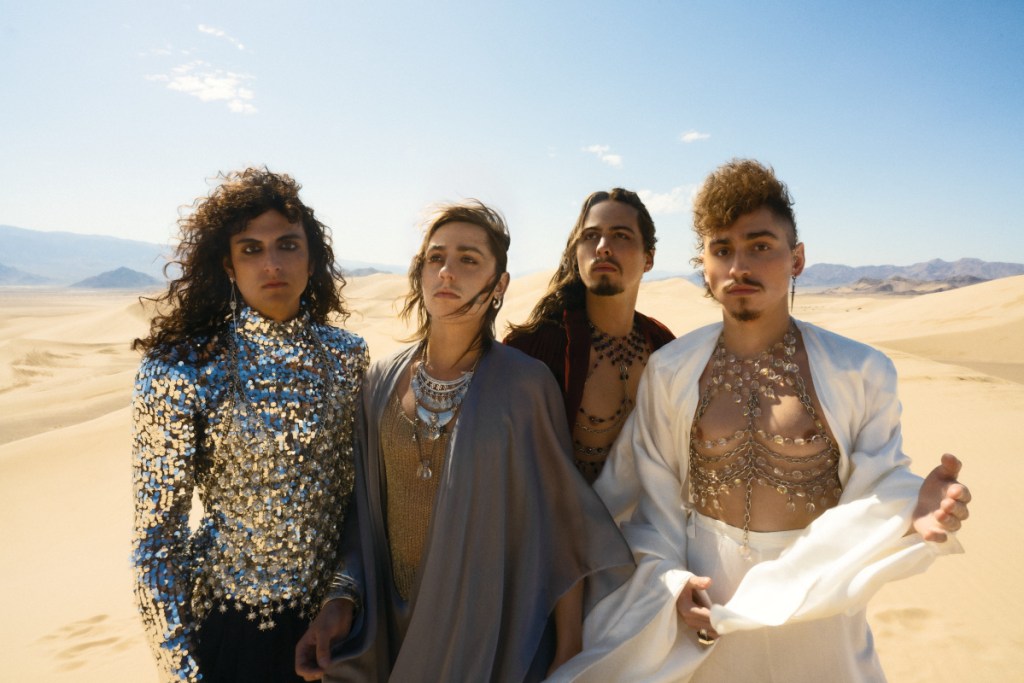
Treetop-touching vocalist Josh Kiszka says the new album that he and his Greta Van Fleet bandmates have put together, Starcatcher, had less to do with tracking and more to do with transcendence. In other words, he says, the album seemed simply to discover itself as he and his compatriots listened. To keep up with it, the musicians harbored an open mind and a taste for the essential aspects of each song, from the bones of the compositions to the theories behind the lyrics. It was a metaphysical trip as much as a musical one.
Indeed, to speak to the philosophical Kiszka, a person as keen on talking about the swirling constellations as he is his next radio single, means to encounter words like “ascendence” and “discovery.” He endeavors in these concepts through a constant readiness to receive. By examining the elements, he becomes expansive.
Videos by American Songwriter
“For this record,” he says, “I opened myself up to the songs as they were.”
The result is the new stirring LP, which dropped on July 21. It’s a 10-song set that reads as much like spells, prayers, meditations, incantations, and beckonings as it does a few months of studio work. But while one could argue that, in a sense, there is no such thing as writing music, per se, only uncovering what is already there, the coin of that exchange has always been receptivity. To be a sponge. And Kiszka and his bandmates are standing arms outstretched, eyes wide ahead of the big plunge.
“Submerging yourself into thoughts and ideas that humankind has generated since the advent of our species,” says Kiszka. ”That’s really fascinating. It’s a testament to knowledge and information and ideas. And that sets you free.”
When Kiszka conceives of the alternative—folks who are not so open-minded—he thinks of a measure of fear. He’s talked to a lot of people over the years, ever since he and Greta Van Fleet became a famous band in the mid-2010s. And he’s found that the more close-minded folks are, often the more afraid they are, too. To let go of the safety blanket—that’s the key, Kiszka says. That’s the portal through which to enjoy the colors and textures of life. He cites the maxim, “The only thing to hold onto is letting go.” And perhaps not coincidentally, Kiszka says his favorite part of the new LP is the maturity he senses on it. It feels more “seasoned,” he says. And it has a “painfully original Greta thing about it.” It’s big, to be sure. It almost attempts to swallow up the listener, like the mouth of a whale or a series of underwater caves.
For an example of these characteristics on the LP, look no further than the fiery hit, “Meeting The Master.” It’s an ecosystem of notes and swells. The stars shimmering above Alaska. The track begins with bright acoustic guitar plucking. Then Kiszka’s voice drips in: Final day to meet the master / it’s my time to go home. The words seem peeled off of some medieval scroll. In contrast, the album’s third track, “The Falling Sky,” rips and roars with electric, propulsive guitars. Kiszka growls, teeth sharp. On “Frozen Light,” the song opens with a live count-off before Kiszka shimmers like the northern lights. On “The Archer,” it’s a race to the finish. A forest of melody. The collection is a continuum of music.
“We don’t stop writing,” Kiszka says of the band’s creative process. “Ultimately, when we’ve practically finished a record, we just start writing another. So, when we finished [The Battle At] Garden’s Gate, that’s when it was obvious that it was time to move to the next thing.”
To record the new album, the group worked with Grammy-winning producer Dave Cobb in Nashville and recorded it largely live as a foursome. Cobb, who’s earned accolades for working with the likes of Americana artists Brandi Carlile, brought confidence to the project. Doing so gave the process a less-is-more feel, says Kiszka. Rather than over-dubbing left and right, everything was more natural and organic. It also proved challenging in the best of creative ways. As in that old adage, “I don’t have time to be brief,” the recording process pushed the boys of Greta Van Fleet. Getting down to the granular takes more time than it might seem at first. Refinement isn’t easy.
“Going back to approaching the more stripped-down four-piece band sound,” says Kiszka, “it was interesting—there were things happening we probably never would have done years ago.”
Fans of the band will certainly recognize the group’s large sound on the album. But when the listener works in a bit, the little details stick out even more. Like a quick acoustic riff, a kick drum rising in volume before the band comes back into the song, or a lyric about what’s beyond, what’s possible. These are the defining details that keep someone coming back for more to any work. The spice in the broth. And for Greta Van Fleet, the group has legions of fans that love what they do, both live and on wax. They’re sought after, their songs like sonic fixes. Or a meal one can’t find elsewhere.
Indeed, Greta Van Fleet is an immensely popular band. They play to tens of thousands of people on the regular. They’ve graced the Saturday Night Live stage and been nominated for multiple Grammy Awards, winning one. To get to this place in one’s career and, what’s more, sustain it takes great care and attention. And Kiszka says he can even be a bit “neurotic” and “obsessive” at times about his endeavors. But in that same vein, what he’s taken away from his effort most recently is a sense of letting that attempt at control go. For one, he’s musing on the idea of “play as productivity.” For another, he’s just trying to take deep breaths.
“You discover more that way,” he says. “And you grow in a far more profound way. The quality of your experience expands when you can just open up to your process and let things come in and don’t force things into place.”
Kiszka puts forth the thought that walking really is just falling with your body catching itself during each step. In other words, nature and instinct can take hold most of the time, and you don’t have to concentrate on trying to control everything about the journey. Rather, one should merely work to be receptive to what is happening. To wit, fans of Greta Van Fleet are certainly receptive to their anthemic offerings. Composed of Kiszka and his twin lead guitar-playing brother Jake, the band is filled out by younger brother Sam on bass and Danny Wagner on drums. Their new album booms with titles like “Fate Of The Faithful,” “Sacred The Thread,” and “Farewell For Now.” On guitar, Jake turns the instrument’s strings into electric blades. The rhythms loom, sing, and forebode. But perhaps the best parts of any Greta Van Fleet album are the big crashes—the drops in the music before the explosions of cymbals and melodic climaxes.
“I think it’s self-indulgence, probably,” Kiszka says, half-joking, talking about the band’s penchant for these big explosions. “Like watching a really sexy bit of an epic movie. It must come from some basic genetic makeup—destruction is desirable in some way. It’s like watching rock ’n’ roll cinema.”
The singer says he and the band do maintain some sense of limits when it comes to their cacophony. But the trick, at least at times, is to test those same limits. To make sure you know where they are, you have to sometimes move past a line or two. Kiszka likens it to the noise of “war and love,” and he isn’t wrong. It’s become the band’s signature, too. Formed in 2012 in small 5,000-person Frankenmuth, Michigan, Kiszka and his brothers were surrounded by the music of their parents as kids. Today, Kiszka says he has music going some “80 percent of the day.” Maybe listening to songs is his way to stay grounded to what he loves most. Not to be distracted by the 1 million Instagram followers or the billions of song streams and ticket buyers. Kiszka says he tries to stay off social media and disengage from its distractions. But the truth of the band’s popularity is inescapable.
“The rooms get bigger, and people come up to you at the airport or on the street,” he says. “They tell you that you changed their lives or that you saved their lives. Had a huge impact. I find it’s profound, but it comes with responsibility.”
Kiszka admits that it does feel at times as if there is a lot of pressure on him and the band. There can be a “great deal of anxiety” especially, he says, “because I’m my worst fucking critic.” This pressure is both internal and external, of course. The expectations from fans (or critics) and the desire to create great work. These wheels, however tough though, must remain greased with a sense of mutual respect between the artist and himself, creator and critic, frontman and fan. It’s a two-way street. Sometimes a band can seem too big not to poke. But there are always human beings on either side of that equation. Respect is ultimately paramount.
“That’s how we deal with it; that’s my perspective on it,” Kiszka says.
Starcatcher is Greta Van Fleet’s third studio LP. In 2021, the band released its second, The Battle at Garden’s Gate, which included soaring songs like “Heat Above,” “Broken Bells,” and “Light My Love.” As anyone who’s heard them knows, the band has an inescapably classic rock feel. Some like to snicker and say they sound too much like other bands like Led Zeppelin. But that’s to miss the point of the group almost entirely. Greta Van Fleet is poetry written on sticks of dynamite. If Kiszka sounds a bit like Robert Plant as the music unfurls, who cares? The band’s work, like that of the best of rock, gives arms and legs to your soul and lets it shake its stuff. And now, with the new record out in the world, Greta Van Fleet has a great deal ahead of it. There’s lots to do. How is Kiszka feeling about everything?
“Scared shitless,” he says, partly joking. True, the band’s momentum is growing “larger and larger” and that’s exciting, Kiszka says. The stage productions will be bigger as the band heads out on an upcoming lengthy tour. The wardrobes will be more “fabulous,” too, and that’s saying something given the skin-tight, at times flower-power garb that the group wears, harkening back to the revolutionary days of the 1960s. But fashion aside, Greta Van Fleet is up for the next challenge. It’s a new chapter, a new day for the foursome.
“It feels like a new era, a new age,” Kiszka says of the band’s moment in time. “We feel more adjusted than ever. We’ve jumped through so many rings of fire to get to where we are now. And there’s no stop in sight. I think that makes us giddy. We’re constantly on the go, creating.”
In the end, everything is an extension of the music. That’s what all of these outfits, stage plots, and sessions are for. But given that, what does the frontman love most about his chosen profession? He contemplates that a lot, he says. So much so that Kiszka wonders how or why anyone might not be into this stuff. For him, music is as much the treasure at the end as it is the map showing the way. He loves to dig and explore. To be “like an investigator or some kind of frontiersman,” he says. But more than anything, what Kiszka appreciates most about the songs is that they’re stories. Almost like films. The artist says he experiences songs visually as much as sonically. For him, they paint pictures as they express their complexities. They envelop as they engender a personal depth of laughter or sorrow.
“Like a whole visceral fucking experience,” Kiszka says, “if you open yourself up to it.”
Photo by Neil Krug
More Features
-
Art Garfunkel performs on TV show, USA, 1975. (Photo by Michael Putland/Getty Images) -
Photo by Luciano Viti/Getty Images -
ANN ARBOR, MI – NOVEMBER 22: American singer, songwriter, and guitarist Boz Scaggs performs on November 22, 1980, at the Hill Auditorium in Ann Arbor, Michigan. (Photo by Ross Marino/Getty Images) -
American singer-songwriter and guitarist Richie Havens, wearing a tan-coloured suede waistcoat over a black turtleneck sweater, plays a Guild D-40 acoustic guitar during a television appearance in London, England, circa 1970. (Photo by Tony Russell/Redferns/Getty Images) -
EUGENE, OR – (EDITORS NOTE: Multiple exposure made in camera) Phil Lesh of the Grateful Dead performs at Autzen Stadium on June 23, 1990 in Eugene, Oregon. (Photo by Tim Mosenfelder/Getty Images) -
UNITED STATES – JANUARY 01: Billy Joel performs live on stage during his 1980 US tour (Photo by Richard E. Aaron/Redferns)