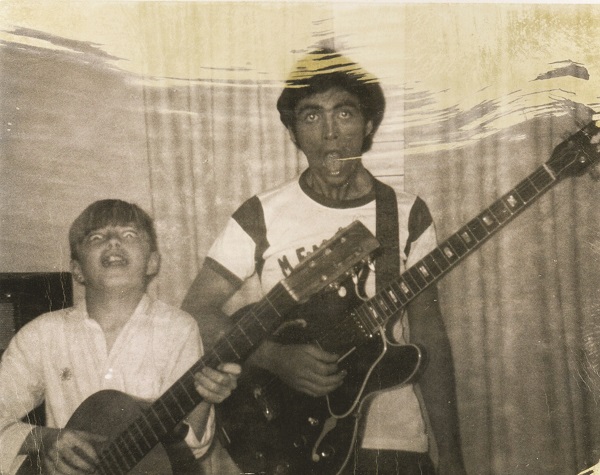
Growing up Memphis in the ’50s and ’60s, I couldn’t have avoided music, even if I’d wanted to. By the late ’60s, it seemed like every kid in Memphis was in a garage band. I joined a teenage band called “The In Crowd” and we played at skating rinks, teen clubs, fraternity parties and small-town concert halls within 100 miles of Memphis.
Most Memphis bands did their first demos at Sonic Studios on Madison Avenue, which was run by legendary rockabilly guitarist Roland Janes. I wrote about our first session there in a previous article. We’d record two songs and lip-synch to them on our local George Klein’s “Talent Party.” We broke up after a couple of years, and I graduated from Messick High School. I was playing a Fender Esquire, to which someone had added a neck pickup and painted black. My amp was a Silvertone with two 12’” speakers.
Later, in the spring of ’67, I got a call from John Evans, one of my old “In Crowd” bandmates. He asked if I wanted to play guitar for “The DeVilles,” a popular local band that John had recently joined. They’d recently hired a new singer, Alex Chilton, a gruff-voiced 16 year old. I said yes and we promptly rehearsed at Alex’s spacious house.
We did quite an eclectic mix of STAX, British Invasion, Motown and pop. But I also had to learn “that song we cut for Roy Mack” (our manager), which turned out to be “The Letter” by Wayne Carson Thompson. They had gone into Chips Moman’s American Studios and recorded the song a few weeks before I joined the band. At that time there was no record deal, just a song “in the can.” Roy Mack also managed a band called The Gentrys, who had a regional hit with “Keep on Dancin’” which was recorded at the same studio.
At our first rehearsal, there in Alex’s parents’ well-lighted living room, they told me how it all went down that day: When they arrived at American at 827 Thomas St. the studio was full of stale food and cigarette butts from the previous night’s recording session.The five DeVilles were met by song-writer and fledgling producer Dan Penn. They’d listened to Wayne Carson’s reel-to-reel demo and had it down pretty good. Alex had been up late partying the night before and his voice was even huskier than usual, especially after the multiple takes it took to get it just right. Dan, a great R&B singer in his own right, coached Alex on the pronunciation of a few words, notably “aero-plane.” The band sang harmonies on it, and string/horn overdubs (arranged by Mike Leech) were done later. Dan decided to add the sound effect of an airplane taking off. A record deal was made soon thereafter with Larry Utall of Bell Records.
“The Letter” went straight to the top of the charts. Richard Malone and Russ Caccamisi had quit the band in the meantime, so now it was Bill Cunningham on bass and me on guitar. We got really busy and changed the group’s name to The Box Tops.
In recording with The Box Tops on subsequent records I got to learn from the the house rhythm section at American Studios. I got to watch and record with them (The Memphis Boys) in Memphis and later on in Nashville. I never saw a sheet of written music at the three busiest studios in Memphis. American Studios, Stax or Hi (Royal). Everything was head arrangements. The artist or writer would play and sing the song in the studio usually and the band would write number charts right there on the spot. It takes a great ear to do that. Every musician is an arranger and producer, in a way. You agree be-forehand who’s going to do the fills in each section.
There are some basic guidelines that everybody followed: 1) Play what fits the song (even if it’s nothing) 2) Don’t “step on” the vocal 3) Less is more and 4) Listening is as important as playing.
I‘ve seen Bobby Emmons sit poised at the keyboard listening to a play-back, and when asked to put a few fills in, he listened all the way through and said “I can’t.” His ears wouldn’t let him clutter things up.
After American, I played on sessions at Hi (Ace Cannon) Stax (song demos for staff writers) Universal (Jerry Butler, Marcia Moore, The Three Degrees) and then got hired by Stan Kessler as staff guitarist at Sounds on Memphis Studios (later to become House of Blues), where I played on sessions by Billy Lee Riley , Dave Moore, The Memphis Horns, and many others.
All of these were “head arrangements” with rhythm sections making up their own parts.
Most of these sessions were done on analog recording equipment, Fender tube amps and assorted guitars. Running your guitar into a Leslie cabinet was a neat trick. Few, if any effects pedals were used at the time by the Memphis guitar players until the late Skip Pitts used a wah-wah pedal on Isaac Hayes’ Shaft soundtrack.