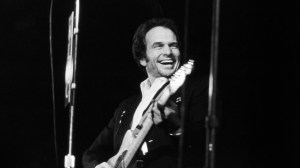

In January 2015, as storm Juno battered the East Coast, MC Taylor was spinning out in a Washington D.C. hotel room. His band, Hiss Golden Messenger, was supporting the easygoing British songwriter Ben Howard on a tour that wasn’t necessarily a perfect fit to start off with. The inclement weather had knocked out their next show — and their next fee — which compounded Taylor’s guilt over leaving his young family behind to hit the road again, having quit his job as a state folklorist following the success of Hiss’ fifth album, Lateness Of Dancers.
To stave off the spiral, he started to write, and would later come up with the line that would light the path to his next record: “I was a dreamer, babe, when I set out on the road/ But did I say I could find my way home?” Heart Like A Levee, Hiss’ second album for Merge Records, is partially about the push and pull between home and tour. “There can be a little bit of collateral damage when you’re trying to chase your dreams, even if you’re trying for there not to be,” Taylor says, calling from his Durham, North Carolina home a couple days before his 41st birthday. “And it’s easy to go out and get lost, and having a hard time getting back to where you were.”
As Hiss Golden Messenger, Taylor strikes a rare equilibrium in his songwriting. He establishes the difficulties of domesticity without denying the enduring love that makes these things worth fighting for, and respects the transcendent possibilities of music-making while remaining steadfastly grounded. It wouldn’t be in his nature to make a straightforward record about the difficulties of life on tour, even though it’s a common concern for him and his bandmates, all of them fathers. “I think traveling brought it on a little bit,” he says of his fleeting crisis, “but I’m also the kind of person that can get lost in his own mind. I’m sort of an internal person and can get lost inside myself, even in a room full of people.”
On Heart Like A Levee’s opening song, “Biloxi,” Taylor writes from the hubbub of his oldest kid’s sixth birthday party. “It’s hard, Lord/ Lord it’s hard,” runs the refrain, less of a lament than a collective sigh over the reality of balancing everyone’s individual needs. “Everybody in the whole damn place has gotta have a good time,” he sings — which can be a challenge when you’re of a solitary disposition, as he is: “All around my old hometown I was known as a loner/ You know I wasn’t lonely, I just liked being alone.” Yet Taylor’s band — Megafaun’s Phil and Brad Cook, and Matt McCaughan — counterbalance his existential queries with joyful music, a soft, rollicking crest that shimmies like a field of corn stalks in the breeze.
“This has been a constant, I feel like, on HISS records,” Taylor explains of his major chord MO. “Trying to make it happy and sad at the same time. That’s really the easiest way to say it. Figuring out a way to maintain that sort of sadness that is — I don’t know how to describe it, really. That is what life feels like for me, you know what I mean? There’s a lot of great things and a lot of hard stuff. And I want my music to exist in that whole world that seems real to me. And I’m drawn toward music that does that too. It just is powerful to me.”
A total openness underpins both the lyrical and musical sides of the record. Heart Like A Levee beams with welcoming Southern hospitality, but it’s also startlingly frank — the kind of honesty that can only ever be the product of unyielding trust. He’s a “rambling rake with a heart of obsidian” on the title track, where he frets, heartbreakingly, “Will you grieve me, honey? Did I give you a reason to try?” The seething “Like A Mirror Loves A Hammer” feels like Taylor’s attempt to chop off a limb to free everyone from his predicament, pleading with his loved ones to “build a wall I cannot climb/ Fix a lock I cannot break.” The weight of guilt bears down on the forlorn gospel of “Happy Day (Sister My Sister),” as he wonders whether he can carry “all of the grace, and all of the sorrow,” but then confronts the relative privilege of his position: “Should I wade in that river? With so many people living just/ Just above the waterline?”
“When I really sit and look at these words, I can see that I’m writing about communication,” says Taylor, who says he sees the tension between family and work as “a fair trade, you know, to be able to have a catalogue of records that are really good documents of where my mind was at during a particular year or time, and having it be something I can give to my friends and family if they’re interested — that’s a pretty big deal for me.”
After years of failing to make it as a musician, first in ’90s hardcore band Ex Ignota, then in early 2000s folk rock act the Court and Spark, 2010’s ashen, devastating Bad Debt was Taylor’s revelation. He wrote it during sleepless nights back when his son was a newborn, with zero expectations, only for it to go on and strike a wider chord. (He’s aware that to this day, it’s still many fans’ favorite Hiss album.) It taught him that “the value in making a record was just for myself being able to exorcise some demons, or have a form to talk about things that were on my mind,” he says. “And I feel like if I can do that in a genuine, straightforward manner that resonates with me emotionally, it’s a success.”
Taylor has considered how the wider audience expectations surrounding Hiss’ sixth record may have affected its writing, actively welcoming “as many people as are willing” to engage with his music, while acknowledging the danger that he elucidates in “Cracked Windshield”: “A song is just a feeling when you make it pay the rent/ Next thing you know you’re saying something you’d never say.” That hasn’t necessarily happened, though he’s not immune to the possibility.
“I would be hard pressed to probably find a recording of myself where there was not some kernel of something in there that I recognized as real,” he says. “But that doesn’t mean that I haven’t thought, maybe I should do it this way, maybe people will respond if we arrange it like this. That always happens — to everybody, I think.” There is some complication about making a living at this, he says, “but I’m pretty sensitive about how I use music in my life. I feel like it has to do something very particular for me. And that’s how I want my music to feel, too.”
That particular quality is an “emotional commitment,” he continues. “It’s hard to explain what exactly that thing is, scientifically, but it’s definitely something that people recognize. It’s something that compels me towards music, I’ll put it that way. And so I feel like knowing that music like that exists in the world, I want to be part of that river.” (Taylor’s social media feeds plot this river with alacrity, constantly sharing heartfelt recommendations for everything from Traffic’s The Low Spark Of High Heeled Boys to Bunny Wailer’s Blackheart Man, and Augie Meyers’ Western Head Music Co.) “You can feel when a musician or artist is making music that’s very self-conscious, and that’s not really what I respond to,” he adds. “I don’t generally think of that as being a pathway towards a sort of timeless vibe. There’s music that feels very self-conscious, and I really would love to stay out of my own way with my own music.”
*****

Heart Like A Levee didn’t even necessarily start out as the sixth Hiss Golden Messenger record. In 2015, Durham’s Duke University approached Taylor about participating in one of their Performances From the Archives, a program that pairs artists with historic resources from their Rubenstein Rare Book and Manuscript Library. Taylor was presented with the late American photographer William Gedney’s portraits of a family at the Blue Diamond Mining Camp in Leatherwood, Kentucky, from 1972, and agreed to work with them. “I spent a lot of time with the photographs, and sort of tried to write towards them, but it wasn’t really working. So I put the photos away and wrote about my feelings, both as we traveled around and while I was at home.”
He would periodically check back in with the photos, keeping them pinned to his writing wall, and found himself drawn particularly to the monochrome image of a young boy that now appears on Heart Like A Levee’s cover, clutching his shoulders and staring deep into Gedney’s camera. “His expression and his eyes are so right on the money of emotion that I feel very powerfully toward,” he says. “There’s a sort of challenging feeling and then a very vulnerable feeling that coexist in his expression that I’m really drawn to. So the emotions that appeared in the pictures, I was kinda hearing them in the songs on this record. It’s a weird relationship, but one that was really fruitful.”
Taylor performed the songs at Duke in October 2015, and soon after entered a local studio in Durham to record the album, jettisoning the immersive barn-tracking experience of Lateness Of Dancers. “I wanted the recording process to be straightforward and sort of fun and impulsive, but I didn’t want to take a really long time to do it,” he explains. “I still feel like there’s some value in trying to make a record quickly.” Taylor and Brad Cook undertook extensive pre-production (“there’s pretty much a home-recorded version that I could conceivably put together,” he says), and laid down the basic tracks live in the studio. “Then I started having people come over and add little parts,” he says, praising his core collaborators, and guests Alexandra Sauser-Monnig, Tift Merrit, Michael Lewis, Matt Douglas, Chris Boerner, Josh Kaufman, Ryan Gustafson, Sonyia Turner, and Jon Ashley.
Already, Taylor considers Heart Like A Levee to be his best album. “I think the way that we captured everybody in the room playing is pretty special,” he says. “It feels like we hit a lot of sweet moments together, which is important to me because the people that I play with — I love them. Having this as a reminder of something we all did together is great. I like the way that it sounds, the way that it’s sequenced — which was not terribly deeply thought out, but rolls in a really powerful way. And there’s a certain set of things that I’m thinking about with this record that really are still with me. And I feel like I was able to articulate them well this time.”
Hiss’ records have often articulated a search for spirituality: not God, precisely, but some kind of guiding, transcendent spirit. Both the wordless crescendo of “Ace Of Cups Hung Low Band” and the final lines of the gently swinging “Highland Grace” feel as close as he’s ever come to finding a resolution in that regard, locating a faith that doesn’t depend on physical proof:
And if you can’t buy it and you stand and deny it
And if you can’t see it and you refuse to believe it
And if you can’t count it but you can’t help but doubt it
But loving her was, easy, the easiest thing in the world.
“That theme is definitely present on this album, this kind of reckoning with spirituality,” he says. “There’s family of course; there’s wandering and trying to come back home, and kind of dealing with the way that we change when we leave and re-entering when you get back home — that’s a real thing.” But for Taylor, part of what he considers to be articulating his thoughts well relies on a lack of specificity. “I feel like there’s enough mystery on this record for me to live with for a while. There’s a lot of question marks here, in a good way — there are a lot of holes for me to go down when I think about these songs, and I have to have that, places to explore certain ideas.”
Often that means writing, and leaving in things that he doesn’t quite understand at the time. “Like maybe I think I’m not articulating it quite right, or it’s a little opaque, but the more I sing it the more I get what my subconscious was trying to say,” he expands. “I think that’s what I want my relationship with my music to be like, even though it’s hard. You can’t program that, but I feel like you have to invite it in when you sense that it might be around. I wanna grow with these songs, and I think part of it is not knowing them fully. There are other songwriters that know every syllable of their songs exactly, and that’s also cool, but that’s not what I’m doing, really.”
More Features
-
Art Garfunkel performs on TV show, USA, 1975. (Photo by Michael Putland/Getty Images) -
Photo by Luciano Viti/Getty Images -
ANN ARBOR, MI – NOVEMBER 22: American singer, songwriter, and guitarist Boz Scaggs performs on November 22, 1980, at the Hill Auditorium in Ann Arbor, Michigan. (Photo by Ross Marino/Getty Images) -
American singer-songwriter and guitarist Richie Havens, wearing a tan-coloured suede waistcoat over a black turtleneck sweater, plays a Guild D-40 acoustic guitar during a television appearance in London, England, circa 1970. (Photo by Tony Russell/Redferns/Getty Images) -
EUGENE, OR – (EDITORS NOTE: Multiple exposure made in camera) Phil Lesh of the Grateful Dead performs at Autzen Stadium on June 23, 1990 in Eugene, Oregon. (Photo by Tim Mosenfelder/Getty Images) -
UNITED STATES – JANUARY 01: Billy Joel performs live on stage during his 1980 US tour (Photo by Richard E. Aaron/Redferns)