
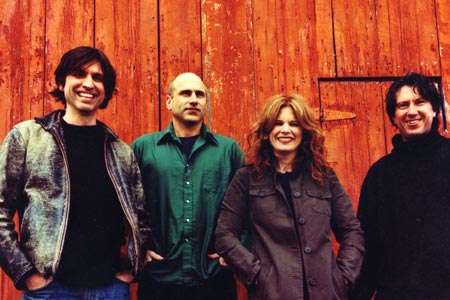
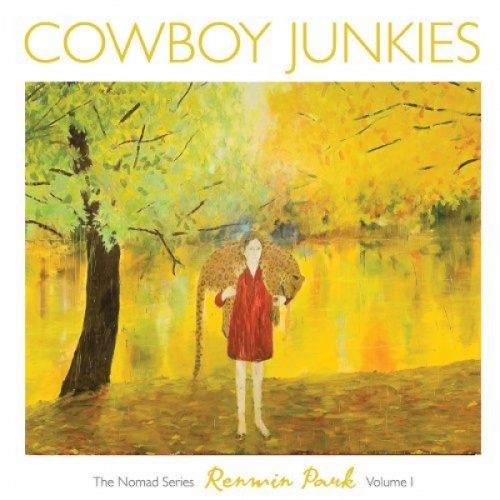
Cowboy Junkies have been making great music since 1985; and they’re about to make a whole lot more. Their latest album, Renmin Park, finds them exploring new sounds and locales; it’s a concept album, inspired by band member Michael Timmins’ trip to China with his wife and adopted daughters. That’s record one in The Nomad Series; they’ve also got two more albums and Demons, an LP of covers of the late, great Vic Chesnutt, in the works. It’s a good time to be a Cowboy Junky.
What lead you to go to China?
Michael Timmons: We always wanted to get back to the country where [my daughters are] from, their home, and their real identity, and give them a sense of where they come from, basically. We wanted to do, rather than doing a two-week rolling trip, which would be kind of pointless, we wanted to give them a sense of the place. And my wife got a job teaching English, which allowed us then all to move there for three months, and the school where she was teaching supplied us with a dorm in the school that we used as a home base and lived in the small town there, and were able to travel from there.
Did you write these songs while you were there, or did you write them when you got back?
These were written when I got back, probably a good year after I returned, where I was able to slowly process the information and figure out how to approach it. There’s no real time when I was there to do that, there was almost too much stimulus in some ways, so I did very little writing. I did no songwriting, I did a lot of sort of personal writing and a lot of recording of sound.
What were some of the things you were inspired to write about on the album?
The album is really a concept album set around our visit there, but part of it is about our daughters and where they’re from, and their situation. Part of it is about the people that we met and some of their stories are sort of embedded in there. Part of it is about some of the many contradictions of modern China, it’s history, and it’s modern history, and part of it is about me, and being a total outsider in a very strange place.
Were your band mates totally into the idea, or was it a tough sell?
They didn’t know what form this thing would take or how we would go about it, so it was difficult for me to explain it to them, to get them on board. I think it was difficult for them at first when it was just a concept, but the minute we began to work on it, the first thing we did was create these loops and use them as field recordings. As soon as they began to hear those, it was like, “OK, I think this is going to be interesting,” so they got into it from that point of view.
Did you have that concept of the Nomad Series in mind before you started Renmin Park?
No. I mean, Renmin Park is the first volume in that series. I guess coming up with the concept for the Nomad Series almost allowed me to get started on Renmin Park because we really didn’t know how to approach our next record or what to do, and we had so many ideas. Once e we came up with this idea of doing four different records, as opposed to trying to distill everything into one, then I was able to kind of focus on the writing and the making of Renmin Park.
Is this a particularly creative time for the band? Do you always have so much material around, ready to put out?
No, we’re feeling particularly creative. We’re in a new phase of what we do from a business point of view; we’re kind of free of any sort of a structure as far as any kind of contracts go. It’s opened up our eyes a lot to what the possibilities are. When you’re under certain contracts, there’s only so much you can do. You’re restricted by the needs of your partner. This has allowed us to free our minds a little bit and experiment and expand and go from there, so it’s really just been a function of where we are as people right now. We have our own studio and we’re excited about the music we’re making, and then couple that with the idea that we can do what we want as far as getting out there and creating what we want, and in any form we want.
What’s the typical songwriting process for the band these days? Has it evolved over the years?
Renmin Park was probably the most radically different way of approaching songwriting for us. A lot of the music landscapes and soundscapes were created beforehand, and then I wrote the lyrics and the melodies to those, which was kind of a different way of doing it. Usually, the two go hand in hand, and are built on together. But with this record, just because of the nature of it, we built a lot of songs around this the sound field recordings I did. Generally though, it’s about the same. I tend to write the songs in isolation and then bring them into the band, and then as a band we begin to work on them and create them and build from there.
Would you say it’s easier or harder to write songs, now that you’ve written so many?
I still really enjoy it. It’s still difficult and it’s still easy. Because I like it so much, it’s easy for me to sit down and focus on writing a song. It’s not an easy thing to do, still—never has been.
Does the band have a general policy about covers? That’s one of the things you do so well.
Not really. Often one of the reasons we’ll do a cover is because of a specific project attached to it, right now in concert we’re doing a Neil Young song, “Don’t Let It Bring You Down.” The reason we’re doing that is because a couple of years ago we did a Neil Young tribute show at Massey Hall here in Canada. We were one of the bands asked to do a song and we picked that one and it’s now in our repertoire. We’re also doing a couple of Rolling Stones covers. We just participated in a Rolling Stones tribute album. Even when we do pick a song, if we don’t like what we’ve done with it, we don’t do it, we move on. We just have to feel we’ve brought something to the song that’s different, that’s the main thing.
I’m curious about Demons, the Vic Chesnutt covers record you guys have coming out in October. Were those songs radically reworked?
We’re just in the middle of doing it. I’d say some of them are pretty radically reworked, although some of them are very straight. I mean, it’s hard for me to know that from my perspective, because as a songwriter and as somebody who’s pretty knowledgeable about the making of songs and music, they’re not radical to me because, I know where the songs are coming from. To me, they’re fairly true to his versions, but I think if you put most of the songs that we’re covering side by side with the originals, I think you’re average listener would go, yeah. those are completely different songs. When we approach them, we never approach a cover by trying to copy the original; we approach it to get an idea of the structure, melody, then we play together as a band and we let it develop and go from there.
What songs have you recorded?
Actually, I’m going to the studio after this. We will have recorded about nineteen tracks. We won’t use them all, we’ll probably cut that down to about twelve, but we’ve done “Sad Peter Pan,” we’ve done “Ladle,” we’ve done “Supernatural,” “West of Rome.” We’ve done “When the Bottom Fell Out,” we’ve done “Flirted with You all My Life,” “Guilty by Association,” “What Do You Mean?” Quite a few.
I can’t wait to hear it.
We’re pretty excited about it. It’s been a really amazing process for us, to really get deeply into his catalogue, to really go through it and to look at how he creates. The fun thing about doing covers is that you really get to get inside of another songwriter’s head, and inside of his process. It’s been amazing with Vic. You realize just how amazing, and how strong and multidimensional what he did was. It’s pretty incredible.
Does it feel strange at all to play his songs, or sad in any way?
Yeah, sometimes. “Intense “is the word, There’s certainly times where I’m listening to a playback that we’ve done and you get that sort of sense of loss, for sure. You think there’s a really brilliant guy who’s gone now, so yeah, it’s been a very intense experience.
What do you think it is about his songwriting that makes it special?
He has so many elements in there within the course of one song He can be deeply serious and then comically hilarious, and ironic, and very honest. And it doesn’t feel odd, they all feel very natural. It doesn’t sound like he’s trying to be these different things. I think that’s what his personality was, I think that’s the beauty of it. And the other thing is the vocabulary he used in the songs. It’s pretty amazing, it’s very unusual, and I think for most songwriters, some of the words he uses, and some of the terms and phrases, they can never carry it off, but he’s able to do so. The other thing is just the way you approach them from a recording point of view — I just love his sort of, almost casual approach to his music; at least it comes off as casual.
The rest of the Nomad project include an album called Sing In My Meadow and one called The Wilderness. Can you tell us what those are going to be?
Sing In My Meadow is still kind of up for debate. We’re still figuring out what that’s going to be and we’re kind of still fine-tuning that one. We haven’t agreed on what it is yet. The Wilderness is really a collection of new material that we’ve been working on before we got into Renmin Park. We were working on a collection of songs and we were introducing them live in concert over the past year, and probably introduced seven or eight of them already on the stage, so that’ll be those songs. That’s basically a collection of new material. Again, I don’t know if there will be a theme that links them together or not, but that’s what that will be.
What’s a song from The Wilderness that people are really getting into, or that you guys are really into?
“Angels in the Wilderness,” where the title of the album comes from. It’s really a reflection on children growing up and going out into the world from a parent’s point of view, in the sense that at one point one has to let them go, and hope that there are angels out there, or whatever you want to call them, forces out there that will keep them safe. You really have no say in that. It’s a real leap of faith, letting your kids got out into the world.
Is there anything else you can tell us about the Nomad Project?
The one thing we’re kind of proud of with this whole project is, we’re using our website as a sort of portal to look into the making of the project. So as we go along, we’re posting a lot of demos, or a lot of writings about the songs and the makings of it. And we’ll continue to do that with Renmin Park over the summer, and then when we’ll move into the fall, we’ll begin to do that with Demons, the next record, so the website is a big place to go to look at what we’re doing and get more involved with it.
More Interviews
-

Photo by Kevin Mazur/Getty Images for CMA -

NASHVILLE, TN – OCTOBER 29: Eagles, Timothy B. Schmit, Vince Gill, Don Henley, Decon Frey and Joe Walsh perform during the Eagles in Concert at The Grand Ole Opry on October 29, 2017 in Nashville, Tennessee. (Photo by Rick Diamond/Getty Images) -

NASHVILLE, TENNESSEE – SEPTEMBER 12: Honoree Vince Gill attends CMT Giants: Vince Gill at The Fisher Center for the Performing Arts on September 12, 2022 in Nashville, Tennessee. (Photo by Jason Davis/Getty Images for CMT) -

Photo by Ingrid Fortenberry