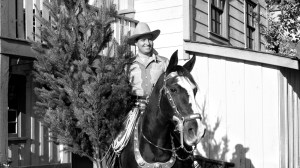
From the musical repertoire to the dress code to its decades-long instrument ban, the Grand Ole Opry took great pride in being as traditional as possible in the years immediately following its creation in 1925. The Grand Ole Opry radio show came on the heels of the incredibly popular National Barn Dance out of Chicago, and the Nashville show stayed true to its inspiration’s roots. Performances centered around bluegrass, gospel, and country—a “rock ‘n’ rollers and long-haired types need not apply” kind of establishment.
But when you’re working with musicians, you’re going to run into some strong personalities. And indeed, Bob Wills and the Texas Playboys’ first appearance at the Grand Ole Opry was a testament to that fact.
Videos by American Songwriter
Bob Wills and The Infamous Grand Ole Opry Instrument Ban
Bob “King of Western Swing” Wills and his Texas Playboys had traveled a long way to reach the iconic stage of the Grand Ole Opry radio show. The Playboys had already established a name for themselves, performing in dance halls throughout the Western U.S., big cities in the East, like Chicago, and even in Hollywood films. The band and its over 20 members were no strangers to the stage by the time they arrived in Music City, USA, to perform at the Opry. However, the Opry’s strict rules did throw the Playboys for a loop.
Opry founder George D. Hay had a particular vision about how he wanted his radio show to operate, and that meant leaning into the Southern rural aesthetic with traditional clothing and instruments (and nothing that contradicted the two). That meant no horns, electric guitars, or drums, which Hay believed were too pop for the program. When one musician asked Hay if he could play a steel guitar through an amp on stage, the founder reportedly said, “I’d rather you not. We want to hold it down to earth.”
Wills and his band were not in the business of holding things down to earth. In fact, according to famed Opry comedian Minnie Pearl, the Playboys’ arrival turned the Nashville program on its head. “The people were awestruck,” she wrote in her biography, per Richard Kienzle’s Southwest Shuffle: Pioneers of Honky Tonk, Western Swing, and Country Jazz. “His men got off the bus dressed in an all-white western wardrobe. No sequins or fancy studs, just exquisitely tailored gabardine, cut in the Western style.” Of course, their outfits wouldn’t be the only thing garnering people’s attention during that fateful visit.
A Last-Minute Decision Changed Up The Iconic Program’s Rhythm
When Bob Wills and the Texas Playboys arrived at the Grand Ole Opry, a member of the production staff told Wills about the program’s instrument ban. If he insisted on having his drummer, Monte Mountjoy, perform, the percussionist would have to do so behind a curtain, out of the audience’s view. “Bob and the powers that be had it out,” Mountjoy later recalled. “He said, ‘My drummer either plays from out behind that curtain, or we don’t play!’” Eventually, Wills ceded to the Opry’s request, and Mountjoy began setting up his drums backstage. “I felt very self-conscious,” he said.
Mountjoy said that when Opry veteran Uncle Dave Macon caught sight of his drumkit, “He about flipped his dipper. We were breakin’ tradition and all that. He went by a couple of times mumlin’ about ‘G**damn young upstarts’ and ‘What they doin’ with those drums here?’ It was pointed at me, and I just went on settin’ my drums up. I didn’t pay any attention to it because it wasn’t my place to say anything.” But if Macon and the production crew thought Mountjoy playing drums behind a curtain was bad, they were in for a real surprise when, mere minutes before the band took the floor, Wills ordered Mountjoy to move his kit to center stage.
The event organizers didn’t have enough time between seeing Wills’ impromptu change and the start of his set to move Mountjoy’s drums back, so Wills and the Playboys performed with their drummer alongside them, making Grand Ole Opry history.
Photo by Michael Ochs Archives/Getty Images
More Features
-
LOS ANGELES – CIRCA 1975: Country singer Dolly Parton performs onstage wearing a yellow dress in circa 1975 in Los Angeles, California. (Photo by Michael Ochs Archives/Getty Images) -
NEW YORK, NY – CIRCA 1980s: David Bowie circa 1980s in New York City. (Photo by PL Gould/IMAGES/Getty Images) -
CROCKETT – APRIL 12: A CBS television country music presentation, A Special Kenny Rogers. Originally broadcast April 12, 1979. Crockett, TX. Pictured is Kenny Rogers. (Photo by CBS via Getty Images) *** Local Caption *** Kenny Rogers -

Photo by The Sydney Morning Herald/Fairfax Media via Getty Images -
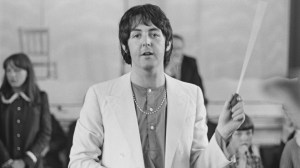
English musician, singer, songwriter, and composer Paul McCartney records the Lennon-McCartney composition 'Thingumybob' with the Black Dyke Mills Band in Saltaire, City of Bradford, West Yorkshire, 30th June 1968. (Photo by Tony Evans/Timelapse Library Ltd./Getty Images) -
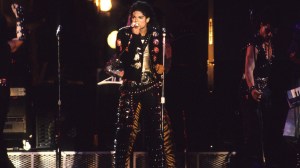
USTRALIA – NOVEMBER 20: Photo of Michael JACKSON; Michael Jackson performing on stage, with backing singers, at the Paramatta Stadium in Sydney – Bad Tour (Photo by Bob King/Redferns) -
Photo by Sinnerman Photography