
Jimmie Rodgers was one of the artists who helped popularize country music in the late 1920s. His blend of folk and blues inspired generations of artists. In fact, one could trace the influences of nearly any modern country artist back to Rodgers. Less than two decades later, Ernest Tubb would come along and forever change the face of the genre with his 1941 single “Walking the Floor Over You.” Many credit Tubb, and specifically that song, with creating honky tonk music. However, Tubb likely wouldn’t have his lasting legacy without the influence of Rodgers.
Before Tubb lost his ability to yodel and found his own sound in the late 1930s, he did his best to sound like Rodgers, his musical hero. He loved the Singing Brakeman’s music and deeply respected his legacy. As a result, in 1936, three years after Rodgers died, Tubb contacted his widow, Carrie Rodgers. The “Thanks (Thanks a Lot)” singer hoped to get a signed photograph of his idol, and received so much more.
Videos by American Songwriter
Ernest Tubb Connects with Jimmie Rodgers’ Widow
Jimmie Rodgers died in 1933, but Ernest Tubb’s reverence for his legacy lived on. Three years after Rodgers’ passing, Tubb found who he believed to be his idol’s widow, Carrie Rodgers, in the phone book. After building up his courage, he dialed the number. He soon found that his assumption was correct and asked Mrs. Rodgers for an autographed photo of her late husband. She agreed, and the two met. By all accounts, they immediately hit it off, and Tubb invited her to listen to his regular show on a local radio station.
That wasn’t the end of their interaction. Instead, the two became close friends. More than that, Mrs. Rodgers started advising the young singer/songwriter and doing what she could to further his budding career. She helped him buy clothes so he could look sharp during his performances. She also helped him find new songs to record. More importantly, she helped Tubb land his first record deal, according to the Country Music Hall of Fame and Museum.
He signed with Bluebird, a subsidiary of RCA Records, the label to which Rodgers had been signed. He released a handful of singles and a pair of albums on the label. Those releases saw him doing his best to sound like Rodgers. His friend and advisor did her best to ensure Tubb’s success, taking him on a tour of movie theaters in the region to help promote those early recordings. Unfortunately, though, both the tour and the recordings were unsuccessful.
Finding Success
Ernest Tubb underwent a tonsillectomy in 1939 that drastically changed his singing style. The surgery lowered his voice and took away his ability to yodel. As a result, he had to find his own vocal style. A year after the surgery, in the spring of 1940, Tubb inked a deal with Decca Records. A year later Decca issued “Walking the Floor Over You” and it helped create the blueprint for honky tonk music.
To sum things up, if Tubb hadn’t picked up the phone on that fateful day in 1936, the history of country music would look much different than it does today.
Featured Image by Universal/Kobal/Shutterstock
More Features
-
Photo by Michael Putland/Getty Images -
NETHERLANDS – JANUARY 01: NETHERLANDS Photo of Liam GALLAGHER and Noel GALLAGHER and OASIS, L-R:Tony McCarroll, Paul 'Bonehead' Arthurs, Noel Gallagher, Liam Gallagher, Paul 'Guigsy' McGuigan – posed, group shot (Photo by Michel Linssen/Redferns) NETHERLANDS – JANUARY 01: NETHERLANDS Photo of Liam GALLAGHER and Noel GALLAGHER and OASIS, L-R:Tony McCarroll, Paul 'Bonehead' Arthurs, Noel Gallagher, Liam Gallagher, Paul 'Guigsy' McGuigan – posed, group shot (Photo by Michel Linssen/Redferns) -

LOS ANGELES – JUNE 12: Rock band Radiohead (Thom Yorke 2nd from left) poses for a portrait at Capitol Records during the release of their album OK Computer in Los Angeles, California on June 12, 1997. (Photo by Jim Steinfeldt/Michael Ochs Archives/Getty Images) -
American Country musician Vince Gill plays electric guitar as he performs onstage at the Beacon Theatre, New York, New York, May 15, 1991. (Photo by Gary Gershoff/Getty Images) -
UNSPECIFIED – CIRCA 1970: Photo of Stoney Cooper Photo by Michael Ochs Archives/Getty Images -
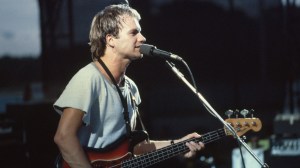
Original Caption) : 1981: Sting, of the British pop band The Police, sings and plays bass during a concert. (Photo by Lynn Goldsmith/Corbis/VCG via Getty Images) -
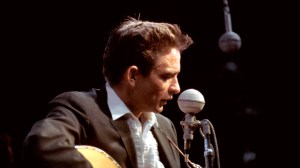
UNITED STATES – JULY 24: NEWPORT FOLK FESTIVAL Photo of Johnny CASH, Johnny Cash performing on stage (Photo by Gai Terrell/Redferns) -
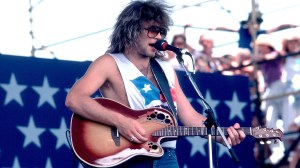
American musician Jon Bon Jovi performs at the Manor Downs Racetrack for the Farm Aid II Concert, Austin, Texas, July 4, 1986. (Photo by Paul Natkin/Getty Images)