
Porter “Mr. Grand Ole Opry” Wagoner certainly couldn’t be considered a one-hit wonder by any stretch of the imagination, but he certainly helped inspire some. For one 1960s artist, that inspiration came from watching Wagoner perform a particularly moving gospel song on his eponymous television show. The inspiration was so swift that the artist managed to scratch out the lyrics to his own gospel song in a matter of minutes.
We’d guess that the final result had too much fuzz for a man of Wagoner’s traditional country sensibilities.
Videos by American Songwriter
Porter Wagoner Helped Inspire This Iconic 1960s One-Hit Wonder
Of all the one-hit wonders to come out of the 1960s, one of the most enduring is far and away Norman Greenbaum’s 1969 track, “Spirit in the Sky.” With its distinctly fuzzy guitar tone, blistering solos, and soulful backup harmonies, the song remains a staple on radio stations and in television and film to this day. When Greenbaum first released it as the title track to his December 1969 album, it skyrocketed to No. 3 on the Billboard Hot 100. Billboard also named the song the No. 22 track of 1970. Yet, as enduring as this song may be, Greenbaum scratched out the lyrics in a matter of minutes.
Greenbaum got the inspiration for “Spirit in the Sky” after watching country legend and television show host Porter Wagoner singing a gospel song about redemption on his titular program. “I thought, ‘Yeah, I could do that,’” Greenbaum recalled in a 2006 New York Times interview. “Knowing nothing about gospel music. So, I sat down and wrote my own gospel song. It came easy. I wrote the words in 15 minutes.” When I die and they lay me to rest, Greenbaum begins. Gonna go to the place that’s the best.
The blend of gritty electric guitar and gospel melodies made the song an instant success, giving it a versatility that made it as appropriate in a church as a dive bar. “I get emails from nine and ten-year-old kids who say it’s their favorite song. I’ve gotten letters from funeral directors telling me that it’s their second-most-requested song to play at memorial services, next to “Danny Boy,”” he continued.
Norman Greenbaum’s Second Wave Of Spiritual Inspiration
In addition to Porter Wagoner’s rousing gospel performance on the Porter Wagoner Show, Norman Greenbaum credited a piece of greeting card artwork as being another significant source of inspiration for “Spirit in the Sky.” Speaking to American Songwriter in 2018, Greenbaum said, “I had come across a Hopi Indian greeting card that had a totem and a spirit in the sky on it, and that stuck in the back of my head, and it all just came together, the Indian part and the Porter Wagoner part.”
The “Porter Wagoner part” included phrases that incorporated Christian terminology, like I’ve never been a sinner, never sinned. Greenbaum, who grew up in a traditional Jewish household, was merely trying to imitate the language of gospel music. That rubbed some Christians the wrong way. Greenbaum told the New York Times critics often pointed to that line in the song, saying, “We’re all sinners. We were born sinners.” He continued, “Okay. So, what do I know? Sanford and Sons was written by Jews, and what did they know about being Black?”
He admitted to American Songwriter, “I did flub it, I guess. If I was a Christian and was writing from that mindset, I would have said, ‘I’ve been a sinner.’ But since I didn’t have that upbringing, it never occurred to me that it was wrong.” Nevertheless, two million sales and a double-platinum certification later, we’d say the general masses didn’t mind the lyrical discrepancy too much.
Photo by Christopher Berkey/EPA/Shutterstock
More Behind The Song
-
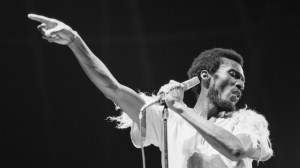
Jamaican singer Jimmy Cliff performs on stage at Porte de Pantin, in Paris. (Photo by John van Hasselt/Sygma via Getty Images) -
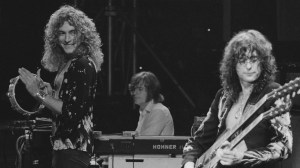
Left to right: Robert Plant, John Paul Jones and Jimmy Page, of British heavy rock group Led Zeppelin, performing at Earl's Court, London, May 1975. The band were initially booked to play three nights at the venue, from 23rd to 25th May, but due to public demand, two more concerts were later added, for 17th and 18th May. Total ticket sales were 85,000. (Photo by Michael Putland/Getty Images) -
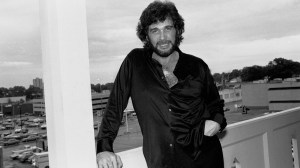
Portrait of country singer Eddie Rabbitt in Memphis, Tennessee, May 31, 1981. (Photo by Paul Natkin/Getty Images) -
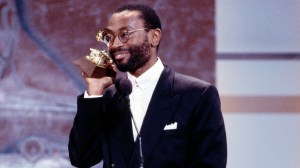
LOS ANGELES – FEBRUARY 22: 31st Annual Grammy Awards. Broadcast February 22, 1989. Shrine Auditorium, Los Angeles, California. Pictured accepting award is Bobby McFerrin. His song "Don't Worry, Be Happy" won Record of the Year, Song of the Year, and Best Pop Vocal Performance, Male. Also Best Jazz Vocal Performance, Male. (Photo by CBS via Getty Images) -
LAS VEGAS, NEVADA – APRIL 03: Singers Mike McGuire (L) and Marty Raybon of Shenandoah attend the 51st Academy of Country Music Awards at MGM Grand Garden Arena on April 3, 2016 in Las Vegas, Nevada. (Photo by Rick Diamond/ACM2016/Getty Images for dcp) -
Photo by Tim Mosenfelder/Getty Images -
The three founding members of Talking Heads on a Manhattan rooftop, US, 1976. (Jerry Harrison would join the group at the beginning of 1977.) (L-R) Bassist Tina Weymouth, singer-guitarist David Byrne and drummer Chris Frantz. (Photo by Linda D. Robbins/Getty Images) -
Patty Smyth of Scandal at the Poplar Creek Music Theater in Hoffman Estates, Illinois, June 3, 1983. (Photo by Paul Natkin/Getty Images)