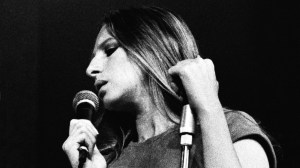
In May 1966, The Rolling Stones released “Paint It Black”, cementing themselves as formidable players in the British Invasion. It also drew comparisons to The Beatles, as the Stones were often pitted against the Fab Four as their edgier counterparts.
In 1964, The Rolling Stones were making a name for themselves in the U.K. while their contemporaries were gaining popularity across the pond. The year after, they broke through with “(I Can’t Get No) Satisfaction”. This put them on a path to mainstream success in the U.S.
Videos by American Songwriter
Around this time, the Stones were taking notice of what The Beatles were doing and drawing inspiration. Additionally, Mick Jagger and Keith Richards were already being compared to John Lennon and Paul McCartney as a songwriting team.
“Paint It Black”—and the 1966 album Aftermath—was a turning point for The Rolling Stones. The album was the first penned entirely by Jagger and Richards. The single became a huge hit and began to solidify the band’s place as a cultural influence. It marked them as a counterpoint to The Beatles, a rougher, edgier version of the Fab Four.
“Paint It Black” Was the First Time The Rolling Stones Used a Sitar, but It Gave Them an “Irrepressible Hit”
In 1965, The Beatles became the first British band to use the sitar. They recorded “Norwegian Wood (This Bird Has Flown)” with George Harrison playing the sitar, which he had picked up by chance while filming Help! in London.
Brian Jones, who at that time was still with The Rolling Stones, was inspired to try the instrument for himself after speaking with Harrison. Jones would craft various melodies on sitar, one of which eventually became the opening riff on “Paint It Black”.
When the single was released, critics were mixed. Some felt it was The Rolling Stones’ best work to date, while others saw it as too derivative of The Beatles. The influence of “Norwegian Wood” is unmistakable, but the sitar on “Paint It Black” went slightly further.
Jones’ work with the instrument essentially inspired an entire subgenre of psychedelic rock music using a minor key, according to the 2005 book Strange Sounds: Offbeat Instruments And Sonic Experiments In Pop.
Many reviews at the time lauded “Paint It Black” for its experimentation. Some felt that it was ushering in a shift away from commercialization and into a more authentic sound. One example includes a 1966 review from Record World.
“Guys are in depressed mood,” the publication wrote. “But the rhythm is anything but depressed. Irrepressible hit.”
Featured Image by CBS via Getty Images
More Behind The Song
-
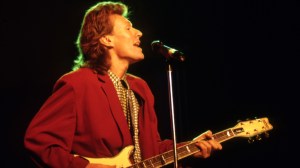
CLARKSTON, MI – AUGUST 22: English singer, songwriter and musician, and former member of the Spencer Davis Group, Traffic and Blind Faith, as well as being a solo artist, Steve Winwood performs at the Pine Knob Music Theatre during his "Back In The High Life Tour" on August 22, 1986, in Clarkston, Michigan, outside of Detroit. (Photo by Ross Marino/Getty Images) -
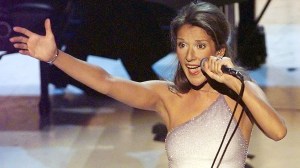
Celine Dion performs the song "Tell Him" from the motion picture "Titanic" during the 40th Grammy Awards at Radio City Music Hall in New York 25 February. Dion was nominated along with Barbra Streisand in the Best Pop Collaboration with vocals categor.(ELECTRONIC IMAGE) AFP PHOTO Timothy A. CLARY (Photo by Timothy A. CLARY and VALERIE MACON / AFP via Getty Images) -
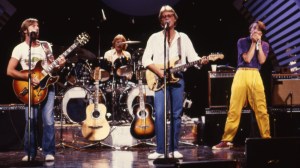
Rock and roll band "America" featuring David Dickey (bass), Willie Leacox (drums), Gerry Beckley (guitar), Michael Woods (lead guitar), Dewey Bunnell (guitar), Jim Calire (keyboards), and Tom Walsh (percussion) perform on "Midnight Special" TV show in October 1980 in Los Angeles, California. (Photo by Ron Eisenberg/Michael Ochs Archives/Getty Images) -
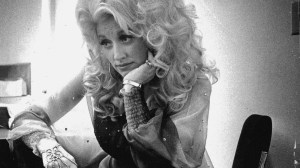
Photo by Pete Hohn/Star Tribune via Getty Images -
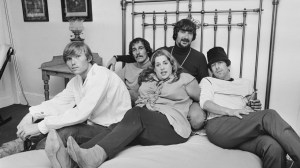
American folk rock group The Mamas and the Papas, 15th June 1966. From left to right, they are record producer Terry Melcher, band members John Phillips, Cass Elliot and Denny Doherty, and record producer Lou Adler. (Photo by Watson/Express/Hulton Archive/Getty Images) -
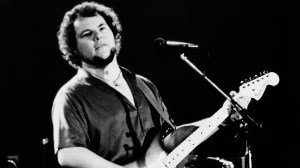
Christopher Cross 1980 (Photo by Chris Walter/WireImage) -
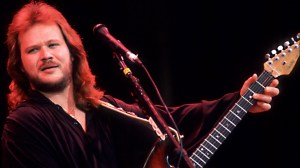
Travis Tritt during Travis Tritt – September 5, 1992 at Star Plaza Theater in Merrilville, Indiana, United States. (Photo by Paul Natkin/WireImage)