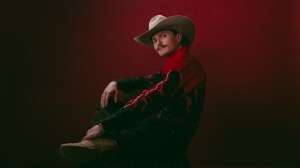

For country stalwart Marty Stuart’s 14th studio album, he returned to his roots, both figuratively and literally. Stuart aimed to bring back the traditional country music sound and style that’s delighted him since childhood, and picked the legendary RCA Studio B in Nashville, where he launched his career as a 13-year old mandolin player for Lester Flatts, to do it in. The result is Ghost Train: The Studio B Sessions, which is filled with such great songwriting and performances, it could easily appeal to country fans and non-country fans alike.
You recorded it at the same recording studio that you were in that you did your first session in, when you were 13 years old. What was that experience like?
Well, I just love that space, it’s one of the greatest studios in the world. It’s really not used as a studio as much anymore, it’s more of a museum and a stop along the route for the Country Music Hall of Fame, but we worked it out where we could go back in and take some gear and record in that particular space. It brought back a lot of memories. It was also kind of overwhelming if you think about all the songs that have been recorded there, it’s just staggering. That place as a lot of heavy ghosts in it that you kind of have to get beyond just to get to that music. It was a head full.
What’s one or two songs that were recorded there?
There’s so many. It’s called The Home of a Thousand Hits, historic RCA studio B, there’s probably a listing of everything that’s cut there. It’s just crazy.
For this album, it’s being billed as your return to traditional country roots, and you’ve said that traditional country music was in danger of slipping way. Why is that?
You don’t hear a lot of it on the radio anymore. It’s almost non-existent. It’s played a lot but it’s not broadcast a lot, and there’s very few TV shows that you could turn on and find traditional country music. It’s just a great American art form, it’s a great part of America’s culture, but it’s a particular brand of country music that I really love the most and I just thought it is too precious to let slip away, so I wanted to jump in there and see if I couldn’t create some new life for it.
You co-wrote the Ghost Train track “Hangman” with Johnny Cash, and that’s the last song he ever wrote. How’s it feel to know that?
Well, it’s kind of overwhelming, but he was my next door neighbor, and I went over there and had that song started, and it didn’t take ten minutes to finish it, and I thought we would—as I left, I said, “Well I’ve got to go to Washington and I’ll see you in about four days”. I said, “You feeling good?” And he said, “I’m feeling good.” And I said, “how’s your spirit?” “It’s good.” “You got plenty of rope left?” And he said, “yup.” And I said, “I’ll see you when I get home,” and I got the call on that particular trip that he passed away, so I really didn’t think much about this other song. It was the last thing I thought about when I heard that news and as a little time got past, the song came back to my mind, and I had a visit with it, and the only thing I regret is that he’s not around so we could have done it together.
One of the great songs on the record is “Country Boy Rock & Roll.” What was the inspiration for that?
We had a bus driver a few years ago who was a big fan of this old legendary bluegrass group called Don Reno, Red Smiley and the Tennessee Cut-Ups, and he suggested that we do that particular song and I vaguely remembered it, so I called and got a recording of it, and we learned it and it’s been one of those songs we’ve included in our concerts, just about every time we’ve ever played since. So that’s where it came from, the bus driver.
And the song “Branded” actually came to you in the shower, is that correct?
Yeah.
Is that a place you often find inspiration?
It’s not the first time. It’s like when you write, you write, you know, you never know when the idea is going to hit you. It’s always wonderful though, when a song is kind of born, but that one, it just kept coming. I had to get out of the shower a couple times and try to find a piece of paper, write lines down, and as soon as I got out of the shower, I went to my desk and I got my guitar and I was singing it, and it was like, it was almost like the song had always been there.
Is there a challenge to writing songs that are in the sort of traditional country vein where you’re trying to, at the same time, create something brand new?
Well, it’s always hard. Everybody thinks that country songs are the easiest ones to write. It’s complex to write something that appears that simple. But I like that particular style, and those are my favorite kind of songs, too. The challenge is writing a good one. It’s easy to write a song. A good one’s the hard part.
Can you talk about the song “Porter Wagoner’s Grave?”
Well, I produced the last record on Porter and we spent a lot of time the last year and a half of his life, working on the record, he went out and started touring, doing some shows with me and my band, he just kind of became a big part of my life, as a friend, he was always my friend, but he became a close friend, and he got sick and it just seemed like in a matter of days he was gone, and after his service after we’d laid the Wagonmaster to rest, I got on a plane and head to Alaska to play a concert. Somewhere out of the middle of nowhere, I pulled a piece of paper out of my bag and started writing those words, kind of just as a rambling poem or something, or a piece of prose, and never in a million years expected to ever do it publicly, but I did it for my band one time and they said, man we have to do that song. It might be a little corny, but no matter what it is, we’ve got to do that song. So I did it in concert once, got a lot of response. Then I did it on my TV show one time, and got a lot of response, and I thought, well, maybe there is something here. It’s just kind of a tribute to an old friend, is what “Porter Wagoner’s Grave” is all about.
You played a show with him at Madison Square Garden not too long ago, opening for White Stripes. What was that experience like, bringing country music to New York?
Well, it’s not the first time I played in New York, but it was a wonderful thing, and I think Jack was a big Porter Wagoner fan. If you remember, he’d done a record on Loretta Lynn, so I think Jack was into the concept, taking country legends and doing new things with them, so he invited Porter to be a part of that show, and me and my band went up there to back him up. It was wonderful for me to see young kids that probably had never even heard of him, responding to him because of the way he looked and the kind of songs he was singing. It was a wonderful experience.
What are your feelings on modern country music? Are you a fan?
Of certain people and certain songs, and I absolutely encourage modern country music, trust me. I totally know that there aren’t a lot of people out there that think the way I do about some things, but we need modern country music as much as we need traditional country music. It’s a balance, and we need bluegrass, and folk music. We need all those divisions of country music, firing on all cylinders. That’s what makes country music so cool to me, but traditional country music kind of got out of balance and it’s starting to fade so it can be disregarded, and that felt wrong to me. So that’s why I followed my heart and did what I did, but absolutely we need young people performing, singing, playing their version. That’s what always made it great.
More Interviews
-

Photo by Stephen Dillon