If her ascent to rock ‘n’ roll stardom were a rollercoaster, Janis Joplin would have been in the middle of an upside-down loopedy-loop in the fall of 1970. Her increasing resumé of iconic live performances—not the least of which included Woodstock the previous year—was gaining Joplin more and more fans across the country. But just as her star was taking off, her terrestrial life offstage became increasingly difficult as substance abuse and failed relationships began taking their toll on the rock vocalist.
She would tragically succumb to the former on October 4, 1970, dying of a h***** overdose at the Landmark Motor Hotel in Hollywood. Four days before her death at 27, Joplin spoke with The Village Voice writer Howard Smith over the phone. The pair discussed Joplin’s sensitivity toward rejection and potential grievances between the singer and the women’s liberation movement. Smith prompted the latter conversation, telling Joplin that he knew women who saw Joplin as a detriment to women’s lib.
Videos by American Songwriter
To be clear, there are multiple social factors that played into this alleged controversy. Joplin’s overt sexuality should have been aligned with the sex-positive women’s liberation movement, in theory. But feminist critics didn’t like Joplin’s “one of the guys” mentality, which set her apart from her female peers. (A “pick me girl,” to use 2026 slang.) Joplin had a powerful rebuttal to these criticisms.
“You Are Only As Much As You Settle For”
Without taking a deep dive into the intricate nuances of feminism and femininity, the dissonance between Janis Joplin and her image of a liberated, brazen woman is aptly summarized in a 1976 retrospective by Rolling Stone. “Joplin’s revolt against conventional femininity was brave and imaginative, but it also dovetailed with a stereotype—the ballsy, one-of-the-guys chick who is a needy, vulnerable cream puff underneath.”
Joplin seemed to prove this theory correct while speaking to Howard Smith just days before her death, explaining sensitivity to rejection by saying, “Girls want to be reassured.” When Smith moved the conversation toward potential critics of Joplin’s, particularly from within the women’s liberation movement, Joplin’s voice deepened. “That’s their problem. Not mine.”
The singer continued that she never felt attacked by or wanted to attack anyone in the women’s liberation movement. Moreover, she argued, “How can they attack me? I’m representing everything they said they want.”
She continued, “You are what you settle for. You are only as much as you settle for. If they settle for being somebody’s dishwasher, that’s their own f***ing problem. If you don’t settle for that, and you keep fighting, you’ll end up anything you want to be. I’m just doing what I wanted to and what feels right and not settling for bulls***, and it worked.”
The Feminist Legacy of Janis Joplin Is a Complicated One
On the one hand, Janis Joplin’s unapologetic authenticity and powerful vocal style make her a significant contributor to women’s advancement in rock ‘n’ roll. But to say she was overtly feminist would be somewhat inaccurate by today’s standards. When Howard Smith pushed back against her assertions of feminism, asking why she didn’t hire women in her band, she said she hadn’t found any good players. She then added, “I don’t want any chicks on the road with me. I’ve got enough competition.”
Joplin then—somewhat ironically—asked Smith if what she said about women “sounded bad.” She reiterated that she didn’t want to offend anyone, citing her own “repressive upbringing” in Port Arthur, Texas. Still, Joplin said that a woman’s choice to march to the beat of her own drum had to come from within. “I don’t think you can talk anybody into fighting against [that regressive upbringing] if they don’t have it in themselves to need more. Just plain need more. If they do need more, they’ll get more.”
Joplin died four days after her phone call with Smith. She left behind a monumental musical legacy, leaving the world with iconic tracks like “Piece of My Heart”, her rendition of “Summertime”, and the posthumous hit penned by Kris Kristofferson, “Me and Bobby McGee”.
Photo by David Fenton/Getty Images
More Features
-

Steely Dan, 1976. Walter Becker en Donald Fagan. Albums Aja, Pretzel Logic, Royal Scam. Singers, songwriters, composers. -
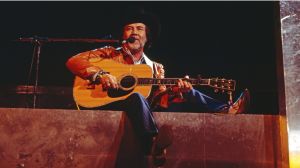
Disco, Musiksendung, Deutschland 1971 – 1982, Sendung vom 28. Mai 1977, Gaststar: Thomas Tommy Overstreet. (Photo by Arthur Grimm/United Archives via Getty Images) -

Carole in front of her home on Appian Way taken 2/13/71 -

American Rock musician Lou Gramm (born Louis Grammatico), of the group Foreigner, performs onstage at Madison Square Garden, New York, New York, October 30, 1981. Visible at right is Rick Wills, on bass. The group was performing in support of their album, '4.' (Photo by Gary Gershoff/Getty Images) -

NASHVILLE, TENNESSEE – SEPTEMBER 04: Hailey Whitters performs at Nashville Palace on September 04, 2025 in Nashville, Tennessee. (Photo by Jason Kempin/Getty Images) -

Bob Dylan poses for a portrait to promote the release of his album 'The Times They Are A-Changin'' in January 1964. (Photo by Michael Ochs Archives/Getty Images)