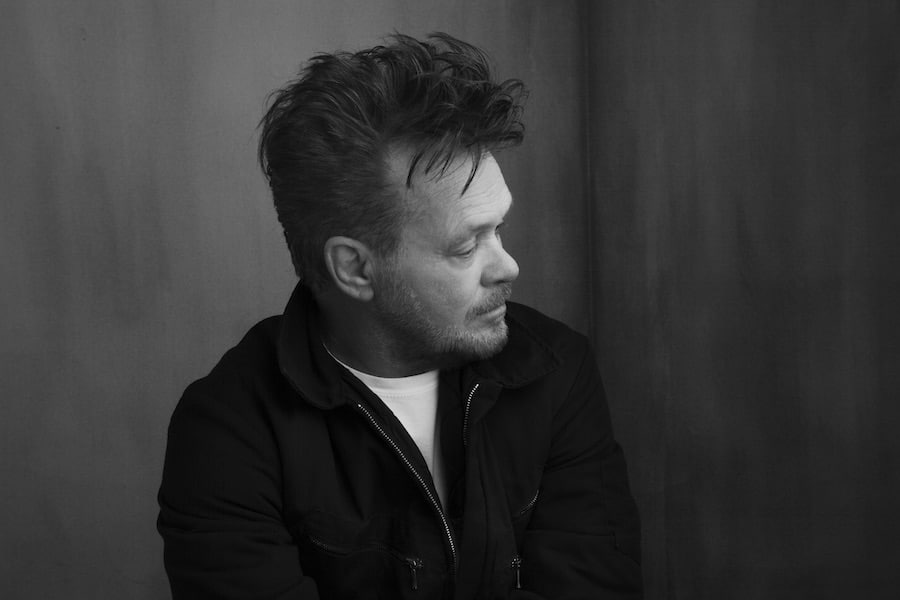
Sometimes the muse really pisses John Mellencamp off.
Inspiration arrives on his doorstep unannounced, at unlikely and inconvenient moments, to make obscene demands on his time and attention, and there’s nothing he can do about it. Take “Easy Target,” which concludes his new album, Sad Clowns & Hillbillies. With its claustrophobic production and gravelly vocals, which at times recall the croaking rasp of Tom Waits, the song a sobering and not especially optimistic consideration of race in twenty-first-century America.
“I didn’t want to write that song,” Mellencamp moans. “I wasn’t sitting around thinking about race or anything like that, but this voice just interrupts and says, ‘Hey, you better write this down.’ Aw, I’m doing something else. Leave me alone. I’m busy. But this voice grows stronger and stronger. ‘John, you need to fucking write this down.’ So I have to stop what I’m doing and write it down.”
Mellencamp is never off the clock. He’s never too far from a pen and paper. However reluctant he might be a times to take dictation from the muse, he never ignores that persistent voice. “It takes however long it takes. Sometimes I can’t write it down fast enough, and sometimes it takes a while. Sometimes I only get a verse. You mean I stopped what I was doing for a verse? Are you kidding me? Don’t bother me with this shit unless it’s going to be something complete.”
Forty years into his career, with more than twenty albums, hundreds of songs, and thousands of shows to his name, Mellencamp doesn’t pretend to understand how any of it works, where his inspiration comes from, or even how not to be a songwriter. “When I was a kid, this kind of thing never happened to me. It was always work to write a song. Now things just come to me and I write them down. I don’t even know what the fuck they’re about sometimes.” He has learned to appreciate the inspiration, wherever it originates and however intrusive it may be, partly because he understands that it has taken a lot of discipline and effort to get to this point in his creative life. “You have to be open to it. You can’t be, what’s the word? immature as a songwriter.”
*****
The muse visited often during the creation of the startlingly diverse Sad Clowns & Hillbillies, which is his first collaborative album. A handful of these songs were either written by or with Carlene Carter, scion of the Carter Family and a notorious hell-raiser in her day. Now in her mid sixties, not much older than Mellencamp himself, she’s cleaned up and settled down, with a richly textured singing voice that recalls her mother June and grandmother Maybelle, matched by a lyrical voice that savors keen observations and carefully drawn characters. She worked with Mellencamp on Ghost Brothers Of Darkland County, the 2013 musical he co-wrote with Stephen King, as well as on the soundtrack to Ithaca, the 2015 directorial debut of his ex Meg Ryan.
The duo toured together and eventually decided to work on some songs together. “We do sing well together,” Carter says. “I know where he’s gonna go and he knows where I’m gonna go. We push each other a little bit, which is healthy. You have to step outside of your comfort zone. It becomes a little bit different when you’re working with someone else.”
Initially the idea was to make an album of country-gospel tunes, which excited Carter. “That’s my wheelhouse! Get me in there! We started that way but didn’t get very far. That just wasn’t what it was supposed to be.” Even at this stage, the collaboration had taken on a life of its own: a sentient thing with its own desires and demands. “When you’re creating something and you’re trying to make it something very particular, it becomes very narrow. Oh, it’s got to be this. Or, it’s got to be that. You end up eliminating a bunch of possibilities. I don’t like to do that. I used to do that as a kid and I found out that it doesn’t really work for me.”
The duo never sat down to write together, as that’s really not how either of them work. Instead, they shared ideas via email, sending scraps of lyrics or melodies back and forth. She wrote the redemption story “Damascus Road” as well as the loping, lusty old-time number “Sugar Hill Mountain,” which he set to music. They both had a hand in the only real duet on the album, a yearning ballad called “Indigo Sunset” that has already become a staple of their live shows. Neither remembers exactly who wrote which parts of that song. “I don’t keep track of that stuff,” Mellencamp admits. “It’s all done on the fly. It’s all done in the studio. I can’t remember who wrote what, but I think she probably wrote the bulk of the lyrics and I wrote the arrangements. We knew we didn’t want to make a traditional duets record.”
“I do like that we’re not singing the traditional duets on everything,” says Carter. “That in itself would spoil the surprise for fans. I don’t feel like a sideman in that regard. John’s always treated me as an equal, which is good because you don’t have any real expectations and you keep the excitement of what’s going to happen next.”
Only one song remains from that early country-gospel incarnation: “My Soul’s Got Wings,” a rousing spiritual with lyrics written by Woody Guthrie. “That one was fun to do,” says Carter. “It was really spontaneous. We all gathered in the break room and ran through it together, with John singing the licks for Andy York to play. There was a lot of handclapping and group singing, a great amount of energy. John even let me play Autoharp on it. We cut it so fast, and it was really joyful. That’s the way it’s supposed to be. If the song can make you smile as wide as humanly possible, you’re doing your job.”
Officially billed as “John Mellencamp featuring Carlene Carter,” Sad Clowns & Hillbillies has a slight catchall quality to it, thanks to its assortment of co-writes and covers. However, perhaps because that’s something neither artist has ever done before, the album sounds like a major statement from two veteran artists. It’s almost alarmingly diverse, ranging from the C&W strut of the title track to the swamp-rock groove of “Grandview” to the dark self-reckoning of “What Kind Of Man” to the churchly exuberance of “My Soul’s Got Wings.” It’s a survey of nearly every hill and dale of Americana music, held together by the character and chemistry of their gruff and graceful voices.
*****
In some ways this is an album that Mellencamp has been working on for most of his life. He’s been living with a few of these songs for decades, in particular two of the cover songs. Back when he was a teenager, a young father, and an aspiring rock star in Indiana, Mellencamp would sit around with friends and trade songs. “We would pass the guitar around to each other,” he recalls. “I would play a song and then the next guy would play a song.” Some were originals, but most were covers. These casual guitar pulls were a formative experience for the Hoosier, allowing him insight into the craft and discipline of songwriting, and his teenage self gravitated toward two songs in particular. The first was “Early Bird Café,” by a fairly obscure San Francisco freak-rock band called the Jerry Hahn Brotherhood, who only released one album in 1970. The other was “Mobile Blue,” by Mickey Newbury, off his landmark 1971 album ‘Frisco Mabel Joy.
Mellencamp has performed these two songs countless times during his life, but he only just now put them on an album. It was a long time coming. “It wasn’t like I was thinking, Oh, what should I do for this record? It was more like, Hey, you know, I’ve been playing these two fucking songs my entire life. Maybe I should actually record them.” He gives them each a slightly different spin. “Mobile Blue” has a breezy feel, retaining the melancholy of the original but with a bit of humor, as though Mellencamp’s narrator is chagrined at his circumstances: stuck inside of Mobile with the L.A. blues again. “Early Bird Café” transforms from a hippie sing-along into something more akin to small-town storytelling, as though it was a real place and not some ’60s countercultural metaphor for the afterlife. “You know, it’s hard to be alive sometimes, but it’s easy to be dead.” Could the twenty-year-old Mellencamp have sung it so well?
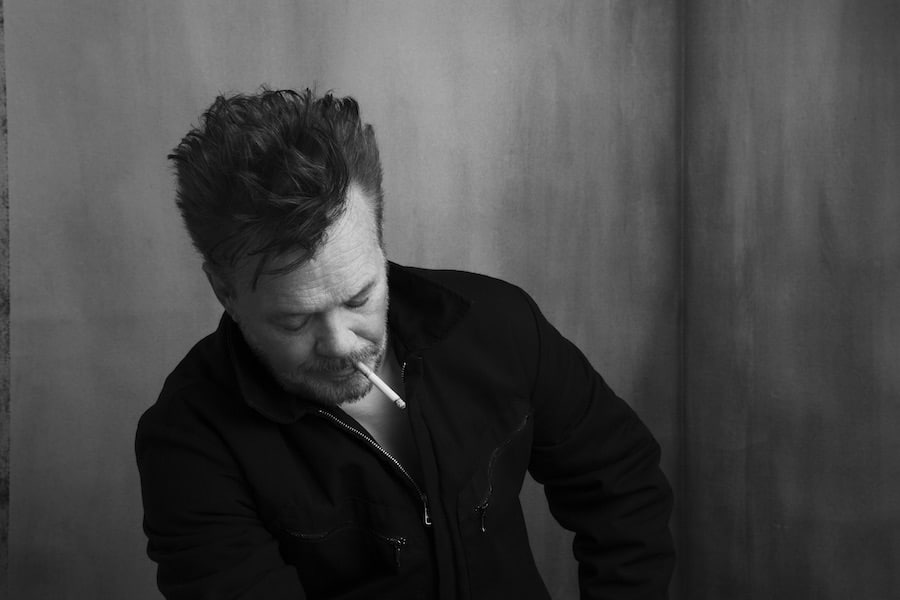
Together these two songs comprise a persuasive showcase for his pack-a-day voice, which wears the years surprisingly well, but they’re also points against which to measure his own development as a songwriter and storyteller. You can hear the roots of his own narrative-driven lyrics in Newbury’s song, and you can hear echoes of Mellencamp’s political tunes in the populist idealism of “Early Bird Café.” It’s not hard to imagine why he would have been drawn to them, but it’s even easier to imagine the effect they had on the aspiring songwriter’s younger self.
Much more recent, but still pretty old, is “Grandview,” the swamp-rock first single from the album. It’s not a cover, but it is a co-write Mellencamp has been toying with for a while. “That song was written many, many years ago by myself and my cousin, Bobby Clark. It’s been hanging around the vault since forever. I pull it out and work on it now and then, but it never really worked. Finally on this record it seemed to gel.”
A showcase for his veteran band, many of whom have been playing with him since the 1990s, “Grandview” is about a small-town guy who dreams big, who wants nothing more than a double-wide trailer parked on the banks of the Ohio River in Grandview, Indiana. From another songwriter, that subject matter could make for a cornpone country song, one that pokes fun at the silly aspirations of the rural poor and gets a cheap laugh out of hillbilly archetypes. But these cousins aren’t playing the material for a chuckle. Instead, they’re impressed by the narrator’s ingenuity and perseverance, especially when he uses that double-wide as a tool of seduction — although the woman, voiced not by Carter but by Martina McBride, is somewhat suspicious. The guy doesn’t even care. He’s happy in his new home. Mar-A-Lago it ain’t, but it’s his very own castle.
*****
Like that happy-go-lucky trailer-park resident in “Grandview,” Mellencamp has always been a dreamer himself: a sentimentalist hiding behind the grimace of a realist. “A walking contradiction,” he calls himself. Before he was so closely associated with heartland rock, Mellencamp went by the name Johnny Cougar and played Roxy Music and New York Dolls covers in a series of Hoosier glitterpunk bands. “I had no desire to write songs. I was just singing. I went to New York to tour the Art Student League, and I had a demo tape with a few songs that weren’t even originals. I got a record deal. There was no plan. I’ve never planned anything in my life.”
His early albums from the 1970s, all under his wildcat pseudonym, reveal a young artist gradually gaining confidence in himself. While he did record some interesting covers around this time — Roy Orbison, the Lovin’ Spoonful, and the Stooges all on his debut — he knew he needed some originals under his belt. They did not come very easily back then. “It was always hard,” he says. “I would sit there for hours trying to come up with one line. Fortunately, I don’t have to do that anymore.”
SIDEBAR: FIVE HIDDEN GEMS FROM JOHN MELLENCAMP
His big break came with his fifth album, 1982’s American Fool, nine songs that evoke the pain and joy of life spent between the coasts and far from any city. Songs like “Hurts So Good” and “Jack And Diane” established him as a voice for the Midwest, an anti-pop star at a time when MTV was peopled with acts that played up the decadent glamour of rock stardom. With each subsequent album Mellencamp portrayed himself as an antidote and antihero, mixing broad nostalgia for a romanticized American past with an understanding of the limited possibilities facing kids growing up in the Reagan-era heartland.
“I was always more influenced by the great American authors than I ever was by other songwriters. John Steinbeck and Tennessee Williams, people like that. Williams’ dialogue was always so lyrical, especially in A Streetcar Named Desire. Just the way Blanche talked and the rhythm of his words.” You can hear that influence in a song like “Jack And Diane,” which is all stage direction and dialogue. The curtain rises on the two title characters “outside the Tastee Freez. Diane’s sittin’ on Jacky’s lap, he’s got his hand between her knees.” They talk about messing around behind a shady tree, but in the song they don’t really do much of anything. It seems they never will.
“I don’t know how I knew this when I was that age, but for whatever reason, I wrote down the line, ‘Life goes on long after the thrill of living is gone.’ When I sing that now, it always surprises me. How did I know that at twenty-give or however old I was at that time? I remember being criticized for that line, like, ‘How dare he write a song that would not encourage people to live their lives fully!’ My response was always, Fuck you. How about the truth?”
The truth as Mellencamp saw it was that life in the Midwest was not easy on kids with big dreams and few resources. Some of them stick around, while others leave town the first chance they get. Some flounder, while others thrive. Mellencamp intended “Jack and Diane” — and almost every one of his songs — as a direct challenge to the listener. “Doesn’t the song go, ‘Hold on to sixteen as long as you can’? In other words, don’t grow up. Don’t let yourself become the kind of person who isn’t interested in learning something new everyday. If you give up, it’s over. You’re done. It all comes down to, You got make the most of the moment.”
*****
Mellencamp made the most of the 1980s. During the Reagan era he was one of the most popular artists of the time, with a string of multi-platinum albums and incredibly profitable tours. The secret to his success, he says, comes from some sage advice he received from an American legend. “Pete Seeger once told me, ‘John, go where they’re not. Write about what they’re not writing about. Don’t be part of the lineup.’” But every hit single and sold-out show took him further away from that ideal, until “I realized I was becoming the guy Pete Seeger told me not to be. So I had to quit for a couple three years.”
In the 1990s he admits he often just went through the motions. A heart attack at 42 slowed him down a bit, although he still smokes twenty years later. He had kids to raise and a gnawing distrust of the music industry constantly demanding product. “You had to make a fucking record every eighteen months, and that’s a lot of records.” Some, like the ambitious Human Wheels, reveal a maturing singer-songwriter with a more nuanced view of America. Other albums he barely even remembers. “With Whenever We Wanted and Dance Naked, it was like, Can we just get in there and get this over with as quickly as possible? My heart wasn’t in it. I don’t remember making those records. I know I made them, but I just don’t know.”
His conflict with celebrity and all the expectations that came with it became legendary, even creeping into his songs. “I said everything in a song called ‘Pop Singer.’ ‘Never wanted to be no pop singer, never wanted to write no pop songs.’ I didn’t want to be part of that world. I didn’t want to go to your nightclub. I didn’t want to hang out after the show. I didn’t want to be part of a movement. My wife once told me, ‘Just be a pair of blues jeans, John. That’s what you’ve always been. Don’t try to be anything more or anything less.’”
Blue jeans, of course, go with everything. You can dress them up or dress them down. They’re probably the most versatile piece of clothing you can buy. Because Mellencamp followed that advice, “I can float around and do whatever I want. If I want to do a country record, I’ll do a country record. If I want to do a jazz record, I do a jazz record.” If he wants to do a collaborative record of covers and co-writes, he does it. Mellencamp has found a comfortable place just beyond the glare of the spotlight, where he can make records whenever and however he wants and tour them on his own schedule. One of the few major artists from the 1980s who still flourishes in the twenty-first century, he may not have the pop-cultural cache of someone like Springsteen or Madonna, but his recent releases surpasses those of his peers — yes, even the Boss himself.
Recent albums reveal an artist still adding strong installments to his catalog, still refining his craft, still seeking out new musical thrills. He recorded 2010’s No Better Than This with T Bone Burnett at historic sites across America, including Sun Studio in Memphis and the Gunter Hotel in Houston (where Robert Johnson cut several sides). Mellencamp’s scope has broadened, moving well beyond the heartland to take in all of America. Released in 2007, right before the housing bubble burst, Freedom’s Road is a bleak depiction of a country already in economic freefall, with the rural poor taking the hardest hits on “Ghost Towns Along the Highway” and the devastating “Rural Route.”
“I don’t really like to talk about the past,” he says. “I’m always looking at what’s coming up around the corner. I think that’s what has allowed me to be in the music business for so long. I don’t give a shit about the past and I never cared for the money. I always detested the idea of being famous. Still do. I wish that wasn’t part of the whole process. I never signed on to be anybody’s role model. I ain’t looking to hang on any crosses.” He’d rather just sing his songs and take dictation from the muse every now and again; that alone is an immense responsibility. “They don’t just send those songs to anybody, I guess is what I’m trying to say.”
More Features
-
MINNEAPOLIS, MN – AUGUST 29: Elvis Costello performs at the Orpheum Theatre in Minneapolis, Minnesota on August 29, 1984. (Photo by Jim Steinfeldt/Michael Ochs Archives/Getty Images) -

Photo by Jason Kempin/Getty Images for Country Music Hall of Fame and Museum -
UNITED KINGDOM – JANUARY 01: WEMBLEY ARENA Photo of Johnny DUNCAN and Janie FRICKE, w/Johnny Duncan (Photo by David Redfern/Redferns) -
LONDON, UNITED KINGDOM – JANUARY 11: Debbie Harry of Blondie performs on stage at Hammersmith Odeon on January 11th, 1980 in London United Kingdom. (Photo by Pete Still/Redferns) -
lake Shelton, presenter Video Director of the Year (Photo by Frank Mullen/WireImage) -
Photo by Robert Kern/Getty Images