
When we think of complicated Led Zeppelin riffs, songs like “Black Dog” and “Stairway To Heaven” are often the first to come to mind. But for bassist John Paul Jones, one of his earliest fretboard challenges came in the first few years of the band’s existence. More specifically, the opening track to their eponymous debut album and the first single the British rock band ever released in the States.
“Good Times Bad Times” is, relatively speaking, one of the more sparse Led Zeppelin tracks in their catalogue. Reflective of its 1969 release date, the band hadn’t quite experimented with expanding their sound with orchestras, wild guitar tones, and larger-than-life drum fills. This particular track feels like something powerful is being strapped down in the introduction, bursting through with rhythmic “dun-un”s before breaking loose into a full rock ‘n’ roll cacophony.
Videos by American Songwriter
As the song progresses, so does the complexity of the riffs Jones and guitarist Jimmy Page were playing. And according to the bassist and “Good Times Bad Times” songwriter, this song had some of the trickiest licks.
John Paul Jones Differentiated Between His Riffs and Jimmy Page’s
In the late 1960s, much of Led Zeppelin’s catalogue came from Jimmy Page’s time in The Yardbirds. The riff for “Good Times Bad Times”, however, was something that bassist John Paul Jones brought in separately. It was also a riff he found especially challenging, and among the hardest to play in the band’s extensive catalogue, and that complexity was something of a signature in Paul’s songwriting.
In Martin Popoff’s book Led Zeppelin: All The Albums, All The Songs, Jones explained how his guitar riffs typically differed from Page’s. “In terms of actual riffs, anything with notes [laughs], lots of notes, like ‘Black Dog’, ‘Good Times Bad Times’…those were my riffs. And anything that was kind of lurchy and chordy were Page’s riffs. That’s how you tell them apart.”
“Good Times Bad Times” might have been a bear to play, but it was well worth the effort. The band’s American debut hit the Billboard Hot 100 that same year, cementing their place as rising rock ‘n’ roll stars. Other notable tracks on this album include the “Good Times Bad Times” B-side, “Communication Breakdown”, as well as “Babe I’m Gonna Leave You” and “Dazed and Confused”.
Photo by Michael Ochs Archives/Getty Images
More Behind The Song
-
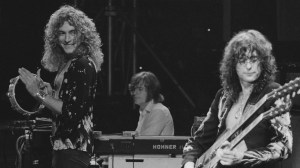
Left to right: Robert Plant, John Paul Jones and Jimmy Page, of British heavy rock group Led Zeppelin, performing at Earl's Court, London, May 1975. The band were initially booked to play three nights at the venue, from 23rd to 25th May, but due to public demand, two more concerts were later added, for 17th and 18th May. Total ticket sales were 85,000. (Photo by Michael Putland/Getty Images) -
Portrait of country singer Eddie Rabbitt in Memphis, Tennessee, May 31, 1981. (Photo by Paul Natkin/Getty Images) -
LOS ANGELES – FEBRUARY 22: 31st Annual Grammy Awards. Broadcast February 22, 1989. Shrine Auditorium, Los Angeles, California. Pictured accepting award is Bobby McFerrin. His song "Don't Worry, Be Happy" won Record of the Year, Song of the Year, and Best Pop Vocal Performance, Male. Also Best Jazz Vocal Performance, Male. (Photo by CBS via Getty Images) -
LAS VEGAS, NEVADA – APRIL 03: Singers Mike McGuire (L) and Marty Raybon of Shenandoah attend the 51st Academy of Country Music Awards at MGM Grand Garden Arena on April 3, 2016 in Las Vegas, Nevada. (Photo by Rick Diamond/ACM2016/Getty Images for dcp) -
Photo by Tim Mosenfelder/Getty Images -
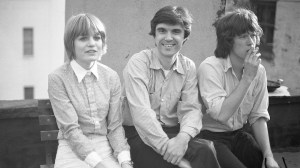
The three founding members of Talking Heads on a Manhattan rooftop, US, 1976. (Jerry Harrison would join the group at the beginning of 1977.) (L-R) Bassist Tina Weymouth, singer-guitarist David Byrne and drummer Chris Frantz. (Photo by Linda D. Robbins/Getty Images) -
Patty Smyth of Scandal at the Poplar Creek Music Theater in Hoffman Estates, Illinois, June 3, 1983. (Photo by Paul Natkin/Getty Images) -
Photo by Michael Ochs Archives/Getty Images