
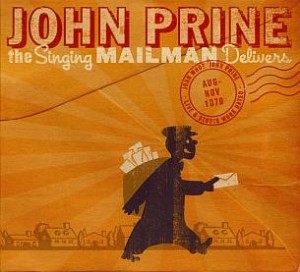
John Prine
The Singing Mailman Delivers
(Oh Boy)
[Rating: 4 stars]
The Singing Mailman Delivers, the first true archival release from John Prine, is a collection of early takes of the songs that would largely make up his self-titled debut. One half of the double-disc set is a collection of demos recorded at a radio station, the other a performance at Chicago’s Fifth-Peg. Many of the staples on John Prine: “Angel From Montgomery,” “Hello In There,” “Sam Stone” (or its working title here, a bit more telling: “Great Society Conflict Veteran’s Blues”), still make up the heart of Prine’s oeuvre as a songwriter and performer today, four decades later.
“Twenty-four years old and writes like he’s two-hundred and twenty,” wrote Kris Kristofferson in the liner notes to John Prine. Prine’s narrators too, the men and women singing his songs: the middle-aged housewife, the old couple whose kids have grown up and left, the kid whose heart’s just been broken, all feel older than they should.
The songs themselves feel ancient. Prine’s singing on “Blue Umbrella,” “Angel From Montgomery,” and “Paradise” sounds as weary and weathered as his disillusioned characters. It’s even more apparent in the live set, where many of the songs result, almost bizarrely, in crowd-pleasing sing-alongs, as if at twenty-four Prine is already the well-traveled veteran troubadour he is today. His songs, to anyone whose ever heard them, are like creation myths, part of our shared vocabulary, holding more weight than they can sometimes bear, from their very moment of inception.
“He starts slow,” said Roger Ebert, in his now-famous review “Singing Mailman Who Delivers A Powerful Message In A Few Words,” after hearing Prine for the first time, “but after a song or two, even the drunks in the room begin to listen to his lyrics. And then he has you.”
One night in November 1970 in Chicago, it took four songs to win over the drunks. Prine is so very young: self-conscious, goofy, and arrogant enough to introduce his next song like this: “This is a song me and Francis Scott Key wrote not too long ago, he writes political songs and I write love songs…it’s a hate song to a woman I love.” He may be suggesting he’s written his own version of our creation myth, a song we can all sing out loud, because it’s 1970, and stars and stripes and bombs bursting in air isn’t going to cut it anymore, or more precisely: “Your Flag Decal Won’t Get You Into Heaven Anymore”. The audience laughs at all this—the previous song, after all, was a comic, absurdist anti-war song— and though Prine may not yet have the drunks listening, he’s already won these people over.
He introduces the next song further, and things don’t seem as funny anymore: “It’s about a kid that went out looking for America and he found her in a bar room, drinking, she was feeling bad.” And then he starts.
“The Great Compromise” is still very new and Prine treats it carefully, gives it special attention. His singing is tremendous, but he’s also careful, he knows this is a delicate setting, this folk club, so he interrupts the sad singer’s story and tries to keep the mood light, a wisecrack here or there, so as to keep his distance from whoever’s singing this song, because maybe he’s a little afraid of what’s being said.
Josh Ritter, one of Prine’s finest disciples, on his album The Animal Years: “I wrote a record, which I meant to write about this country, and it all came out sounding like a love song.” In the “The Great Compromise,” a girl named America breaks the singer’s heart. She hops into another man’s foreign sports car (“a Hanoi Hudson,” Prine adds, not insignificantly) when he’s not looking, but there will be no warfare, not even a fight, just a lot of bad dreams. By the last verse she’s become a sick woman, and it’s no fun not-believing in her anymore: “but sometimes I get awful lonesome, and I wish she was my girl instead, but she won’t let me live with her, and she makes me live in my head.” If all lasting relationships, as they say, are about compromise, then this lady, full of “blossom and beauty, born on the 4th of July,” hasn’t kept up her end of the bargain.
If America really is a woman, then Prine’s earliest songs are tales of her cruelest endeavors: she robs men of their childhood paradises and turns them into little souvenirs that make them cry, and then she leaves them standing in the rain, feet cold and wet, trying to think this whole thing over. They may all just be hate songs to a woman Prine loves.
More Reviews
-

John Oates performs with The Good Road Band on March 15, 2026, at The Cabaret Theatre at Mohegan Sun in Uncasville, Connecticut (Photo by Khoi Ton/Courtesy of Mohegan Sun) -

Boy George and members of Culture Club perform at Mohegan Sun Arena in Uncasville, CT, on March 1, 2026 (Photo by Khoi Ton/Courtesy of Mohegan Sun)