
By the early 1970s, Johnny Cash was well into his “musical relic” status, as far as the youngest generation of music listeners was concerned. The country singer was the kind of music an 18-year-old’s parents would listen to. This made it highly likely that the youth would label it as uncool, unhip, and out of touch. His public support of President Richard Nixon and the Vietnam War effort confirmed these assumptions.
However, after the Kent State Massacre in May 1970, when Ohio National Guard members opened fire on unarmed students on the college campus, Cash never publicly showed support for the president again. In fact, he started to adopt a different public stance altogether. And during a visit to Vanderbilt University in Nashville in 1971, Cash proved that he still had his finger firmly on the pulse of what was happening in the world. Even if he had some learning to do (and was cutting records when most college freshmen were in diapers).
Videos by American Songwriter
As country music legend tells it, Cash was speaking to students from Vanderbilt when one asked him why he always wore black. He responded with a song that would later become a signature track: “Man in Black”.
Johnny Cash Wrote “Man in Black” to Lay out His New Artistic Ethos
Johnny Cash was a country music star and a veteran. These two life experiences naturally positioned him more in line with military support than not. However, as political tensions reached a fever pitch in 1971, Cash began taking a more humanistic approach. He supported the soldiers who were overseas not out of some sense of national pride but because he knew their sacrifice firsthand.
He says as much in the sixth verse of “Man in Black”, a song that lays out the many reasons why he’s always dressed in dark, somber colors. “I wear it for the thousands who have died believin’ that the Lord was on their side. I wear it for another hundred thousand who have died believin’ that we were all on their side.” Elsewhere, he said he wore black “for the poor and the beaten down, livin’ in the hopeless, hungry side of town.”
In the age of the draft, Cash’s declaration that he wore black to mourn the “fine young men” who lost their lives every day fighting overseas was an especially resonant message. During a performance at the Ryman Auditorium, Cash dedicated “Man in Black” to a group of Kentucky servicemen in the audience. “This is my uniform,” Cash said. “For four years, I wore the uniform of the United States Air Force. Now, they call me the man in black.”
Cash’s “Man in Black” was more than a self-narrative anthem. It was an expert display of how to ride the line between pro-veteran and anti-war, something few artists have done successfully before or since.
Photo by CBS Photo Archive/Getty Images
More Behind The Song
-

KENT, WA – DECEMBER 06: Country music singer and songwriter Luke Combs performs on stage during The Hometown Holiday show hosted by 100.7 The Wolf at ShoWare Center on December 6, 2018 in Kent, Washington. (Photo by Mat Hayward/Getty Images) -
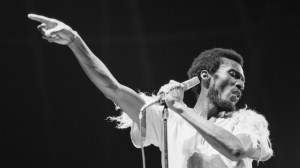
Jamaican singer Jimmy Cliff performs on stage at Porte de Pantin, in Paris. (Photo by John van Hasselt/Sygma via Getty Images) -
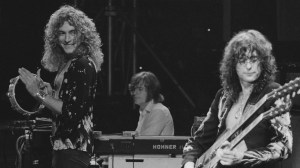
Left to right: Robert Plant, John Paul Jones and Jimmy Page, of British heavy rock group Led Zeppelin, performing at Earl's Court, London, May 1975. The band were initially booked to play three nights at the venue, from 23rd to 25th May, but due to public demand, two more concerts were later added, for 17th and 18th May. Total ticket sales were 85,000. (Photo by Michael Putland/Getty Images) -
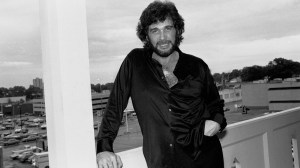
Portrait of country singer Eddie Rabbitt in Memphis, Tennessee, May 31, 1981. (Photo by Paul Natkin/Getty Images) -
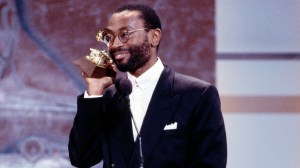
LOS ANGELES – FEBRUARY 22: 31st Annual Grammy Awards. Broadcast February 22, 1989. Shrine Auditorium, Los Angeles, California. Pictured accepting award is Bobby McFerrin. His song "Don't Worry, Be Happy" won Record of the Year, Song of the Year, and Best Pop Vocal Performance, Male. Also Best Jazz Vocal Performance, Male. (Photo by CBS via Getty Images) -
LAS VEGAS, NEVADA – APRIL 03: Singers Mike McGuire (L) and Marty Raybon of Shenandoah attend the 51st Academy of Country Music Awards at MGM Grand Garden Arena on April 3, 2016 in Las Vegas, Nevada. (Photo by Rick Diamond/ACM2016/Getty Images for dcp) -
Photo by Tim Mosenfelder/Getty Images -
The three founding members of Talking Heads on a Manhattan rooftop, US, 1976. (Jerry Harrison would join the group at the beginning of 1977.) (L-R) Bassist Tina Weymouth, singer-guitarist David Byrne and drummer Chris Frantz. (Photo by Linda D. Robbins/Getty Images)