
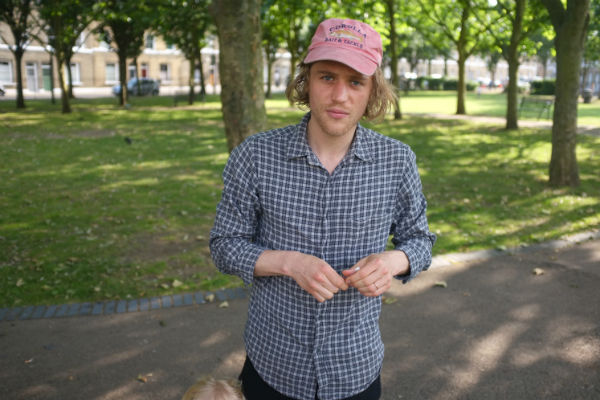
Johnny Flynn is an elusive guy. Such is the nature of the troubadour.
Over the course of several weeks, we try to connect a couple of times for a trans-Atlantic phone interview but end up missing each other. I finally track him down on his cell early one morning in late summer. When I reach him he is driving through the wilds of North Wales with his family in tow, en route back to his hometown of London. The connection fades in and out.
“Hello? “Can you hear me?” “Hello?”
He finally comes through but now he’s talking to someone; it’s his wife I presume. A toddler shrieks in the background.
“Sorry, but can you call me back in ten minutes?” he asks. “Really sorry about this.”
I get back in touch with him and the signal is better. He takes a moment to adjust his hands-free headset so he can talk and negotiate the road.
“Sorry, but I was in the store earlier and my son was running away from me and I had this other stuff I hadn’t paid for. I was running out of the shop and I thought I was gonna get arrested for stealing.”
Flynn, who cut his teeth among the London folk scene that included Laura Marling and Mumford and Sons, is a master of many trades: songwriter, poet, actor – but thief is not one of them. His latest album, Country Mile, continues his streak of accomplished songwriting. Whereas its predecessor Been Listening was a more stripped down affair, Country Mile is a more developed album musically, with intricate arrangements and varied instrumentation. Thematically, the album chronicles a life on the road, one lived on the fly and not hemmed in by parameters.
“A lot of these songs are about journeying in different ways,” he says. “I felt like tying them together under the title ‘Country Mile,’ so it’s kind of an announcement of what the album is about. That first song is about setting out … and other songs are about different aspects of that journey.”
Flynn’s own journey of late has taken him to some interesting haunts. In the last two years he took on leading roles in the Globe Theatre’s production of Richard III and Twelfth Night – playing women in both cases (The Globe casts males in the female roles, as was the custom in Shakespeare’s time.) He also earned kudos for playing a trust-fund heroin addict in the U.K. indie film Lotus Eaters, and is set to star alongside Anne Hathaway as a Brooklyn-based rock star in the upcoming film Song One.
Treading the boards of the Globe Theatre and reciting the words of the bard night after night lent inspiration to his writing, Flynn says. “When you read Shakespeare’s poetry it is inspiring, but even more so if you’re doing a play for ten months. You’re hearing the poetry and why it works or why it doesn’t work.”
Flynn says he has far more lyrics in his stockpile than he does melodies. That being said, he is one of the few modern songwriters whose words can stand up on their own, as poetry on the page. (Google his spoken-word performance of “The Triumph Of Hellenism,” a Keatsian ode about the power of art over death, and see for yourself.)
“With all the stuff that I write, it’s always maybe gonna be a song at some point,” he adds. “With ‘The Triumph Of Hellenism,’ I wanted to turn that into a song because it had a short A/B [line] structure that would work. The songs on the first few albums, there’s a fine line between the songs as poems; they are poems set to music, maybe. I feel this album is more about the melody.”
On the song “After Eliot,” he tips his hat to another of his literary heroes – the modernist poet T.S. Eliot, who Bob Dylan famously referenced in “Desolation Row.” The tune is about a female muse who has “Never been seen/ And never been lost.” “After recording it I realized that I had subconsciously referenced his style quite a lot,” Flynn says of Eliot, “but the song isn’t about him as a person or anything.
Though he often connects with his literary heroes through the lines of his songs, Flynn recently got to meet one of those heroes in flesh. That would be Dylan, who showed up at one of the plays Flynn appeared in earlier this year.
“It was really briefly and I don’t think he’d remember it,” he says. “I sent a pretty roundabout invitation to him and he came to the play to my surprise. I think I shook his hand. I can’t quite remember. I was in a bit of a daze to be honest, to find myself to be face to face with him.”