

Justin Robinson & the Mary Annettes
Bones for the Tinder
(Five Head)
[Rating: 3.5 stars]
In 2010, the Carolina Chocolate Drops won a Grammy for Best Traditional Folk Album, but their music is anything but traditional. Instead, the group works with the steadfast notion that the sounds and styles developed in the early twentieth century still have power and appeal in the early twenty-first century. The group looks backwards for inspiration, but they only have to look around for subject matter: Full of money-related songs both new and old, the award-winning Genuine Negro Jig had more relevance to the current recession than to the Great Depression.
Following that victory, however, founding member Justin Robinson—whose spry vocals and fiddle had proved a sly foil to Rhiannon Giddens’ powerful pipes—left the group suddenly, citing the drag of constant touring and his own creative restlessness. He wanted to resume other activities, namely a degree in forestry and a new culinary venture, but less than a year later, Robinson is already releasing his first solo album.
Bones for the Tinder picks up more or less where Genuine Negro Jig left off. Robinson and his backing band, the Mary Annettes, play a range of postwar styles—from r&b to Motown soul to hip-hop—on old-school folk instruments. On “Bright Diamonds,” they craft a thudding beat from a bass drum, handclaps, and dulcimer, which adds tension to Robinson’s dark, worried lyrics. Similarly, he half-raps shout-outs to Janet Jackson and Shakira on “Ships and Verses.” “We don’t care if your hips lie,” he sings over a spectral banjo strum. “We’re not here for truth, we just want to catch your eye and let the beat rock.”
Without the Chocolate Drops to back him up, Robinson corralled a group of North Carolina musicians called the Mary Annettes, and they prove resourceful as they realize seemingly everyone of his whims. Elizabeth Marshall’s cello adds syrupy undercurrents to “Bonfire (Bones for the Tinder)” and “Kissin’ and Cussin’,” while Sally Millikens’ fiddle ghosts his vocals on “Nemesis or Me” and “The Phil Spectors.” Still, Robinson has trouble carrying his first full solo album on his own. He’s best when he has another voice to sing against, as on “Bright Diamonds,” with its chattery chorus, or “Kissin’ and Cussin’,” which hints at a he said/she said song structure that they never fully explore.
Bones never quite lives up to Robinson’s past glories, but that’s a lot to ask for. A very specific, almost palpable melancholy pervades even the most upbeat songs here: The lighter-than-air “Thank You Mr. Wright” first marvels at the wonder of flight, then imagines in surprising detail a plane crash. Robinson is no pessimist, though. He’s just trying to imagine all the possibilities. For an artist so focused on the past and the present, Bones points to greater things in the future.
More Reviews
-
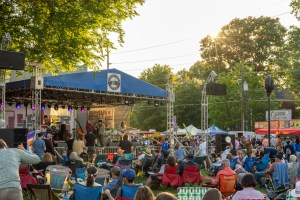
Lower Town Arts and Music Festival, 2026 (Photo by Paducah Convention and Visitors Bureau) -

John Oates performs with The Good Road Band on March 15, 2026, at The Cabaret Theatre at Mohegan Sun in Uncasville, Connecticut (Photo by Khoi Ton/Courtesy of Mohegan Sun)