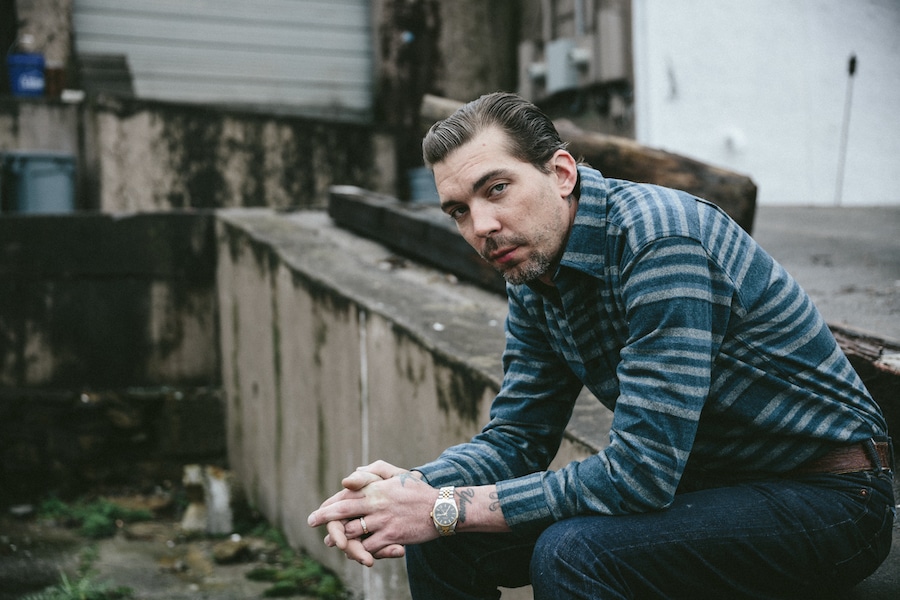
It’s La Croix kind of day in Nashville, and the flavored sparkling water is flowing at the Sound Emporium, the legendary studio founded by Cowboy Jack Clement in the late 1960s. Well, La Croix and marijuana, to be fair: and one works better than the other to quench this searing, sticky August heat. Justin Townes Earle is here with his band and co-producer, Adam Bednarik, to partake in both while making his new album, The Saint Of Lost Causes. But, right now, they’re sitting in the living room area next to a vintage Capt. Fantastic pinball machine, talking about the origins of a weed grinder. Wasn’t it from the place across the street from the strip club that’s now a parking lot, someone asks?
“Yeah, the Classic Cat,” Earle says in his rasped-up drawl, sitting on the couch in a neatly tailored denim shirt with his long thin legs stacked on one another like a grasshopper. “It was one of Nashville’s oldest strip clubs. Back in those days, the only thing that was downtown was the Southern Baptist Convention. And right in the seat of the Southern Baptist Convention was just a string of whorehouses and massage parlors. I think Nashville had more whorehouses than Reno at one point.”
Videos by American Songwriter
Though Earle now lives in Portland, Oregon with his wife and daughter, he came back to record The Saint Of Lost Causes after making his last LP, Kids In The Street, in Omaha with Bright Eyes’ Mike Mogis. The decision to come back to Music City was made more out of practicality than anything else — this is where the studios, the studio musicians and the resources are. “You want whores and gambling? You go Vegas,” he says. “You want music and studio musicians and studios? You come to Nashville.” The Saint Of Lost Causes, however, is very much a broader look at America with a journalist’s eye, and not just at any one place or experience: it’s about the people we forget, the lost stories. The daily suffering and injustices we are able to turn a blind eye to, because life’s a lot more comfortable when we forget they even exist.
“I just wanted to represent as much of America as I possibly could,” Earle says.
That stark inequality — the new barreling down the old, in favor of the shiny and hip — is part of the reason Earle left Nashville to begin with, watching the places and people he knew from his childhood left behind or destroyed altogether. He doesn’t find Portland to be much better, though. He’s thinking about moving to Mexico, or maybe the Caribbean islands, because his wife is a surfer. Or perhaps to upstate New York, or a reluctant return to Tennessee, where he’d at least be close to family. For Earle, though, it seems like the only way to get to where he really wants to go is to get ahold of a time machine to the past, or at least a better future that may or may not ever come.
But he still knows the old Nashville as well as anyone: it was his childhood home, his playground, his home for renegade, youthful mischief. He grew up here, back before the cranes and the Bachelorette parties, before his beloved minor league baseball stadium was left behind for a newer, trendier one, where you can order a grapefruit and vodka slushy or get mango chutney on your hot dog. Back when the town had more whorehouses than Reno.

Today, these storied walls are loaded with beverages, weed and snacks (some fresh fruit, a couple muffins on the counter), and a picture of Earle sits on the vintage jukebox next to a glowing sign that says “artist of the week,” which is not too far from how long he actually plans to spend recording here. When it comes to studio time, he’s an in-and-out kind of guy. He arrives with fully formed melodies, worked out arrangements, finished lyrics. He doesn’t understand why anyone would sit around for two thousand dollars a day just to work out a song, and that idea of hanging around in one place for too long reminds him of exactly what he was trying to avoid by being a musician, anyway: day after day at the same office, with the same people, a cog in a machine.
And after getting a little stoned, he and Bednarik head into the control room to listen back to “Over Alameda,” a song that encapsulates this very idea of the rich getting richer and the poor never being given the tools they need to get out of poverty — or even cross physical barriers, to “where the green grass grows.” After Kids In The Street found him experimenting beyond his breed of country blues, this album finds him settling back to his roots with a potent, topical twist. “It’s fair to say that each Justin Townes Earle album will never be re-writes of his other albums,” says the artist and photographer Joshua Black Wilkins, who has shot the cover of several Earle records.
“It’s a folk song about south central Los Angeles,” Earle explains about “Over Alameda” after listening to a playback intentionally. He writes many of his songs from historical books or documentaries, and this one came from a film he saw about the Jordan Downs Housing Project, a subsidized housing complex that represents, to many, the inescapable jaws of poverty.
Like “Over Alameda,” The Saint Of Lost Causes comprises many of these stories: the children of Jordan Downs playing just minutes from the mansions of the rich and famous, the people in Appalachia consumed by opioids and with water too poisonous to even shower in, and the city of Flint, left to perish and rot after being discarded. It’s the first time that Earle has ever ventured so deeply into social consciousness. “The Woody Guthrie came out in me,” he says.
Right now, Earle’s rolling around in an office chair, reading over several lyric sheets and visibly deep in thought. He wonders aloud if they should pull back on the acoustic guitar a little, or maybe completely.
“It sounds way too outlaw country,” Earle says. “Not that that’s a bad thing, but only Waylon should sound like Waylon.” They listen to a few more sections, sip more La Croix and talk about an Instagram account that has been cracking them up called Dirk Nashville, which basically trolls the town’s more commercially minded artists and their humble brag songwriting sessions (Earle, however, doesn’t ever seem to take out his phone). “As far as co-writing,” Earle says. “Don’t.” He means it. He’s turned down co-writes with Ryan Bingham, and owns his publishing, which comes in handy when a sync offer comes around. The title track of the album was even written for a video game, though they didn’t end up using it. Earle doesn’t mind those sorts of commercial opportunities as long as no one tells him what to do.

Earle’s never been one to write songs by committee anyway, and The Saint Of Lost Causes is no exception. Most were sketched out in his home office back in Portland, where he can also watch old baseball games from the 1970s. A big Chicago Cubs fan, he says the sport is one of the few things in life that truly makes him proud to be an American. Back when he was growing up in Nashville, his grandmother had season tickets to the Nashville Sounds games, and would take him along often — she’d pop a ball cap on top of her giant permed hair, and they’d sit and watch together, shoulder to shoulder. Other times, he’d ride his bike down to the stadium with his friends and wait around until the fourth inning, when they’d let the neighborhood kids in for free.
He told a lot of those kinds of tales on his last album, Kids In The Street, from back when he lived in a working-class neighborhood that is now home to artisan goods, expensive boutiques and gourmet ice cream shops. Though they weren’t confessionals — Earle’s a storyteller at heart — they did pull from experiences in his own life, being raised by a a single mother who took the brunt of the childcare while his father, Steve Earle, was on the road and rising to fame. The Saint Of Lost Causes, however, is a broad survey of the injustices and inequality spread across America, often inspired by tales he absorbs. It examines America from a bird’s eye view and asks, where did we go wrong? And who did we wrong along the way?
One song, called “Appalachian Nightmare,” is a complete story from start to finish, about two cop killers on the run from the law. Earle lived in Appalachia himself for a stint, in Johnson City, and was alarmed by what he saw — the stark poverty, the drug abuse, the crime. Later, when he came through on tour, he once stayed at a hotel where there were signs directing guests to not even take a shower, because the water was so toxic.
“The oxycontin had just really taken hold then, and hillbillies were robbing drug stores left and right,” Earle says, who is a recovering addict. “The streets were just flooded with cheap pharmaceuticals. I was already doing a lot of opioids by that time, but definitely that is where my addiction really took off. I moved away from the center city to the mountains, and found more and cheaper drugs.”
Another song, “Flint City Shake It,” was inspired by a documentary on Netflix called Flint Town, which focuses on the corruption within the police department in the city that still doesn’t have clean water available to all of its residents. “It’s a city that we’ve completely turned our backs on and just let die,” he says. “The entire Rust Belt is just dead, because we turned our backs on Americans. Americans turned our backs on Americans. We like to think that we’re all together, but we’re not. We are very, very selfish.”
In the studio, Earle and crew get to work on another song, this time about corporate greed and recklessness called “Don’t Drink The Water.” It’s a bluesy shuffle based on a film, Blood On The Mountain, about the Elk River Chemical Spill, where toxic waste from the Freedom Industries facility poured into the water. Earle strides slowly back into the recording room, which is lined with warm wood and decorated with patterned rugs, and he and the band start hammering out some guitar and vocal parts that conjures up both Lightnin’ Hopkins and the Allman Brother’s “One Way Out.”
Something happens sonically that Bednarik likes. “Can you go back to that fucked-up sound?” he asks, drinking his grapefruit LaCroix. After a few more takes, Earle heads back into the control room and starts writing in a tan notebook. He wants it even bluesier: less outlaw, more woozy harmonica.
The only one thing for sure, he says: there’s no room for steel guitar.
*****
It’s a few months later when we meet up again in Nashville, on a particularly wet day in winter when flooding is a top concern. Earle is at New West, his label, signing some vinyl and going outside in the downpour every once in a while for a smoke. When he comes to town, he stays at the Hutton Hotel on the west side, and he isn’t doing much on this short trip except shoot a few videos and have dinner with an old friend of his from growing up called Cheddar, who has recently been released from prison.
Earle’s just returned from the Cayamo cruise, so he’s happy to be on land (“it’s a floating hangover,” he says.) Still, he’s not eager to do much exploring, mostly because all of his favorite spots are gone, anyway. He’s fine to hang here. Wearing a plaid shirt, brown leather jacket and stovepipe jeans, Earle gives the black-and-white office dog a good pet before heading upstairs to a lounge room, this time with a Topo Chico in hand. He’s trying to relax, but it’s a hard week to feel settled, like most of the past two years — just this morning, Venezuela is in crisis, Donald Trump is tweeting foreign policy and a few days ago it was the one-year anniversary of the Parkland shooting. If you want to be relaxed, you have to learn how to forget. Or at least smoke a lot of weed.
Watching everything unfold in the world around him, Earle didn’t feel an obligation, so to speak, to write a more socially conscious record (he makes it clear that he considers this LP to be a “social” LP, not a “political” one, and he’s right — poverty, basic human rights and corporate negligence shouldn’t technically be partisan issues, though they absolutely are). But he also couldn’t ignore what he was seeing and hearing, and what he had witnessed for his entire life: both the problems that plague mankind, and the writers who synthesize them so effortlessly. “Justin grew up around Townes Van Zandt and Guy Clark plus my Dad who was a great storyteller himself,” says his father Steve Earle. “Political is just a label some people hang on songs that aren’t about girls.”
Earle’s been worried, too, about the upcoming presidential election (it likely goes without saying, but he’s not a fan of Donald Trump). “This day and age definitely fueled the idea of this record, because even when we thought it couldn’t get worse, it did,” he says, the rain pounding unforgivingly on the roof. “I wish I could say that I had faith in Americans, but I don’t. I like Julian Castro. But will Americans elect someone named ‘Castro’? I don’t have faith in them to do it, and that’s sad, but I know I said the same thing about Obama. I didn’t think that Americans would do it. But if the fucking Democratic Party’s not careful, throwing a confetti of candidates out, they’re going to screw up and get the son of a bitch elected again.”
Bednarik, who has worked with Earle for a decade, thinks he “is constantly evolving as an artist, and I think the songs on this album reflect what’s currently on his mind,” he says. “We’ve not had a conversation about what exactly this current reality is in which we exist as a society. But, in my opinion, it’s amazing how Justin can step back and write music that can be so relatable to everyone without exception. It’s important to have a voice for those who don’t have a platform to speak for themselves.”
Speaking for those who don’t have a platform to speak for themselves, Woody Guthrie or Bruce Springsteen style, is at the heart of the record. And while Earle knows that seeing any of this as partisan is rather ridiculous, he accepts that he could lose some fans along the way. “When you do records like this, you are going to polarize certain people,” he says. “So you gotta be ready for that. But I’m an Earle: we’re polarizing as fuck. You either love us, or you fucking hate us, there’s no in-between. You either think we are sweet and funny and mouthy, or we’re loudmouths. But I think the goal of art is to try to make it something universal.”
“He truly does what he wants and if you try to hold him back you’re gonna regret it,” says fellow artist Sammy Brue. “Some people would say that’s a bad thing but, in my eyes, it’s badass.”
It’s not all hard edges, though: “Frightened By The Sound” is a slow, tender ode to parenthood and the terrifying realities that settle in when you love something as deeply as you love a child. Earle’s really enjoying fatherhood, but the idea of what’s to come for his baby daughter keeps him up at night.
“Sometimes I look at her and I go, ‘What the fuck have I done?’” he says, shifting forward on the couch. “I look at the world around me, and think about how I brought this beautiful little girl into this world. Not that I would trade her for anything, of course, but it’s a scary idea. We always say that we make everything better for our kids, each generation, but it’s just not true. Every generation screws things up more and more and more.”
It’s getting late in the afternoon, and there are more records to sign, so Earle heads back downstairs to have a smoke and take a few pictures with some of the staff. After this he will head back to the Hutton and get ready to meet up with Cheddar, who is very much like one of the characters he paints in The Saint Of Lost Causes. Charged with second-degree murder after a bar fight 15 years ago, Earle notes that, “If he were white, he would have gotten manslaughter.” He’s likely right. Now Cheddar is back in the world, a decade and a half later, with no tools to succeed and no rehabilitation. Just tossed back in the mix with a bus ticket and a couple of bucks, expected to suddenly change.
“Cheddar is institutionalized as hell,” says Earle. “So I was like, man, you just got out of prison, so I said, ‘How about this: I am staying at the Hutton Hotel, and why don’t you come over, and we’ll walk across the street to the Midtown Café, and have a nice meal, and a quiet drink at the hotel later?’” Of course he’d pick the Midtown Café: unlike everything else in the area, it’s been around for over 30 years, opening up when Earle was a kid. He and Cheddar got into a lot of trouble back then, when there were more whorehouses here than Reno, and he smiles, pleased with such a civilized plan.
“I told him I think his mother would be very proud of us.”