
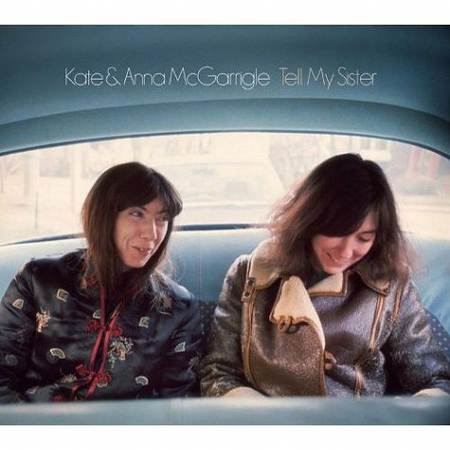
Kate And Anna McGarrigle
Tell My Sister
(Nonesuch)
[Rating: 4 stars]
They were the unlikeliest of pop stars, two Emily-Dickinson sisters from the ancient Laurentian mountain range northwest of Montreal, plain-spoken homebodies taught to play piano by the village nuns and known, even revered, worldwide for their clever and candid songwriting, a decidedly sporadic and increasingly quirky recording career, and an even-more-decidedly-sporadic-and-increasingly-quirky schedule of public appearances. (As younger sister Anna explained recently, “Kate and I were famous for not touring.”)
Early on, Kate married the similarly sporadic and quirky singer/songwriter Loudon Wainright III, a union that bore a second generation of sporadic-and-quirky professional Wainright musicians, Rufus and Martha, thus forming the trunk and main branches of an extended musical family tree that also included a full roster of talented and accomplished local folkies the sisters have known since college along with a few famous admirers, like Maria Muldaur, Linda Ronstadt, and Emmylou Harris, thrown in for good measure
Kate’s unfortunate death from cancer in January 2010 at the age of 63 has once again pulled the spotlight of cultural celebrity their way, and the release of Tell My Sister — a box set containing their first two albums and a third CD full of spare, acoustic demos and other previously unreleased tracks — was followed in May by a pair of memorial/benefit concerts in New York City’s Town Hall, featuring guests Emmylou Harris, Norah Jones, and a cast of many others.
The sister’s first two releases, Kate & Anna McGarrigle and Dancer with Bruised Knees, from 1975 and 1977 respectively — fully restored and remastered here by the pair’s original producer, Joe Boyd — are now considered underground masterpieces. But it’s Tell My Sister, the third disc here, that’s the real revelation — a fresh-sounding, awe-inspiring collection of demos, unreleased tracks, and acoustic interpretations that still feels remarkably relevant and compelling.
And Odditties is the perfect companion-piece to that third disc, presenting an even dozen tracks from the vast McGarrigle archive, personally selected by Anna and released in December 2010 on a small Canadian label.
“The Work Song,” “Heart Like a Wheel,” and “Talk to Me of Mendocino” were the McGarrigle Sisters’ biggest hits and they are the crowning jewels of the Tell My Sister acoustic CD, which makes it clear the McGarrigle’s prevailing vibe is channeled almost directly from Stephen Foster. (In the late 1980s, the sisters proposed a Stephen Foster biopic that never materialized to PBS, the American public television network; they hoped it would star Jeremy Irons as the “dissolute” hero.)
Odditties begins with four Stephen Foster tunes, includes a lovely, multi-tiered arrangement of the Cajun classic, “Parlez-nous a Boire,” and concludes with a coolly understated rockabilly arrangement of “You Tell Me That I’m Falling Down,” a McGarrigle Sisters honky-tonk ballad that easily stands with the very best of the genre.
Early on, the sisters explained their approach to music in “The Work Song,” first recorded by Maria Muldaur on her 1974 solo debut: “Back before the blues were blue, when the good old songs were new / Songs that may no longer please us, about the darkies, about Jesus / When Mississippi minstrels, the color of molasses / Strummed upon their banjos to entertain the masses / Some said, “garbage,” others cried “art!” / You couldn’t call it soul, but you had to call it heart.”
That credo pretty much expresses what made the McGarrigle Sisters iconic — an unmistakably vulnerable presentation of deep longing and faith-based devotion expressed through the medium of charming and utterly delighful 19th-century parlour songs.
More Reviews
-

Lower Town Arts and Music Festival, 2026 (Photo by Paducah Convention and Visitors Bureau) -

John Oates performs with The Good Road Band on March 15, 2026, at The Cabaret Theatre at Mohegan Sun in Uncasville, Connecticut (Photo by Khoi Ton/Courtesy of Mohegan Sun)