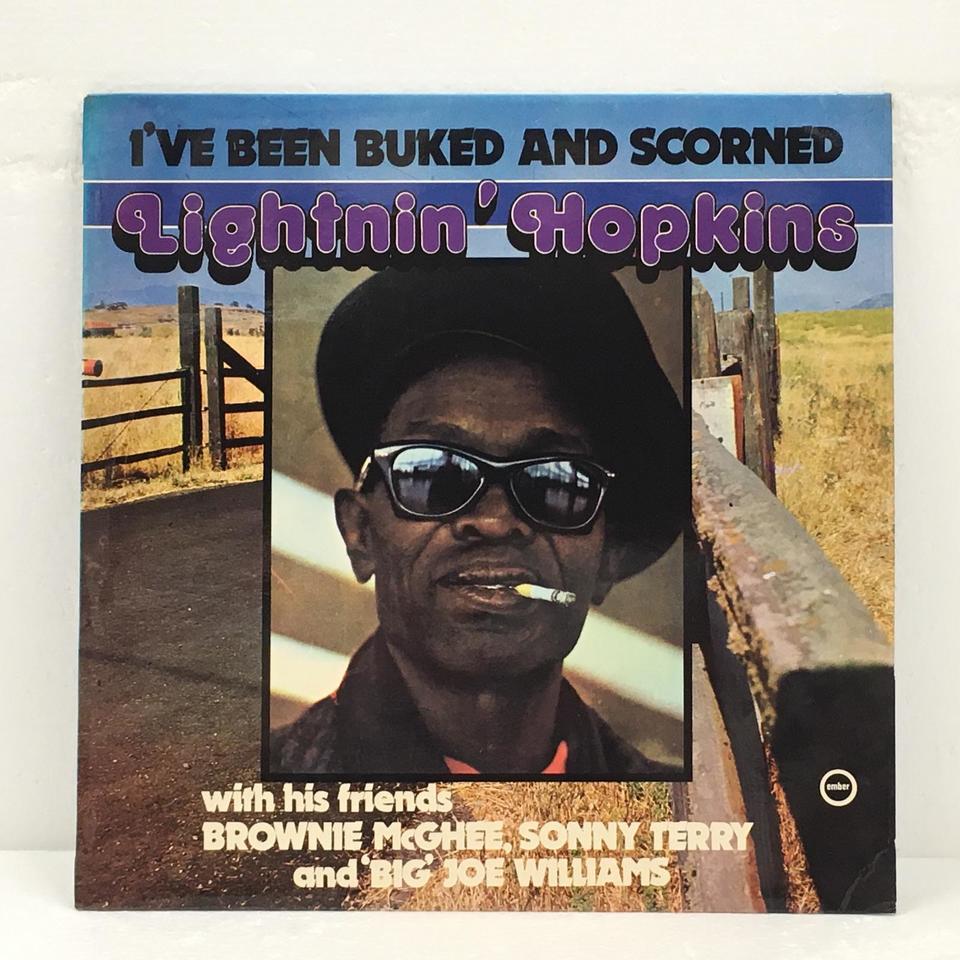
“Lightnin’ struck the west coast, and the blues came rolling down.” — Brownie McGhee
In the original liner notes to one of the finest treasures of blues music, producer Ed Michel observed, “It’s been pointed out, not without justification, in American folk music circles [that] ‘the Seegers take from the Lomaxes, and the Lomaxes take from God.’” A more succinct summation of the genesis of modern American music cannot easily be made.
The album to which I am referring is First Meetin’, a 1960 studio recording of a rare moment when unscripted genius appeared and the engineer rolled the tape from the warmup. That Bess and John Lomax Jr. were involved in arranging the session would be reason enough to anticipate significance, but it wouldn’t have taken the sense God gave a fencepost to do so — the schedule for the day was to capture for the first time together on record Lightnin’ Hopkins and Brownie McGhee.
Compounding the importance, eight years prior McGhee had recorded “A Letter to Lightning Hopkins,” a jive-laden homage to the Texas legend. But, in spite of their long-stated mutual admiration, the two had still not met when Bess Lomax informed the brass at World Pacific Studio that Hopkins would be in Los Angeles (with brother John Jr. in tow) around the same time McGhee would be finishing a six-week stint with harp legend Sonny Terry at The Ash Grove. Apparently, by divine appointment it would now seem, Big Joe Williams was also in town on vacation from St. Louis. Arrangements were made and with jazz and symphonic bassist Jimmy Bond, brilliantly on an upright, the four bluesmen would proceed that day to record one of the baddest tracks ever laid down on tape.
Emerging from the unequable tragic beauty of the old spiritual, first printed under the title “Ain’ Gwine Lay My ‘Ligion Down“ in In old Alabama: being the chronicles of Miss Mouse, the Little Black Merchant but more commonly known as “I Been ‘Buked and I Been Scorned,” the highly improvisational jamming and “testifyin’” of “Bucked and Scorned” is a manifestation of the shamanistic power of the blues to summon strength and conjure joy out of authentic testimonies of sorrow and grief.
The title, corrected in later releases to “’Buked and Scorned” and “I’ve Been ‘Buked’ and I’ve Been Scorned,” forms the essential refrain, while the tonal center exists in the countervailing forces of contradiction — its’ doleful testimony is sung in a major key. On the First Meetin’ recording, the four trade off-the-cuff verses of warning and woe while the guitars of Hopkins, McGhee, and Williams weave an acoustical, cut time torrent of bright leads over Jimmy Bond’s relentless bass line. Illuminated by the plaintiff wails of Sonny Terry’s harp, the result is inescapable hypnosis, a leaning in to observe every word and every note. In a word, it is the blues.
First recorded by the Tuskegee Institute Singers on February 14, 1914, the origins of the hymn extend back into the shared lamentations and expressions of hope that sustained a people who faced daily the scorn and crushing rebukes of soul and spirit that define bond slavery.
In the midst of such suffering, the voice of the Divine singing psalms of pathos and edification in the temple of the human form is discernible, and although it is true that there exists in both the Psalms of Hebraic antiquity and “I Been ‘Buked and Scorned” a cosmos of unspoken details of experience that belong only to those who lived in that reality, when Mahalia Jackson sung it in sanctifying invocation to over 250,000 people of every color at the Civil Rights March on Washington in 1963, its authority to universally bless was a public display of its place in the holy canon.
The intimate musical connection between the raucous romp of “’Buked and Scorned” and the old hymn is not necessarily obvious, despite the direct transcription of the title line. But, a thematic comparison between the lyrics of Odetta’s version of 1956 and those of Hopkins’ 1960 version reveals a common narrative testimony of suffering, personal experiences of talk and being talked about, death, and a final affirmation of faith. So observed, these points of correspondence make clear how close to the surface of conscious creation the words and sentiments of the original were when five musicians, each afflicted with a bad case of the blues, walked into a Los Angeles recording studio, the afflatus surged, and Divinity spoke into being a moment of pure musical joy.