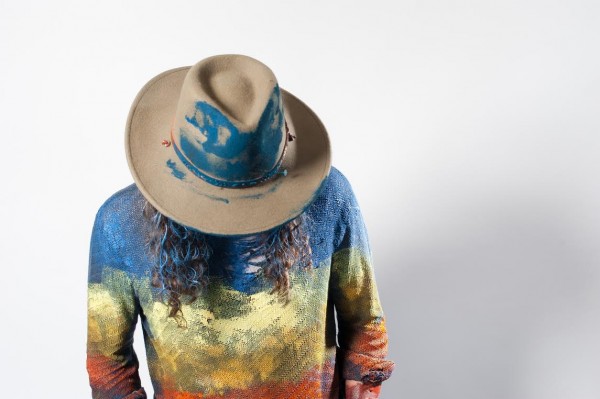
For Adam Stockdale, who performs under the moniker Albatross, moving to Nashville from the English Midlands has been the smartest choice in his musical career. After graduating from university in Brighton, he began doing guitar tech work for local English bands, including Mumford And Sons before they hit it big. Networking with musicians, along with being a guitar geek, helped land him more work and the opportunity to tour the world. “Every band I worked for was through word of mouth and knowing a crew member from a previous tech job.” Stockdale bonded with the Nashville music community and made the move to the US in early 2013. His upcoming release, Desperate Times Best Forgotten, melds his British songwriter background and percussive guitar style with the church, gospel and old-time musical influences of his supporting cast of Nashville players, including the banjo, violin andupright bass trio Chessboxer.
You’ve started a record label, Word Of Mouth Recordings, with a unique twist. It gives passionate fans an equity stake in the label. What made you decide to do this?
It was a concept that had always been on my mind. With my last record I didn’t have a major push. It was just a record I was proud of and wanted to get out there. The new record has been finished for a while and I was shopping around to several small labels and trying to get feedback on the record. I don’t want my fans to feel that my responsibility to them as an artist ends with the sale of a record. Being an artist is a privileged position and you should always show respect to the music lovers’ participation in that relationship. Every label I approached loved the record but didn’t feel they could take on the record. So that was a learning process.
How are you viewing each contribution?
If I benefit from the record’s success then they do as well. There’s no employee responsibility. The investment money is targeted towards the normal things labels do (marketing, social media, press, retail). If they want to just purchase that share and take their royalties that’s fine. I’m thankful to anyone who believes in me as an artist. But for those who want to be more involved they can be. There’s no role that comes with your investment.
Can you elaborate a little more?
I don’t want anyone to be able to buy than one share of $100. It’s not about the investment per person or the money. It’s about the amount of people. Everyone has the same percentage. The name Word of Mouth says it all. It’s my belief that people telling others is the best way to spread the word about something that is good and people like. With the Internet it’s a way to expand the ability to do that. I’m not looking for one main investor. If one person comes in and says “I’ll give you the $20,000 but I want 50% of the record,” that would be great in terms of having the $20,000 to put back in the record. But then I would only have one person telling the world they’re involved in the project. I’m looking for music lovers who want to feel they are involved in the creative process of the record. So then I’ve got 200 people who are stoked to have their name in a record and are telling people “hey listen to this project I’m involved in and believe in.” What I gain from the investors in the long term is more than what I feel I will gain from the monetary sales of the record. Each investor also gets a copy of the album in every format (CD, vinyl, digital), merchandise, my previous album plus every record I make in the future.
At what point do the investors see a return?
There’s no recoupment per se. As soon as the records are sold there’s an equal split between everyone. The maximum amount of investors I’m looking for is 200 and the maximum amount I’m giving away is 50% of the record. I’m giving more to the producer and musicians on the record. I’ll probably make less than everyone else but I think that’s a small price to pay in terms of doing it the way I think it should be done. So if I get the 200 investors at $100 each then each person will get .25 percent in the record label with regards to this album. From the minute the first album is sold they will make that percentage of that record and every copy that sells. If I sell 4000 copies, which I think I can do, they’ll make their money back. And for the life of the record after that they will make money from every sale. It’s set up so there is a contract and certificate welcoming you as a member. There’s a breakdown of your investment, what you get, your equity percentage. I personally provide the sales breakdown every quarter and payment is made digitally through Paypal or Venmo.
Are you looking for other artists to sign to the label?
At this stage I don’t really want to promote what I’m doing as a platform. Someone tried to do that last year but they emphasized the platform more than the individuality of what it means for a fan to be involved with an artists’ specific project. Crowd funding can sometimes have a negative or lazy connotation. This seems to be the next logical step in crowd funding. I want people to understand that it’s about sharing and giving back because that’s what I believe music is about. And that’s hopefully what will build a loyal fan base that wants to continue to follow me.
That’s a big part of the folk tradition- the community aspect and the passing down of songs.
Yes and that’s a beautiful thing. It’s definitely something I feel has been lost with the way we put out music. The Internet has been a very positive experience for me but it can be a very faceless way of telling people about your music. There doesn’t have to be any relationship. The whole design of Word Of Mouth is for people to feel they have a relationship with me and I want them to understand how important I take that responsibility.
Moving on to your music, you have a great fingerpicking style and cool chord changes. It’s not typical three-chord folk music. It’s very involved. I imagine that has a lot to do with your upbringing in England.
My dad was in a band so I was lucky as a young kid to have music around me from a young age. He made sure I was exposed to good music like the Beatles, Kinks, the Stones, Dire Straits and Eric Clapton. And being a kid of the 80s I loved Van Halen, Slash and Jimi Hendrix. My guitar heroes as a kid were players who favored melody, where you can hum their solos like it’s a top line melody when there’s no vocal.
“Do You Think Of Me?” is a beautiful song on the record.
That’s one of my favorites. It’s in a tuning- C-G-D-G-B-D- with a capo on the 5th fret. I use that tuning a lot, probably four or five songs on the record. I discovered that tuning while working on Fleetwood Mac’s ‘Never Going Back Again,’ which is similar but not quite the same. Playing acoustic guitar on your own you learn about having independent bass, rhythm and melody lines within one guitar part. Without a doubt my favorite acoustic player is John Martyn. For me, he was up there with Nick Drake, who was a friend of his. Most of the songs on the record are written about my decision to move to America. For me emotionally it’s a milestone- the rain I came through to get to the rainbow. That song was about a long-term relationship that didn’t work out. More than wondering if they were thinking about me, I wanted to know if they were happy when thinking about our relationship. That song is one where I said exactly what I wanted to say.
To support the Word Of Mouth Project click here.
To pre-order Desperate Times Best Forgotten click here.
More Latest News
-

Photo by John Atashian/Getty Images) -

Photo by Terry Wyatt/WireImage -
Photo by Frazer Harrison/Getty Images for Stagecoach -
THOMPSON, CONNECTICUT – The Capulet Fest was scheduled to be held at the Thompson Speedway Motorsports Park in June 2024 in Thompson, Connecticut. (Photo via NBC Connecticut) -

INGLEWOOD, CALIFORNIA – JANUARY 30: Jelly Roll performs onstage during the FIREAID Benefit Concert for California Fire Relief at Intuit Dome on January 30, 2025 in Inglewood, California. (Photo by Amy Sussman/Getty Images for FIREAID) -
Kolbi Jordan auditioned for season 23 of 'American Idol.' (Photo via Instagram)